
Why Automation Fails More Often Than Traders Expect
Most crypto traders start using automation because they are tired of spreadsheets, manual entries, and second guessing their numbers. Syncing trades directly from Binance, Bybit, Coinbase, or OKX feels like flipping a switch that instantly makes your trading data reliable. In reality, automation does not guarantee accuracy. It only moves the responsibility from manual input to system design.
The dangerous part is that automation failures are usually silent. Your journal still fills with trades. Your dashboard still shows clean charts and statistics. Nothing looks broken. But small issues like missing fees, incorrect symbols, partial fills being grouped incorrectly, or futures data being interpreted as spot data slowly distort your results. Over time, those distortions shape your decisions. You adjust position size based on false risk metrics. You abandon strategies that were actually profitable. You trust performance data that is quietly wrong.

This is why automation mistakes are more harmful than manual mistakes. When you enter a trade by hand and make an error, you often notice it. When automation makes the error, it feels authoritative. The data looks official, so you stop questioning it.
This article is not about whether you should automate your trading journal. You absolutely should. It is about understanding where automation commonly breaks and how to design your workflow so your data stays clean, consistent, and trustworthy. Treat automation like a system that needs structure and maintenance, not a shortcut that runs itself.
Treating Automation as “Set and Forget”
The most common mindset mistake traders make with automation is assuming that once trades are syncing, the system is finished. You connect your exchange, see trades appearing, and mentally check the task off. From that point forward, you trust whatever the journal shows without questioning how that data is being processed.
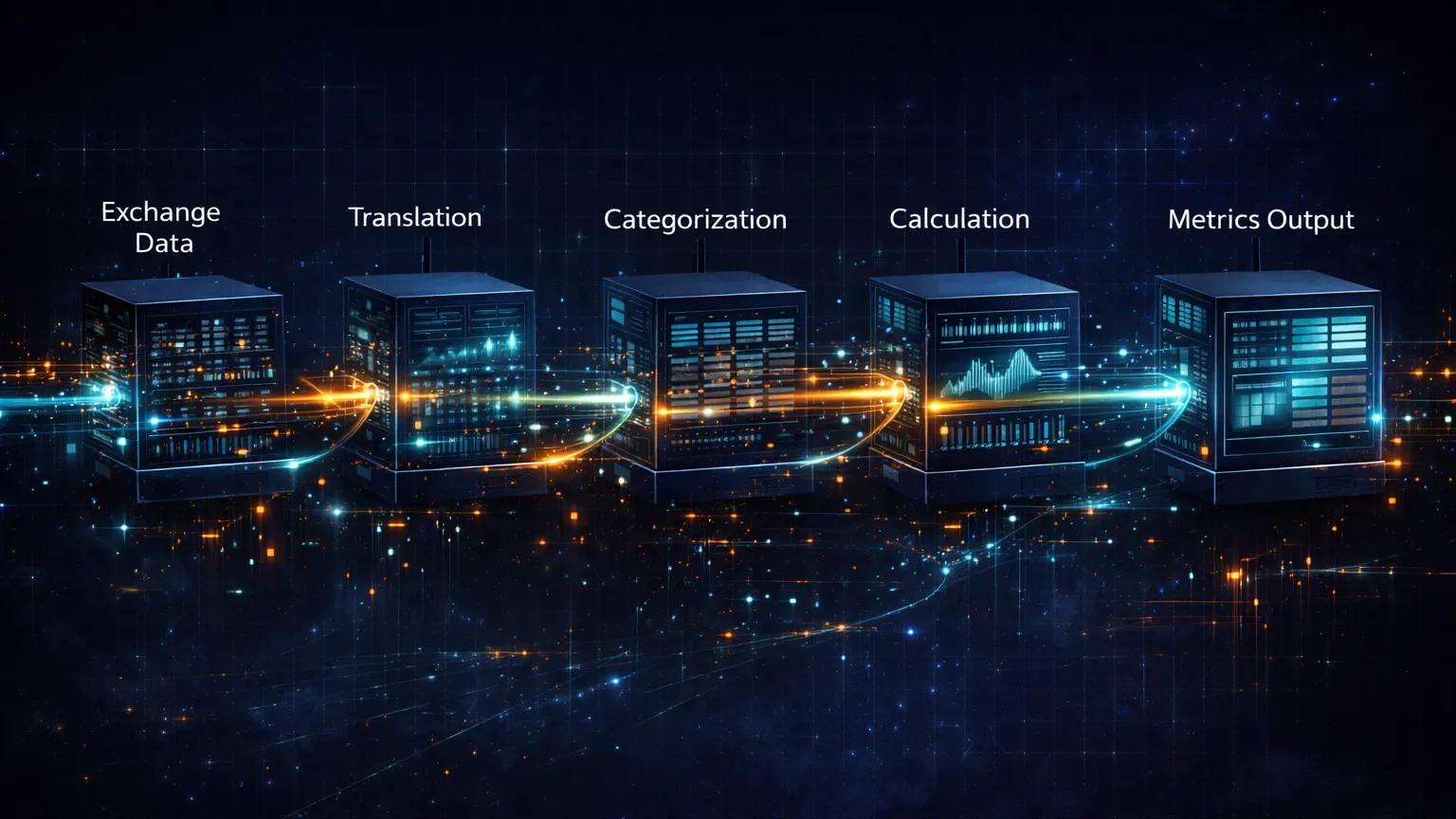
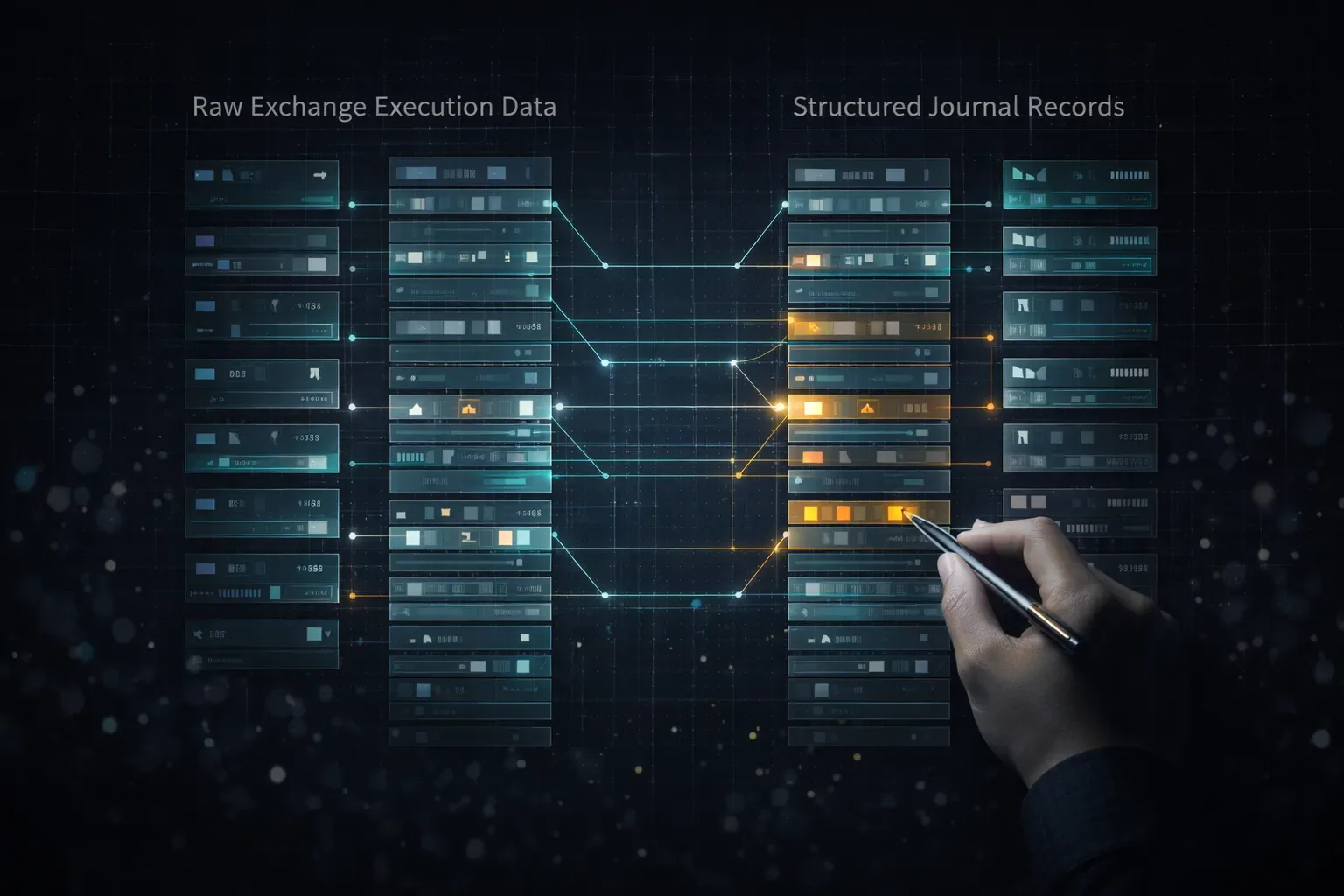
Automation is not a switch. It is a pipeline. Data is pulled from the exchange, translated into your journal’s structure, categorized, calculated, and then displayed as performance metrics. Every step in that chain can introduce small errors. When traders treat automation as “set and forget,” they stop monitoring that pipeline. The system keeps running, but no one is checking whether it is still running correctly.
This becomes especially dangerous in crypto because exchanges update APIs, add new order types, change fee structures, and modify how futures data is reported. A small backend change on Binance or Bybit can alter how certain fields are returned without you noticing. Your journal continues syncing, but some values may suddenly be missing or interpreted differently.
A simple example is fee handling. One month your exchange reports fees as a separate field. The next month it bundles them into the execution price. If your journal assumes one format and the exchange switches to another, your net PnL becomes distorted without any obvious error message. You still see profits and losses, but they no longer reflect reality.
Another example is partial fills. Crypto exchanges often fill orders in multiple pieces. If your automation groups those fills incorrectly, you might see fewer trades than you actually placed, or your entry and exit prices might be averaged in a way that hides slippage. Your stats still exist, but the behavior behind them has changed.
Treating automation as finished also prevents you from developing a validation habit. A healthy automated journal workflow includes periodic checks. You randomly select a few trades, compare them against the exchange history, and confirm that position size, fees, timestamps, and PnL match. This takes minutes, but most traders never do it after the first setup.
Automation works best when you treat it like infrastructure. You would not assume your internet connection is perfect forever without testing it. Your trading data deserves the same level of care. A few quick spot checks each week prevent months of bad decisions built on corrupted numbers.
Connecting Multiple Exchanges Without Normalization
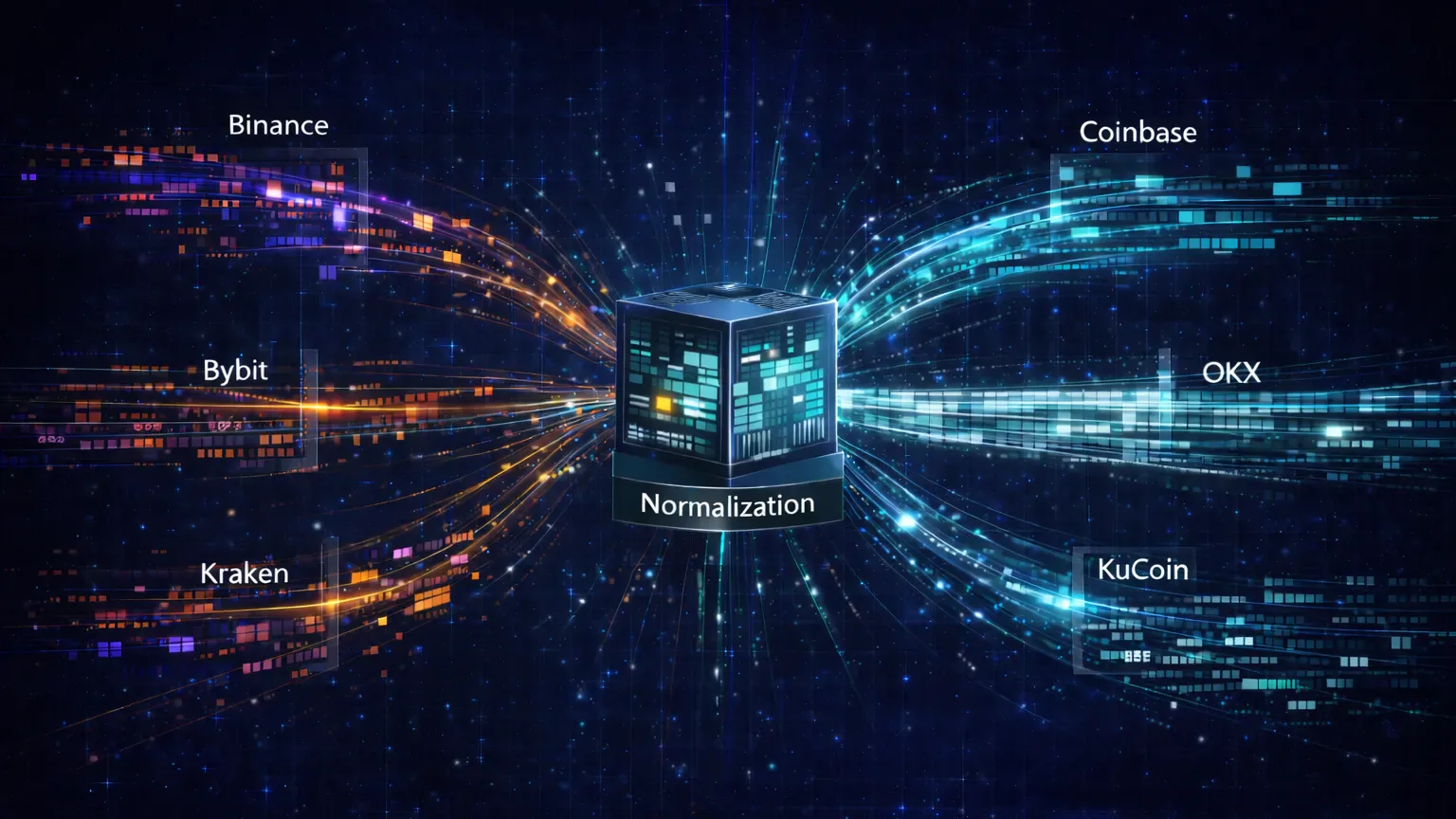
One of the fastest ways to corrupt an automated trading journal is by connecting multiple exchanges and assuming their data is already compatible. On the surface, a trade is a trade. It has an entry, an exit, a size, and a result. Under the hood, every exchange structures that information differently. If your journal does not normalize those differences properly, your performance metrics become a blend of incompatible data formats.
Symbol naming is the first place this breaks. Binance might label a futures contract as BTCUSDT, while another exchange uses BTC-USDT or BTC/USDT. Some use uppercase, some include contract types, and some add suffixes like PERP. If your journal treats these as separate instruments, you end up splitting your performance across multiple “symbols” that are actually the same market. Your statistics look fragmented and your edge becomes harder to identify.
Fee structures are another major source of distortion. One exchange might report fees in the base asset, another in the quote currency, and another in a platform token like BNB. If your journal does not convert all fees into a common currency before calculating PnL, your net results become inconsistent. Two identical trades on two different exchanges can appear to have different profitability simply because the fee reporting format changed.
Currency handling creates similar problems. Some exchanges report balances in USDT, others in USD, and some mix stablecoins. If your journal treats all stablecoins as equal without tracking conversion rates, your aggregated performance slowly drifts away from reality. This is subtle at first, but over hundreds of trades it becomes meaningful.
Futures and spot data become even more dangerous when mixed without normalization. Spot trades settle immediately. Futures trades involve leverage, margin, funding, and liquidation risk. If these two trade types are grouped under the same calculation rules, your risk metrics become meaningless. A futures trade and a spot trade with the same PnL percentage do not represent the same risk exposure.
This is where traders often misinterpret automation. They assume that because data is flowing in, it must be standardized. In reality, automation only imports raw information. The intelligence comes from how that information is translated into a unified structure.
| Data Element | Exchange A Format (Example) | Exchange B Format (Example) | Why It Breaks Accuracy |
|---|---|---|---|
| Symbol Name | BTCUSDT | BTC/USDT | Splits the same market into separate symbols |
| Fee Currency | USDT | BNB | Distorts net PnL if not converted properly |
| Trade Type | Spot | Futures | Blends incompatible risk profiles |
| Timestamp | UTC | Local exchange time | Creates ordering and session errors |
| Quantity Precision | 0.001 | 0.0001 | Affects position sizing calculations |
| Funding Fee Reporting | Separate transaction | Embedded in trade record | Understates or overstates real profitability |
Without normalization, your journal becomes a collection of incompatible datasets pretending to be one system. You might think you are analyzing performance, but you are really analyzing formatting differences.
A reliable automated workflow treats every connected exchange as a translation problem. Data must be converted into a common language before it can be trusted. When that step is skipped, automation amplifies inconsistency instead of removing it.
Ignoring Futures-Specific Data That Skews Results
Futures trading introduces variables that simply do not exist in spot trading. When those variables are ignored or misinterpreted by automation, your journal can show performance numbers that look accurate on the surface but are fundamentally wrong.
Funding fees are the most obvious example. On perpetual contracts, you either pay or receive funding based on market conditions. This fee is part of your real profitability. If your journal does not import funding payments or fails to associate them with the correct position, your net PnL becomes inflated or deflated. A strategy that appears profitable may only be surviving because funding costs are missing from the equation.
Leverage creates another layer of distortion. Two trades that both return five percent do not represent the same performance if one was traded at 1x and the other at 10x. Your journal must understand margin usage and position sizing relative to account equity. If it only records price movement, it hides the true risk you took to achieve that return.

Liquidation fees and insurance fees are often overlooked. They do not happen frequently, which makes them easy to ignore. But when they do happen, they can turn a manageable loss into a major drawdown. If your automation skips these fees, your worst trades appear less severe than they actually were, and your risk models become optimistic.
Partial fills become even more important in futures. Large orders are often executed in multiple pieces across different price levels. If those fills are merged incorrectly, your entry price becomes artificially clean. Slippage disappears from your data. You think you are executing better than you really are.
Another common issue is position reversals. In futures, closing a long and opening a short can happen in one order. Some exchanges report this as a single trade, others as two separate actions. If your journal misreads this, it can flip your trade direction or double count your exposure.
These are not edge cases. They are structural realities of futures markets. A journal that treats futures like enhanced spot trading is missing half the story. The more active and leveraged your trading becomes, the more dangerous this oversight is.
Futures automation only works when the system understands margin, funding, liquidation mechanics, and execution behavior. Otherwise, the most aggressive traders are also the ones with the most distorted performance data.
Letting Tags Become Noise Instead of Signal
Tags are one of the most powerful parts of an automated trading journal, but they are also one of the easiest ways to destroy clarity. Automation multiplies whatever structure you give it. If your tagging system is clean, your insights become sharper. If your tagging system is messy, your data becomes unusable faster than if you had no tags at all.
The first mistake is over-tagging. Traders start by tagging everything they can think of: setup type, session, emotion, news context, confidence level, market structure, time of day, and execution quality. Within a few weeks, every trade carries six to ten tags. At that point, tags stop being filters and start being decoration. You cannot see patterns because every trade looks unique.
The second mistake is inconsistent naming. One day you tag a setup as “breakout,” another day as “breakouts,” and another day as “range breakout.” Your journal treats these as three separate categories. When you analyze performance, none of them has enough data to be meaningful. Your edge becomes fragmented across small buckets that never mature into reliable statistics.
Emotional tags create a different problem. Traders often tag feelings like “fear,” “FOMO,” or “overconfidence” without defining what those mean behaviorally. Over time, the tag becomes subjective. Two trades marked “fear” may represent completely different situations. The data looks descriptive, but it cannot be analyzed.
A good tagging system is small and intentional. Each tag should answer a specific question:
- What setup was this?
- What mistake, if any, occurred?
- What market condition was present?

Anything that does not support those questions usually belongs in notes, not tags.
Automation makes tagging errors harder to detect because the system will happily generate reports from bad structure. You might see a tag labeled “scalp” with a negative expectancy and assume scalping is not working. In reality, half of those trades may not even be scalps. They were simply tagged that way in moments of inconsistency.
Tags are not labels for memory. They are inputs for statistics. When you treat them casually, you poison the analytics that automation is supposed to improve.
Automating Without a Manual Review Process
Automation only works when it is paired with regular validation. Without a manual review habit, small errors stay hidden and slowly compound into large distortions. Traders assume that because the journal is syncing automatically, the data must be correct. In reality, automation removes effort, not responsibility.
A simple manual review process does not need to be complicated. Once a week, you randomly select a handful of trades and compare them directly against your exchange history. You check position size, entry and exit prices, fees, timestamps, and net PnL. If anything does not match, you investigate immediately. This takes five to ten minutes and protects your entire dataset.
Most traders skip this because nothing appears broken. The dashboard loads. The metrics update. The charts look professional. That visual confidence is exactly what makes automation dangerous. When manual journals fail, they fail loudly. When automated systems fail, they fail quietly.
Manual reviews also reveal structural issues that no dashboard can show. You might notice that funding fees are missing from futures trades. You might realize that partial fills are being merged incorrectly. You might discover that spot and futures trades are being grouped under the same risk calculations. These are not bugs you notice by staring at statistics. You notice them by comparing raw data.
| Check Item | What to Verify | Why It Matters |
|---|---|---|
| Trade count | Journal trade count matches exchange history | Detects missing or duplicated trades |
| Entry and exit prices | Prices match the exchange execution prices | Prevents false PnL and slippage data |
| Position size | Quantity and contract size are correct | Protects risk and expectancy calculations |
| Fees and commissions | All fees are included and converted properly | Keeps net performance accurate |
| Funding payments (futures) | Funding is attached to the correct positions | Avoids inflated profitability |
| Trade direction | Long and short positions are identified correctly | Prevents reversed trade logic |
| Timestamp alignment | Timezones and session grouping are consistent | Protects session and time-based analysis |
This checklist is not about perfection. It is about catching drift early. If your data is off by one percent this week and another percent next week, your performance analysis slowly becomes fiction.
Automation without review is like trading without stops. It works until it doesn’t, and when it breaks, it breaks silently.
Assuming the Dashboard Equals Truth
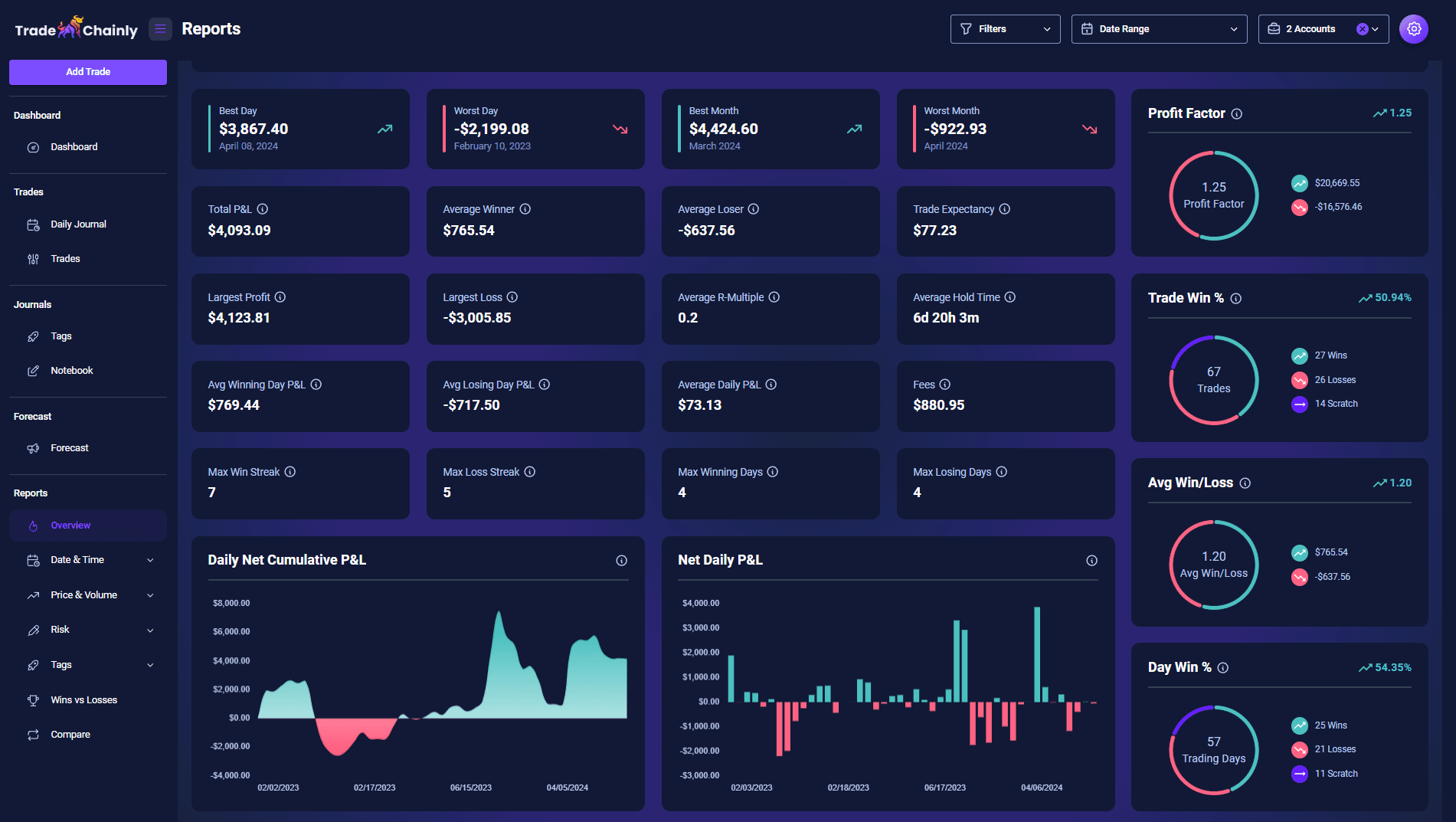
Dashboards are designed to simplify complex data. That is their strength and their weakness. When you look at a clean equity curve, a polished PnL chart, or a set of sharp performance metrics, it feels like you are looking at truth. In reality, you are looking at the final output of a long chain of assumptions, calculations, and transformations.
A dashboard does not show raw data. It shows interpreted data. Every number has already been filtered, grouped, converted, and summarized. If something earlier in the pipeline is wrong, the dashboard will not warn you. It will simply present the wrong result with confidence.

This is why traders often trust dashboards too quickly. Visual clarity creates psychological certainty. You see a drawdown curve and assume it reflects real risk. You see a win rate and assume it reflects real execution. But if funding fees are missing, if trades are being grouped incorrectly, or if leverage is not being accounted for, the dashboard is telling a story that never actually happened.
Another subtle issue is aggregation. Dashboards love averages. Average win, average loss, average R multiple, average holding time. Averages hide distribution problems. If half your data is clean and half is corrupted, the dashboard still produces smooth statistics. You feel informed while standing on unstable ground.
A strong automated workflow includes the ability to trace metrics backward. When you see a number that surprises you, you should be able to click into it, inspect the underlying trades, and verify how it was calculated. If the dashboard is a black box, you are trusting a system you cannot audit.
The goal of automation is not to replace thinking. It is to reduce manual labor while preserving analytical control. When traders start treating dashboards as unquestionable truth, automation stops being a tool and starts becoming a liability.
Conclusion – Build Automation Like a System, Not a Shortcut
Automation is not something you turn on and forget about. It is something you design, maintain, and occasionally challenge. When it works well, it removes friction, saves time, and gives you a clearer picture of your performance than any manual journal ever could. When it is built carelessly, it quietly pushes you toward bad decisions with confidence.
Most automation mistakes come from trust without verification. Traders assume that syncing equals correctness. They assume dashboards equal truth. They assume that more data automatically means better insight. In reality, automation only amplifies whatever structure you give it. Clean systems produce clarity. Messy systems produce convincing nonsense.
The traders who get the most value from automation treat their journal like infrastructure. They normalize data between exchanges. They respect the differences between spot and futures. They build small, intentional tagging systems. They review raw trades regularly. They understand that accuracy is a habit, not a feature.
This is where platforms like TradeChainly are meant to fit into your workflow. Not as a magic solution, but as a system that makes disciplined automation possible. Continuous trade syncing, structured tagging, and transparent performance analytics only become powerful when you pair them with thoughtful design and regular validation.
If your goal is real improvement, automation should help you see reality more clearly, not hide it behind pretty charts. Build your journal like you build your trading plan. Deliberately, carefully, and with accountability.
That is how automation stops being a shortcut and starts becoming an edge.