
Why This Debate Matters in Crypto Trading?
Are you journaling to feel organized, or to get the truth about how you trade? In crypto, that difference decides whether a journal helps or quietly misleads you. Journaling is not record keeping. It is whether your data is accurate and consistent enough to improve decisions. The way you journal shapes how well you understand your own behavior.
Crypto moves faster than most traders admit. Futures traders and scalpers can place dozens of trades in a session. Spot traders often trade multiple pairs across different timeframes. Add leverage, funding rates, partial fills, and sudden market shifts, and trade history becomes complex fast. If your journal cannot capture that complexity, your analysis warps.
That is why manual versus automated matters more in crypto than in slower markets. In equities, a trader might take a few trades per week and log everything carefully. In crypto, missing a handful of trades can skew your stats. Win rate, average R multiple, drawdown profile, and expectancy all depend on complete, precise data.
Manual journaling feels harmless at first. A spreadsheet, a few screenshots, maybe handwritten notes. It looks manageable when you are new or trading small size. The issue is not how it starts. It is how quickly it breaks once activity increases. More trades create more friction. Eventually, the journal stops matching reality.

Automation stops being a convenience and becomes a structural advantage. It is not saving a few minutes. It preserves data integrity. It captures every fill, fee, funding payment, and position size adjustment without relying on memory or discipline.
When your journal is incomplete or inconsistent, your conclusions fail. You may think a setup is profitable when it is not. You may blame psychology for losses that come from poor execution. You may abandon strategies that are working because your data is fragmented. That is not a trading problem. It is a data problem.
This is not about which method feels nicer. It is about which method gives you the truth. In crypto trading, truth comes from automation.
What Does Manual Journaling Look Like in Real Life?
Most manual journals start with good intentions. A spreadsheet template, a few columns for entry and exit, maybe a section for notes. Early on, it feels productive. You reflect on decisions and try to build discipline. For a short stretch, it even works.
Then real volume shows up.
A typical manual workflow looks like this. You finish a session, open your exchange history, filter by date, copy trades one by one, paste them into a spreadsheet, convert timestamps, calculate position size, calculate PnL, subtract fees, sometimes forget funding, sometimes forget partial fills, then move on because it is already late. Screenshots go into folders you rarely open again. Notes get rushed or skipped.
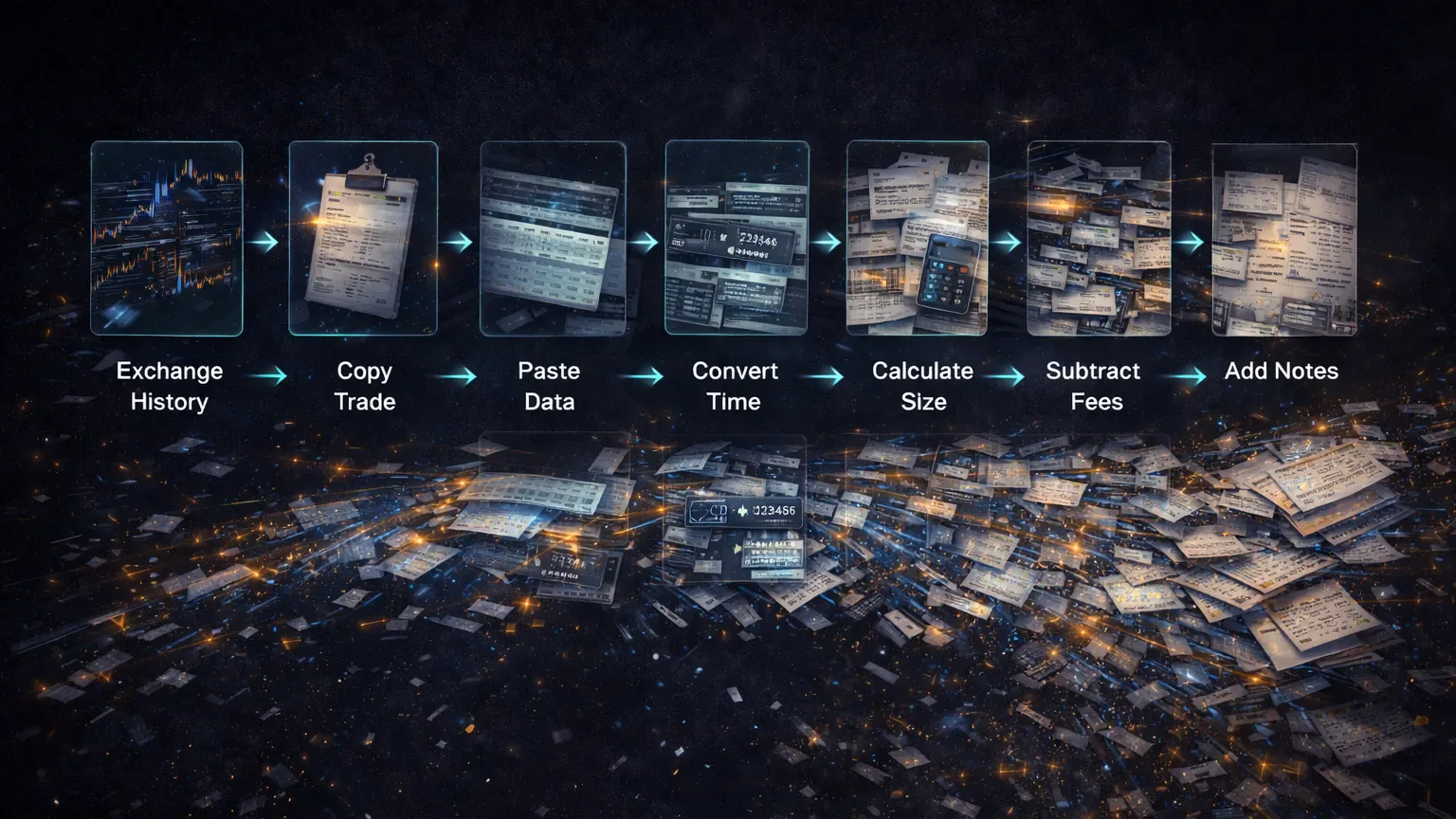
Futures makes this messier. One position can have multiple entries, partial exits, funding charges every eight hours, and liquidation risk that changes throughout the trade. Translating that into a clean dataset is slow and error-prone. Most traders simplify it just to finish. Simplification is where accuracy dies.
Manual journaling also leans on memory. If you do not log immediately, details fade. Why you entered, what you reacted to, how confident you felt, whether you hesitated or chased price. After a few hours, the context blurs. After a day, it is gone.
Over time, corners get cut. Small trades get skipped because they “don’t matter.” Fees and funding get ignored because it is “too annoying to calculate.” Updates get delayed until the weekend, and you never fully catch up. The journal becomes a partial snapshot, not a true record.
Fragmentation adds another layer. One file for spot. Another for futures. Notes in a separate app. Screenshots in random folders. There is no unified view of performance. You try to analyze behavior using pieces scattered across tools.
This is not a discipline problem. It is a workflow problem. Manual journaling asks you to behave like an accountant after trading. Traders are not built for that. The more active and serious you become, the less realistic the process becomes.
Most traders do not quit journaling because they stop believing in it. They quit because the process becomes heavier than the benefit they get back.
What Are the Hidden Costs of Manual Journaling?
The biggest problem is not time. The real cost is that manual journaling slowly corrupts your data and your behavior without you noticing. By the time you realize the journal is unreliable, months of decisions were built on shaky info.
Manual entry creates subtle errors. A wrong position size, a missing fee, a miscalculated percentage, a skipped trade. Each mistake feels small. Across hundreds of trades, those errors compound. Your stats stop representing your actual performance. Your edge becomes harder to measure because the baseline is wrong.
Incomplete data is just as damaging. When trades are missing, results become biased toward what you chose to record. Losing trades are more likely to be skipped. Quick scalps are more likely to be ignored. Trades taken while emotional or distracted get forgotten. What remains is filtered trading, not honest trading.
Manual journaling also creates resistance. After a long session, few traders want another thirty to forty minutes logging numbers. The journal becomes tied to fatigue and frustration. Resistance grows. Journaling becomes irregular. Reviews become shallow. Eventually the habit collapses.
Inconsistency is another cost. Some weeks are detailed and clean. Other weeks are rushed and incomplete. That makes comparison over time unreliable. You cannot confidently answer whether execution is improving or whether a new setup is working.
| Manual Journaling Issue | What Actually Happens in Practice | Impact on Trading Performance |
|---|---|---|
| Missing trades | Small or fast trades are skipped | Win rate and expectancy become inflated or distorted |
| Fee and funding omissions | Fees and funding payments are ignored or estimated | Net profitability looks higher than reality |
| Calculation errors | Position size or PnL is entered incorrectly | Risk metrics become unreliable |
| Delayed journaling | Trades are logged hours or days later | Context and emotional data is lost |
| Inconsistent updates | Some sessions are journaled, others are not | Performance trends become impossible to trust |
| Simplified trade structures | Complex positions are logged as single entries | Execution quality and trade management analysis disappears |
| Fragmented tools | Trades, notes, and screenshots live in different places | No unified view of behavior or performance |

Manual journaling also limits how deep you can go. If every metric must be calculated by hand, you track fewer metrics. You ask fewer questions because the cost of answering is too high. Instead of exploring patterns, you settle for surface conclusions.
Worst of all, manual journaling can create a false sense of control. You feel productive because you are writing things down. You feel disciplined because you are trying. But discipline without reliable data does not produce improvement. It produces confidence on weak foundations.
That is why manual journaling often plateaus. It builds awareness, but rarely builds precision. In crypto trading, precision is everything.
What Is an Automated Crypto Trading Journal, Really?
Automation sounds complicated or risky to some traders. In reality, the concept is simple. An automated crypto trading journal connects to your exchange through an API and pulls trade data automatically. Every fill, every position change, every fee, and every funding payment gets recorded without you touching anything.
Automation does not replace thinking or reflection. It replaces manual data entry. Instead of acting as a bookkeeper, you act as a trader and analyst. The journal becomes a live record of activity, not a task you need to catch up on.
Automation usually means four concrete things. Trades are imported directly from the exchange, with no copying, pasting, or conversions. Data is standardized so position size, entry price, exit price, PnL, fees, and timestamps follow the same structure for every trade. Updates are continuous, so the journal updates as soon as you trade. Historical data stays intact because nothing depends on memory.

This matters because crypto creates more complexity than most traders expect. Futures involves leverage, funding, partial fills, and liquidation thresholds. Spot often spans multiple pairs and sessions. Automation handles that quietly. Your dataset stays complete regardless of how active you become.
An automated journal is not about piling on features. It removes friction. When journaling stops being a task, it turns into a habit. A habit creates reliable insight.
Automation also creates consistency. Every trade is recorded the same way. Every session is captured with the same structure. That consistency is what makes performance analysis meaningful. Without it, comparisons across weeks, months, or strategies become guesswork.
Think of automation as infrastructure. You do not notice it when it works, but everything collapses when it is missing. Crypto moves fast. Your journal needs to move at the same speed. Manual systems cannot keep up.
Why Does Accuracy Matter More Than Convenience?
Accuracy is the first real advantage. Not convenience. Not speed. Accuracy. In trading, accuracy is the foundation everything else sits on.
Manual journals rely on approximation. Fees get estimated. Position sizes get rounded. Multi-leg positions get simplified into single entries. Funding payments get forgotten or treated like noise. Over time, the journal becomes a rough sketch, not a precise record.
Automation removes estimation. Trades are recorded exactly as they happened on the exchange. If you entered in three parts and exited in four, the journal reflects that. If you paid funding five times during a long position, those payments are included. If slippage occurred, it shows up in real execution price. Nothing is guessed. Nothing is smoothed over.
Small errors distort performance metrics. A few missing fees can turn a marginally profitable strategy into what looks like a strong one. Ignoring funding can make high-leverage futures trading look safer than it is. Skipping losing scalps can inflate win rate until it becomes statistically meaningless.
Accuracy changes how you interpret mistakes. With clean data, you stop arguing with results. There is no room for “maybe” or “probably.” The numbers show what happened. That forces honesty in reviews.
Automation also enables execution analysis. Accurate timestamps and fills show whether entries are late, exits are rushed, or risk management is inconsistent. Manual journals rarely capture execution quality because traders simplify trades to save time. Automation keeps the full structure.
Fees and funding are not trivial in crypto. On high leverage, funding alone can decide whether a strategy is viable. If your journal ignores it, you are trading blind.
Accuracy is not a luxury. It is the minimum requirement for serious improvement. Automation is the only realistic way to achieve it at scale.
How Does Automation Change Your Behavior?
Time savings are real, but the bigger shift is behavioral. Automation changes how often you review, how honestly you reflect, and how consistent your process becomes.
Manual journaling starts every review with friction. You update the spreadsheet, check what is missing, calculate numbers, clean things up, then finally look at performance. That friction creates resistance. Some days you push through. Other days you avoid it. Reviews become irregular and shallow.
With automation, the barrier is gone. Data is already there. Clean. Updated. Structured. When you open the journal, you start analyzing immediately. That changes your relationship with journaling. It becomes lighter, faster, and repeatable.

Once automation is in place, review frequency usually rises. Not because traders become more disciplined, but because the cost of reviewing drops close to zero. A quick look after a session becomes normal. A deeper review at the end of the week feels manageable. The habit forms because the process stops being exhausting.
Automation also reduces emotional avoidance. After a bad day, manual journaling is easy to skip because it takes effort and you feel frustrated. With automation, the data is already recorded. Avoiding it becomes a conscious choice instead of a convenience. That increases accountability.
Objectivity improves too. Manual journals encourage selective memory. You remember the good trades and downplay the bad ones. Automated journals present everything equally. Wins, losses, mistakes, and discipline all show up in the same dataset. Narrative bias fades. You stop telling stories and start observing.
Consistency compounds over time. Journaling stops being a chore and becomes part of trading. Trading feels incomplete without review. That shift is hard to maintain with manual systems because they demand too much effort.
Automation does not make you more motivated. It makes motivation less important. Improvement still happens on average days, when discipline is low and energy is limited.
What Does Manual vs Automated Look Like Side by Side?
Manual and automated journaling are not just two tools. They behave differently under real trading conditions. Manual journaling can work in theory. In practice, it depends on energy, memory, and willingness to do administrative work after trading. Automation removes those variables. The system records. Your job becomes interpretation and improvement.
| Dimension | Manual Crypto Trading Journal | Automated Crypto Trading Journal |
|---|---|---|
| Data accuracy | Dependent on careful entry and calculations | Pulled directly from the exchange with exact values |
| Trade completeness | Trades are often skipped or simplified | Every trade, fill, and adjustment is recorded automatically |
| Fees and funding tracking | Frequently ignored or estimated | Captured exactly as charged by the exchange |
| Time per journaling session | High and inconsistent | Very low and predictable |
| Review frequency | Irregular due to friction | Naturally higher due to low effort |
| Error risk | High, increases with trading volume | Minimal, limited mostly to exchange-side data |
| Scalability | Breaks down as trade frequency increases | Handles high-frequency and active trading easily |
| Emotional resistance | High after losing or exhausting sessions | Lower because data is already recorded |
| Execution analysis depth | Limited due to simplified entries | Full execution structure preserved |
| Long-term consistency | Hard to maintain | Built into the system |
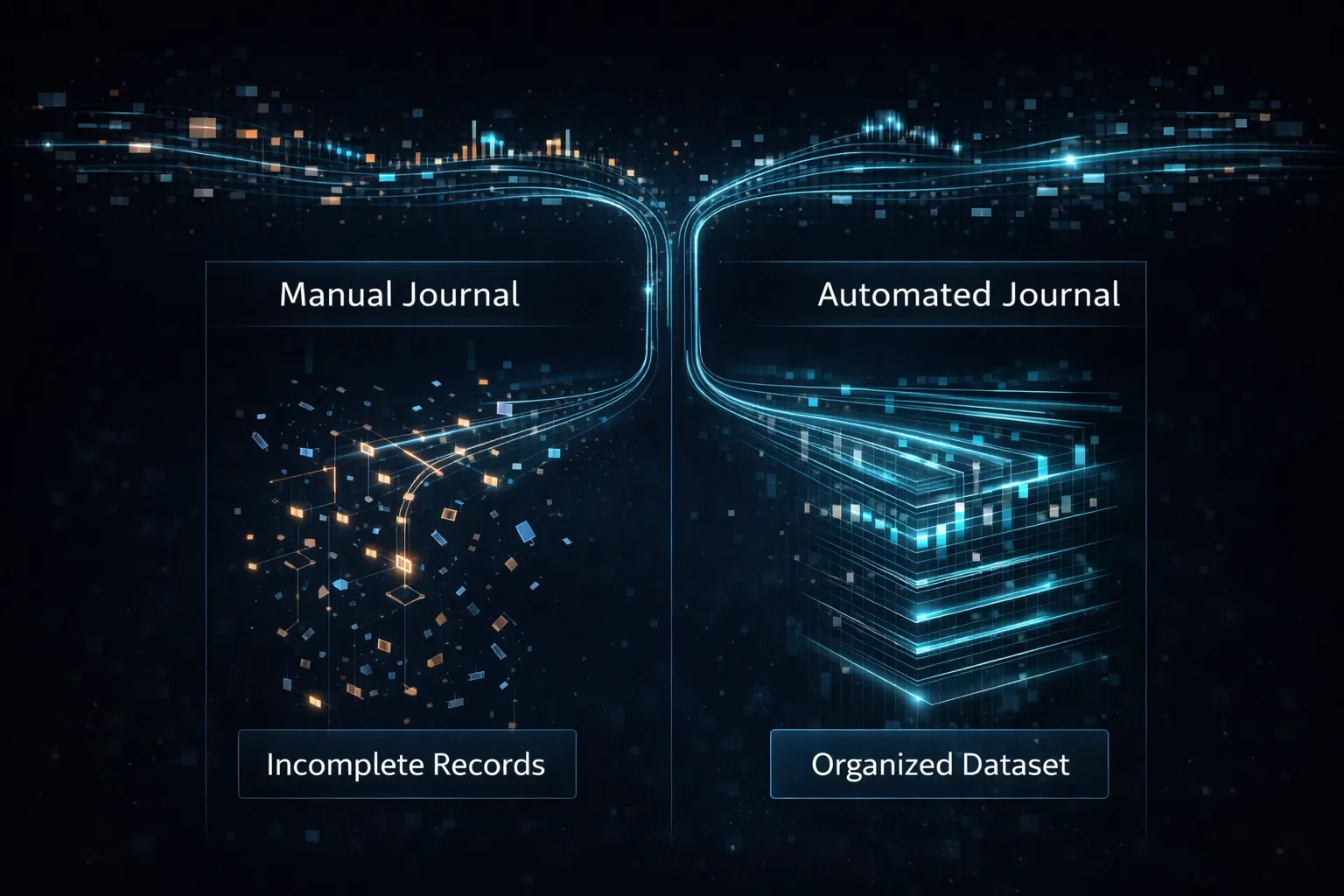
Manual journaling is fragile. It works best under ideal conditions: low trade volume, high discipline, and plenty of time. Remove any one of those, and quality degrades.
Automation is resilient. It does not care how tired you are, how emotional a session was, or how many trades you took. Data gets captured regardless. That reliability allows real performance analysis over long periods.
Even disciplined traders benefit. Discipline fluctuates. Systems do not. If improvement depends on mood and energy, it stays unstable. Automated journaling removes that instability.
Why Is Automation More Important in Crypto Than Traditional Markets?
Automation helps anywhere, but crypto makes it close to mandatory. The market structure makes manual journaling less reliable than in stocks or forex.
Crypto trades 24/7. There is no open and close. No natural reset. Sessions blend. A position opened at night can be managed in the morning and closed in the afternoon. Manual journaling struggles because there is no clear boundary for when you are “done” and ready to log everything.
Futures adds complexity. Positions scale in and out. Funding is applied periodically. Liquidation thresholds change as size and margin change. These details are not optional. They shape profitability and risk. Manual journaling often simplifies or ignores them because they are cumbersome to track.
Crypto traders also trade more frequently. Scalping, momentum, and breakout strategies generate many small trades. Higher trade count breaks manual systems fast. What felt manageable at five trades per day becomes impossible at thirty.
Exchange fragmentation matters too. Many traders use multiple platforms: Binance for futures, Coinbase for spot, OKX for specific pairs, or Bybit for certain contract types. Manual journaling across exchanges means dealing with different interfaces, formats, and time zones. Automation unifies it into one dataset.
Volatility makes execution quality critical. Slippage, partial fills, and sudden price jumps shape outcomes. Manual journals rarely capture these accurately. Automated journals preserve real execution conditions, which helps explain why a strategy performs the way it does.
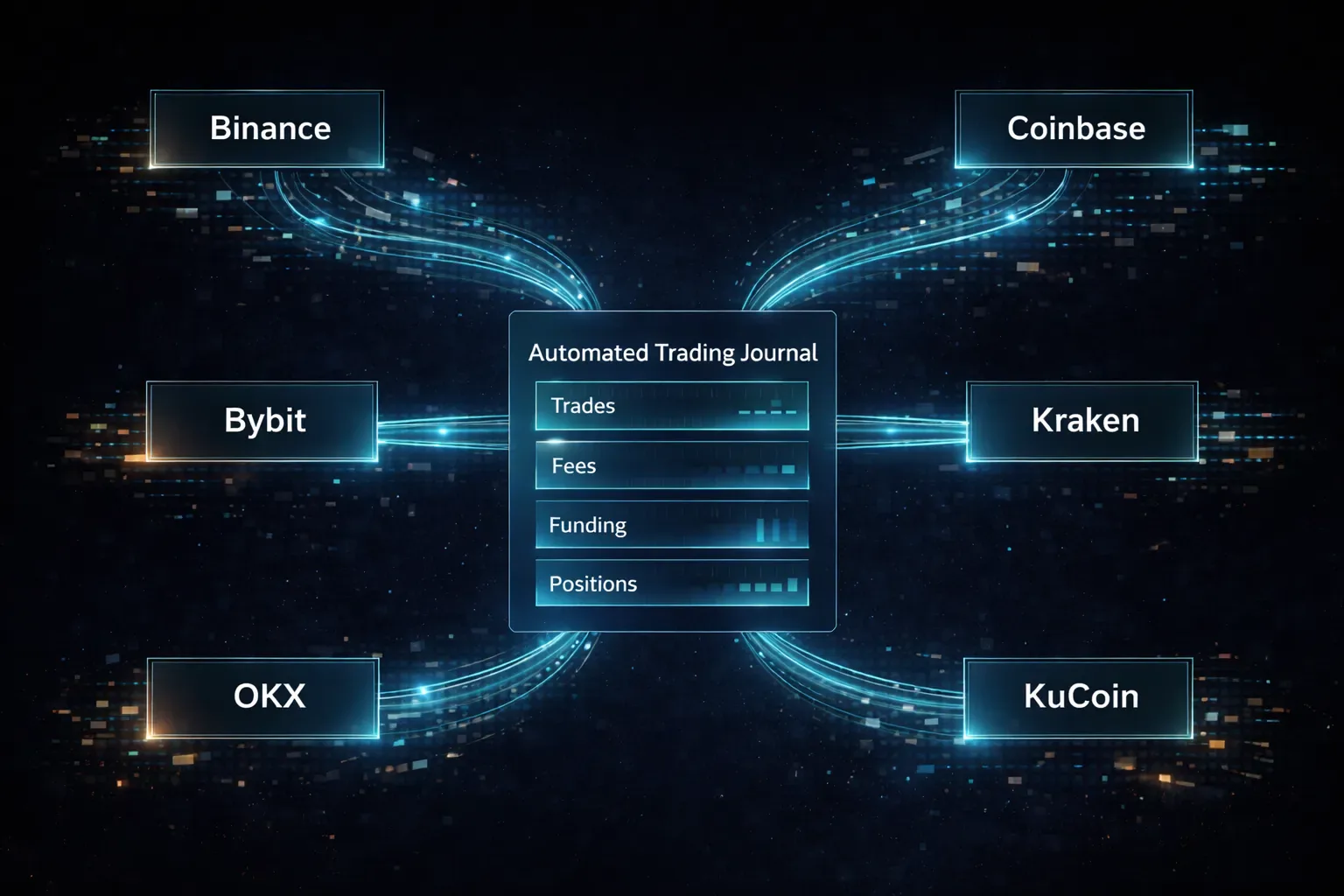
Traditional market traders sometimes get away with simpler journals because activity is slower and structured. Crypto traders cannot. Speed, frequency, and complexity require a system that runs continuously and precisely. Automation is the only approach that matches the pace.
What Changes When You Can Analyze Deeper?
Once data is accurate and complete, automation starts paying real dividends. You stop treating trades as isolated events and start seeing patterns. Journaling shifts from documentation to performance engineering.
With manual journaling, many traders stick to a small set of metrics. Win rate. Total PnL. Maybe average R. Anything deeper feels too heavy because it requires more prep. Automation removes that limitation. You can analyze from multiple angles without increasing workload.
Tagging becomes practical. When trades are imported automatically, you can categorize them by what matters: setup type, market condition, mistake, emotional state, time of day, or strategy variation. Over time, tags reveal which behaviors and conditions drive profit and which quietly drain it.
You stop asking “Am I profitable?” and start asking sharper questions. Which setups produce the best risk-adjusted returns? Which mistakes cost the most money? How does performance change during high volatility? Do you trade worse after a losing streak?
Answering those questions manually usually requires an unrealistic amount of data prep. With automation, the foundation is already built.
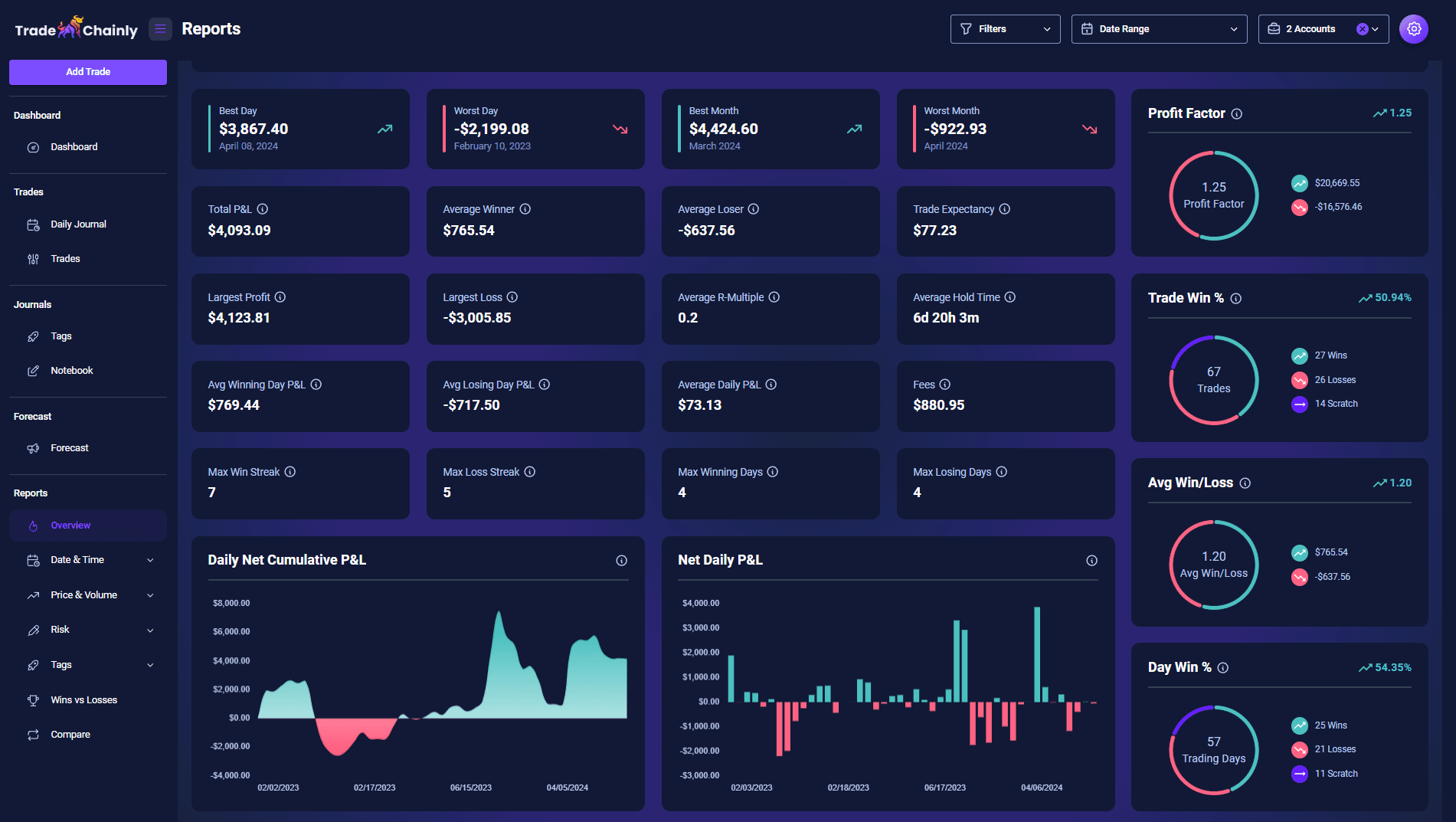
Dashboards and reports become reliable too. With a complete dataset, summary views reflect reality. A weekly report is not a guess. A monthly breakdown is not a partial snapshot. You can trust what you see.
This is where platforms like TradeChainly become useful in an educational way, not as a marketing concept. When trades are automatically imported and combined with tagging and performance analytics, you move from surface journaling to pattern discovery. You stop tracking activity and start tracking behavior.
Deeper analysis changes how you improve. Instead of trying to fix everything, you target the one or two variables that matter. Maybe one setup drives most profits. Maybe one mistake accounts for a large share of losses. Automation makes focused adjustments possible.
That is the difference between journaling that feels productive and journaling that produces measurable improvement.
When Does Manual Journaling Still Make Sense?
Manual journaling can still be useful in specific situations. The goal is not to dismiss every non-automated approach. It is to see where manual systems have a ceiling.
Manual journaling can work when you are new and trade very little. One or two trades per week can fit a simple spreadsheet and written notes. At that stage, the main benefit is not statistical precision. It is learning reflection, spotting mistakes, and thinking in probabilities.
It can also help if journaling is primarily a writing exercise. Slow, deliberate reflection can improve clarity and emotional awareness. That has value early in building discipline.
The problem starts when activity increases.
Once you trade actively, manual systems break down. More trades mean more data, more effort, more resistance. Journaling becomes something you struggle to maintain instead of something that supports your trading.
Manual journaling fails when you need precision. If you care about exact metrics, drawdown analysis, fee impact, funding impact, and execution quality, manual entry becomes unrealistic. Complexity is too high to manage consistently without automation.
Manual journaling also hits a wall when you want pattern recognition. Comparing setups, strategies, or behavioral patterns requires a structured dataset. Notes without automated data become disconnected from performance.
Manual journaling is a learning tool. Automated journaling is a performance tool. One builds awareness. The other builds edge. Most traders outgrow manual systems faster than they expect, especially in crypto, where activity and complexity scale quickly.
If the goal is improvement beyond basic self-reflection, automation stops being optional. It becomes the foundation.
What Should “Good Automation” Include?
Not all automation is equal. Connecting to an exchange and importing trades is the start, not the finish. Good automation is reliability, clarity, and how easily data turns into insight.
Trade data must be complete. Every fill, fee, funding payment, and position adjustment needs to be captured. If funding is skipped or complex positions are merged into simplified entries, you are back to approximations. Automation only works when it preserves the full structure of how you traded.
Syncing must be consistent. A journal that imports once and fails silently is worse than manual because it creates false confidence. Good automation updates continuously and makes it obvious when something breaks. You should not wonder whether today’s trades are missing.
Metrics must be clear and standardized. Entry, exit, PnL, return, drawdown, and risk metrics should follow consistent logic. When definitions change or are hidden, analysis becomes confusing. Good automation removes ambiguity.
The interface should support review, not overwhelm. Traders do not need endless charts and filters. They need clear answers: What is working? Where is money being lost? Which behaviors repeat? Automation should simplify decisions, not bury them.
Workflow matters too. Automation works best when it fits how traders think. Trades flow in automatically. Tags and notes get added during reflection. Reports summarize performance without prep. The rhythm is trade, review, adjust, repeat.
Tools like TradeChainly are designed around that idea. When trades sync continuously and combine with tagging, notes, and analytics, the journal becomes a working environment instead of a storage space. The automation fades into the background. The focus becomes understanding behavior and improving execution.
Good automation feels boring in the best way. Predictable. Quiet. Reliable. You stop thinking about the process and start thinking about your trading. That is when a journal becomes part of your edge.
How Do You Turn Data Into a Repeatable Improvement Loop?
Automation matters most when journaling stops being something you check occasionally and becomes a system you work inside. With accurate, always-available data, improvement becomes a process, not a reaction.
Many traders review only after big wins or losses. Those reviews are emotional and narrow. Automation makes scheduled review realistic. A short check after each session. A deeper weekly review. A monthly performance summary. Consistency matters more than any single deep dive.
A simple loop forms. You trade. Data is captured automatically. You review what happened. You identify one adjustment. You apply it in the next session. Then it repeats. There is no setup phase and no cleanup phase. The system is always ready.
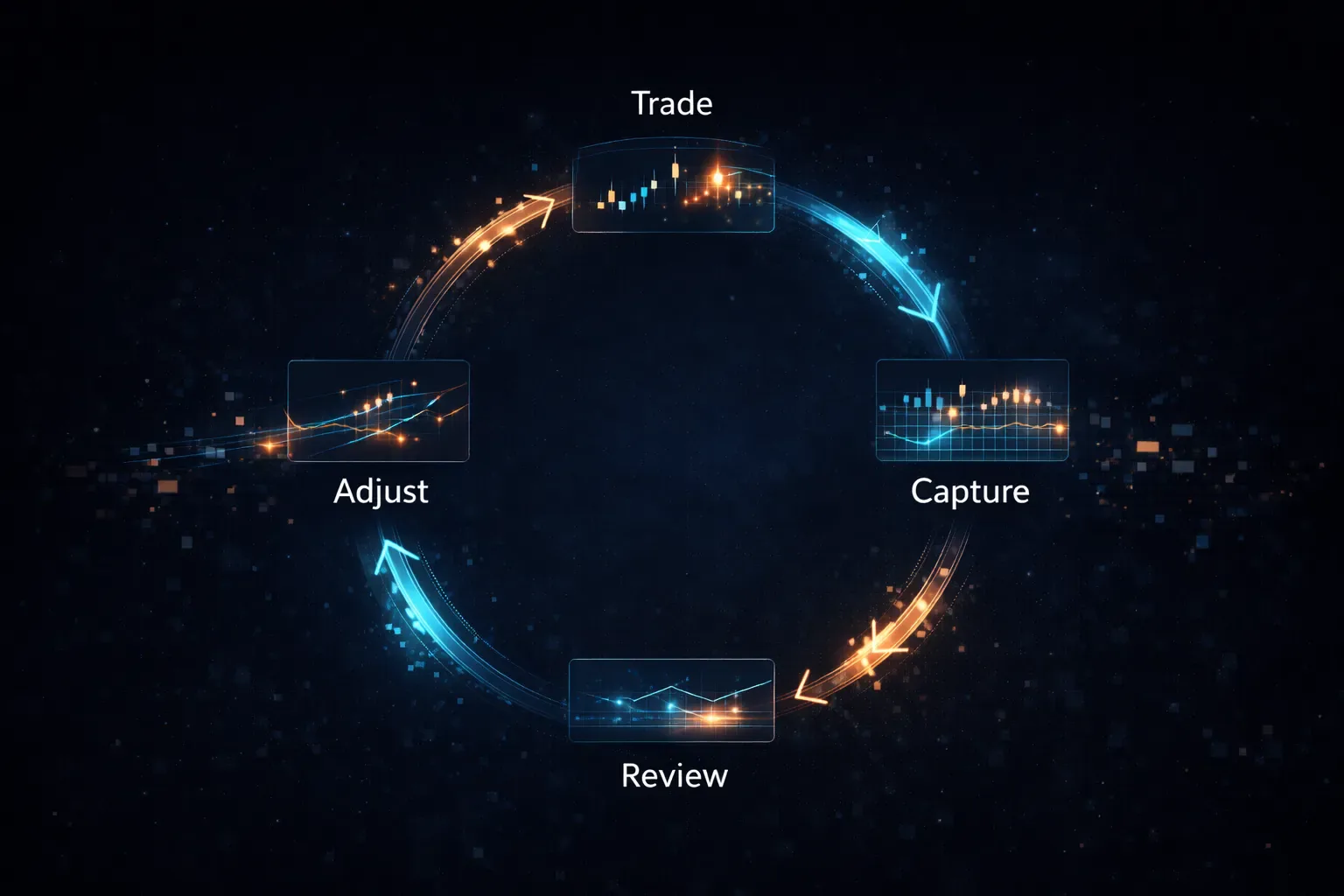
That structure changes how improvement feels. You stop trying to fix everything at once. You make small, targeted changes based on evidence. Maybe you reduce size on a specific setup. Maybe you stop trading a certain hour. Maybe you tighten rules around revenge trades. Each adjustment is grounded in data, not emotion.
Automation also speeds feedback. You do not wait weeks to know whether a change helped. With clean data, shifts in behavior and performance show up faster. That short feedback cycle accelerates learning.
This separates random journaling from structured development. A repeatable loop creates momentum. You are not hoping to improve. You are running an improvement process. That only works when the foundation is automated.
So, What’s the Bottom Line?
Manual versus automated stops being preference once you trade in real conditions. Crypto is fast, complex, and unforgiving. Any system that depends on perfect discipline and endless energy eventually fails.
Manual journaling teaches awareness. Automation builds precision. Awareness matters, but precision is what turns awareness into edge. Incomplete or inconsistent data leads to uncertain conclusions. Clean and complete data makes improvement measurable.
Automation does not make you a better trader by itself. It gives you a foundation for honest evaluation. It removes excuses, removes friction, and removes silent errors that distort performance. You stop guessing and start observing. You stop reacting emotionally and start adjusting strategically.
Automation wins because it is stronger. It holds up as activity increases, strategies evolve, and expectations rise. It scales with you instead of collapsing under progress.
If you want a practical example of how this looks in a crypto-specific environment, platforms like TradeChainly show how automated trade syncing combined with tagging, notes, and analytics can turn journaling into a performance workflow rather than a reporting task.
If your goal is to trade seriously and improve consistently, your journal cannot be fragile. It needs to be structural. In crypto, automation is that structure.