
Why Trade Import Errors Quietly Break Your Journal
Why do your journal stats sometimes feel “off” even when you know what happened in the market?
A win rate jumps unexpectedly. A losing day shows up profitable. Monthly PnL does not match what the exchange shows. When that happens, the issue is usually not your analysis. It is the data entering your journal.
Most traders treat journaling as something that starts after the trade is closed. They focus on writing notes, tagging setups, or reviewing performance metrics. Journaling starts earlier than that. It starts at the moment your trade data enters your system. If that data is incomplete, duplicated, or slightly wrong, every insight you try to extract later is built on a weak foundation.
Crypto makes this harder to ignore. You are not dealing with a single broker and a single asset class. You are dealing with multiple exchanges, spot and futures markets, different fee structures, funding payments, partial fills, leverage, and 24/7 trading. Small inconsistencies in how trades are imported quickly turn into big analytical problems. A missing fee changes your real profitability. A timezone mismatch shifts trades into the wrong day. A duplicated position inflates your win rate. Over time, these errors distort your view of your own performance.
When traders complain that journaling “doesn’t help” or that their stats feel unreliable, the root problem is often not the journal itself. It is how trades are being imported into it. Clean data creates clarity. Messy data creates confusion and doubt.

There are two main ways traders connect exchanges to a crypto trading journal. The first is by manually importing CSV files exported from an exchange. The second is by connecting the exchange through an API so trades sync automatically. It looks like a technical choice. In practice, it shapes how consistent you are, how accurate your data becomes, and how much mental energy journaling demands from you.
This article breaks down what crypto exchange journal integration really means and how CSV imports and API connections differ in real trading workflows. Not in abstract software terms, but in how they affect your daily habits, your confidence in your stats, and your ability to actually improve as a trader. By the end, you should be able to choose an import method that fits your trading style and long-term goals, rather than picking whatever seems easiest in the moment.
The Integration Problem: What “Crypto Exchange Journal Integration” Actually Means
When people talk about connecting an exchange to a trading journal, they often imagine a simple pipeline where trades magically appear in their dashboard. Integration is more specific than that. It is the process of taking raw execution data from an exchange and transforming it into structured, reliable records that your journal can analyze.
Every trade you place on Binance, Bybit, OKX, Coinbase, or any other exchange creates multiple data points. There is the entry price, exit price, position size, side, order type, fees, and timestamps. If you trade futures, you also have leverage, liquidation price, funding payments, and sometimes multiple partial fills that make up a single position. A journal cannot work with vague summaries. It needs every one of these details to be accurate and consistently formatted.
Integration is the bridge between the messy reality of exchange data and the clean structure a journal needs. When it works well, you stop thinking about data collection and focus only on analysis. When it works poorly, you end up debugging your own trading history instead of learning from it.
Crypto makes this harder than most other markets. In equities, a trader often uses one broker and one account. In crypto, many traders use several exchanges at once. You might scalp on Bybit, hold spot positions on Binance, and test strategies on OKX. Each exchange formats data differently. Fees are calculated differently. Timezones are handled differently. Even basic concepts like “a trade” can be represented differently depending on whether the platform logs orders, fills, or positions.
This is why crypto exchange journal integration is not just a convenience feature. It is the backbone of the entire journaling system. Your dashboards, reports, tag statistics, and performance metrics are only as good as the consistency of the data feeding them.
Integration has three responsibilities. First, it must capture every executed trade without missing or duplicating anything. Second, it must normalize the data so that trades from different exchanges behave the same inside your journal. Third, it must keep this process repeatable so your history stays clean over time.
Whether you use CSV files or an API connection determines how well these responsibilities are handled. The difference is not just technical. It directly affects how much trust you can place in your stats and how sustainable your journaling habit becomes as your trading activity grows.
Using CSV Imports Without Regret
A CSV import is the most basic way to get your trades into a journal. You go to your exchange, export your trade history as a file, and upload that file into your journaling platform. The file itself is just a spreadsheet-style document that contains rows of trades and columns for things like timestamp, symbol, side, size, price, and fees.
For many traders, this is their first experience with journaling automation. It feels structured compared to writing trades by hand, and it gives you immediate access to performance stats without building anything technical. You place trades, download a file, upload it, and your journal populates.
The simplicity is the main strength of CSV imports. They require no permissions, no API keys, and no ongoing connection between your exchange and your journal. You stay in full control of what data you share and when you share it. For traders who are cautious about security or who only journal occasionally, this can feel more comfortable than connecting an account programmatically.
CSV imports also make sense in a few specific situations. If you trade very infrequently, manual uploads may not be a burden. If you are testing a new journal or experimenting with different platforms, CSVs let you move historical data around easily. They are also useful when an exchange does not offer stable API access or when you want to import archived data from a platform you no longer actively use.

But CSV imports come with trade-offs that are easy to underestimate at first. Every import is a snapshot in time. The moment you export the file, it becomes outdated. Any trades placed after that export require another download and another upload. Over weeks and months, this creates a manual maintenance loop that slowly becomes friction.
There is also a consistency problem. Different exchanges structure their CSV files differently. Some separate trades by orders, others by fills. Some include fees in base currency, others in quote currency. Some include funding payments, others separate them into a different report. Every import becomes a small translation exercise, even if the journal tries to standardize things for you.
Errors often creep in silently. A missed day of trading means missing data. Uploading overlapping date ranges can create duplicates. Timezone differences can push trades into the wrong day, which affects daily performance statistics. Partial fills can be split across rows and treated as separate trades unless they are merged correctly.
Another limitation is how CSVs handle futures trading. Funding payments, liquidation-related fees, and position-based accounting are rarely cleanly represented in a simple trade export. Many CSVs focus on order execution but ignore the financial events that materially affect profitability. This makes it harder to trust PnL accuracy unless you double-check everything manually.
Despite these limitations, CSV imports are not wrong or useless. They are a stepping stone. They help traders move from manual tracking to structured data. They teach you what kind of information matters. They expose inconsistencies in your own execution history. For early-stage journaling, that learning process has real value.
The problem is that CSV imports do not scale well with activity or ambition. As trade frequency increases, manual uploads turn into a chore. As analysis becomes more detailed, data gaps become more damaging. Over time, traders either accept slightly broken data or start looking for a more automated solution.
CSV imports are best viewed as a transitional tool. They are useful for starting, testing, and experimenting. They become a bottleneck once consistency, accuracy, and low-friction journaling start to matter.
The Scaling Solution: API Connections Explained
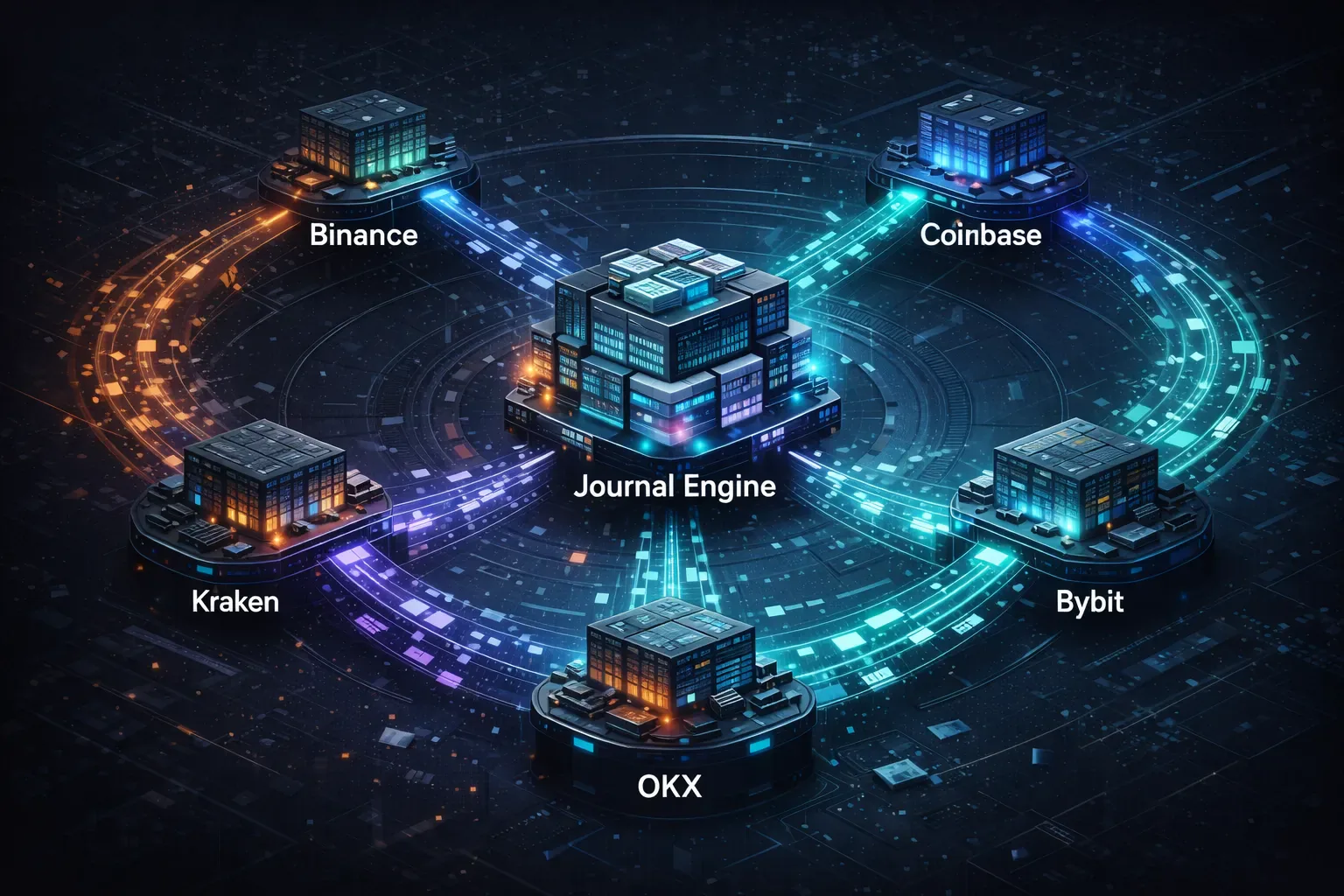
An API connection works very differently from a CSV import. Instead of you manually exporting files, your trading journal connects directly to your exchange through a secure interface provided by the exchange itself. That interface allows the journal to request your trade history and keep it updated automatically.
When you create an API key on an exchange like Binance, Bybit, OKX, or Coinbase, you are generating a set of credentials that define what an external application is allowed to access. For journaling, this is usually limited to read-only permissions. The journal can view your trades, positions, fees, and funding payments, but it cannot place or modify orders. This separation is important because it means automation does not compromise control over your account.
Once the API is connected, syncing becomes continuous. New trades appear in your journal without you doing anything. Funding payments update automatically. Position data stays current. There is no concept of “exporting” anymore. Your journal becomes a live mirror of your trading activity rather than a collection of historical snapshots.
API connections change how journaling feels. The friction disappears. You no longer have to remember to upload files. You do not have to worry about missing a day. You do not have to merge overlapping CSV ranges. Your data stays current by default, which makes reviewing performance feel lighter and more natural.
APIs also handle crypto complexity far better than CSVs. They can pull funding payments, liquidation-related adjustments, and position-level accounting that CSVs often miss or fragment. For futures traders, this is critical. A strategy can look profitable on paper while quietly losing money through funding and fees. Only a complete data feed exposes that reality.
Another advantage is normalization. Journaling platforms can standardize how different exchanges represent trades because APIs expose structured, predictable endpoints. While each exchange still has quirks, API data is easier to map into a consistent internal format than CSV files that change structure depending on region, export settings, or account type.
Security is usually the main concern traders have with APIs. In practice, API-based journaling is safer than most people assume. You control the permissions. You can restrict keys to read-only access. You can revoke them at any time. And you can isolate them to specific IP addresses if your exchange supports it. The risk profile is lower than sharing login credentials or uploading raw account statements.
The real cost of APIs is not financial or technical. It is psychological. You must be willing to trust automation. You must accept that your journal is now continuously connected to your trading activity. For traders who like full manual control, that can feel uncomfortable at first. But it is also what unlocks consistency at scale.
API connections turn journaling from a task into infrastructure. Instead of asking “Did I upload my trades?” you start asking “What does my data show me today?” That shift changes how often you review, how seriously you take your stats, and how reliable your decision-making becomes.
The CSV Problem: What Breaks in Real Workflows
The question is how CSV imports and API connections behave side by side in a real trading workflow. The difference is not just about convenience. It affects accuracy, maintenance, and how sustainable your journaling process becomes over time.
With CSVs, you are responsible for data continuity. Every time you want your journal to be up to date, you must export, upload, and verify. That means journaling is always tied to an extra task. If you skip that task for a few days or weeks, your data becomes fragmented. You stop trusting your dashboards because you are never fully sure whether everything is included.
APIs remove that responsibility. The data stream stays active whether you think about it or not. Your journal reflects your trading activity automatically. This consistency changes how traders behave. Instead of batching analysis sessions around CSV uploads, they tend to review more frequently and with more confidence.
Accuracy is another major difference. CSV files often simplify or omit information that matters in crypto. Funding payments, partial fills, liquidation-related fees, and cross-margin adjustments are either separated into different exports or missing entirely. APIs usually expose this data in a more complete form. That does not guarantee perfection, but it reduces the number of blind spots.
Maintenance is where CSVs quietly become expensive. If you trade on multiple exchanges, you must repeat the export process for each one. You must remember which files you uploaded and which date ranges they cover. You must avoid overlaps and gaps. Each manual step introduces the chance for small errors that compound over time.
With APIs, maintenance becomes centralized. You connect once and the journal keeps syncing. If you add a new exchange, you connect one more API and the system absorbs it. Your workload does not scale with your trading volume.
Psychological friction is harder to quantify, but it matters. CSV imports make journaling feel like homework. APIs make it feel like infrastructure. One is something you must remember to do. The other simply exists in the background.
| Factor | CSV Import | API Connection |
|---|---|---|
| Setup effort | Simple, no credentials needed | Requires creating API keys and permissions |
| Ongoing work | Manual exports and uploads | Fully automatic syncing |
| Data completeness | Often partial, varies by exchange | Usually more complete and structured |
| Accuracy over time | Degrades with missed uploads and overlaps | Remains consistent with continuous sync |
| Multi-exchange trading | High friction, repeated work | Scales cleanly with each new exchange |
| Futures support | Often fragmented | Better coverage of funding and position data |
| Psychological load | Feels like a recurring task | Feels like background infrastructure |
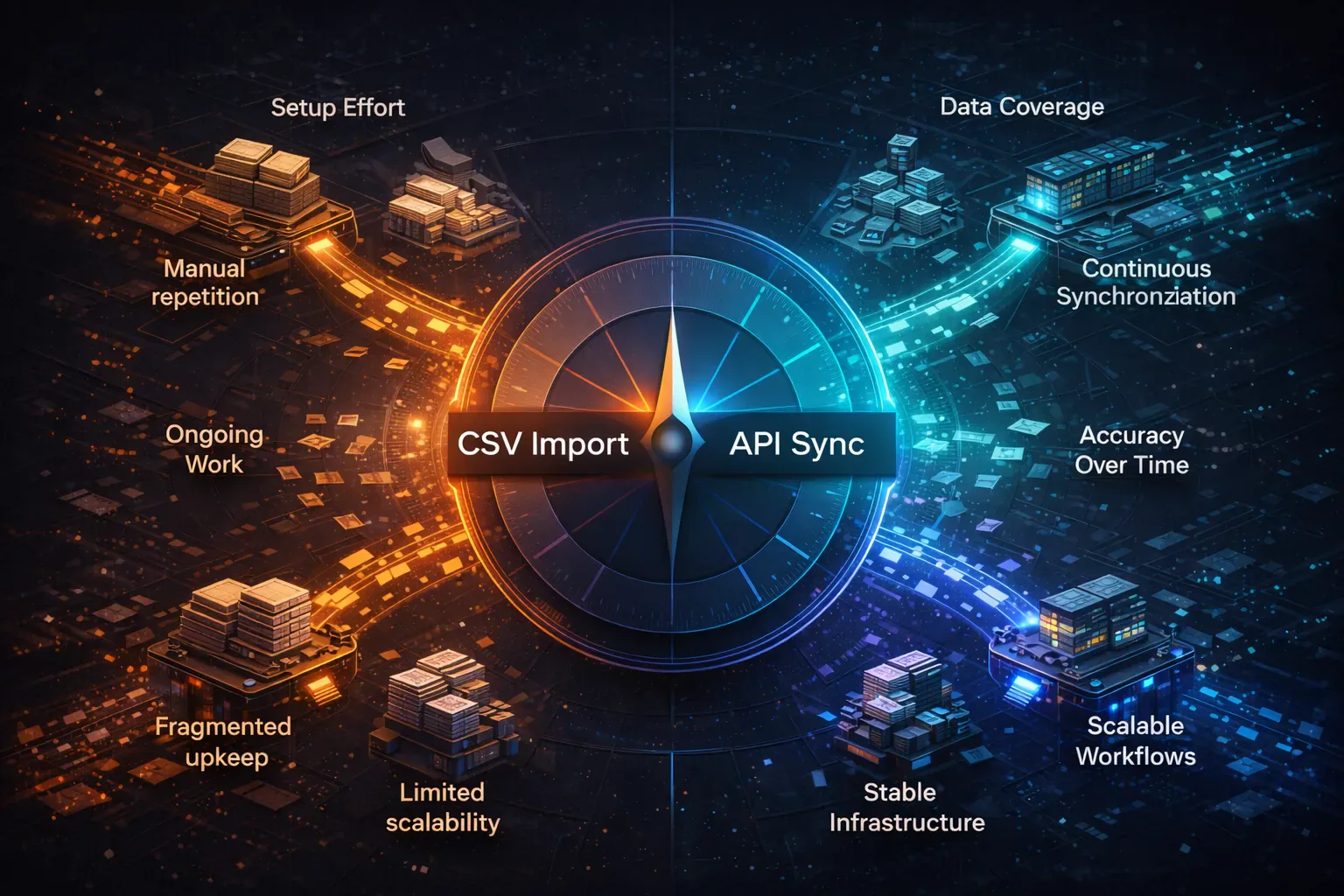
Neither method is objectively “wrong.” CSVs are practical when you are testing, trading lightly, or working with limited access. APIs are superior when consistency, accuracy, and long-term analysis matter. The more seriously you treat your trading data, the more the API approach starts to feel less like a luxury and more like a necessity.
Debugging Dirty Imports: Data Quality Problems That Break Your Journal
Most traders only notice data quality problems when their stats start to look strange. A win rate jumps unexpectedly. A losing day appears profitable. Monthly PnL does not match what the exchange shows. These issues rarely come from the journal itself. They usually come from how trade data is being imported and maintained.
One of the most common problems is duplication. It happens when overlapping CSV date ranges are uploaded or when a trader re-imports a file without clearing previous data. The journal ends up counting the same trade twice. That inflates trade count, distorts win rate, and makes risk metrics meaningless. APIs largely remove this problem because each trade has a unique identifier that only syncs once.
Missing data is just as damaging. A forgotten CSV upload means entire sessions vanish from your history. If you review performance based on incomplete data, you are drawing conclusions from a distorted sample. APIs reduce this risk because syncing does not depend on your memory or discipline.
Timezone mismatches create more subtle damage. Some exchanges export in UTC, others in local time. If your journal interprets timestamps differently, trades slide into the wrong trading day. This affects daily stats, session performance, and behavioral analysis. Over time, it becomes harder to trust any day-level insights.
Partial fills are another hidden source of noise. A single position may be executed through multiple fills, each appearing as a separate row in a CSV. If those fills are not merged correctly, your journal treats one trade as several. That changes average risk, reward ratios, and trade frequency metrics. APIs usually expose both fill-level and position-level data, making normalization easier.
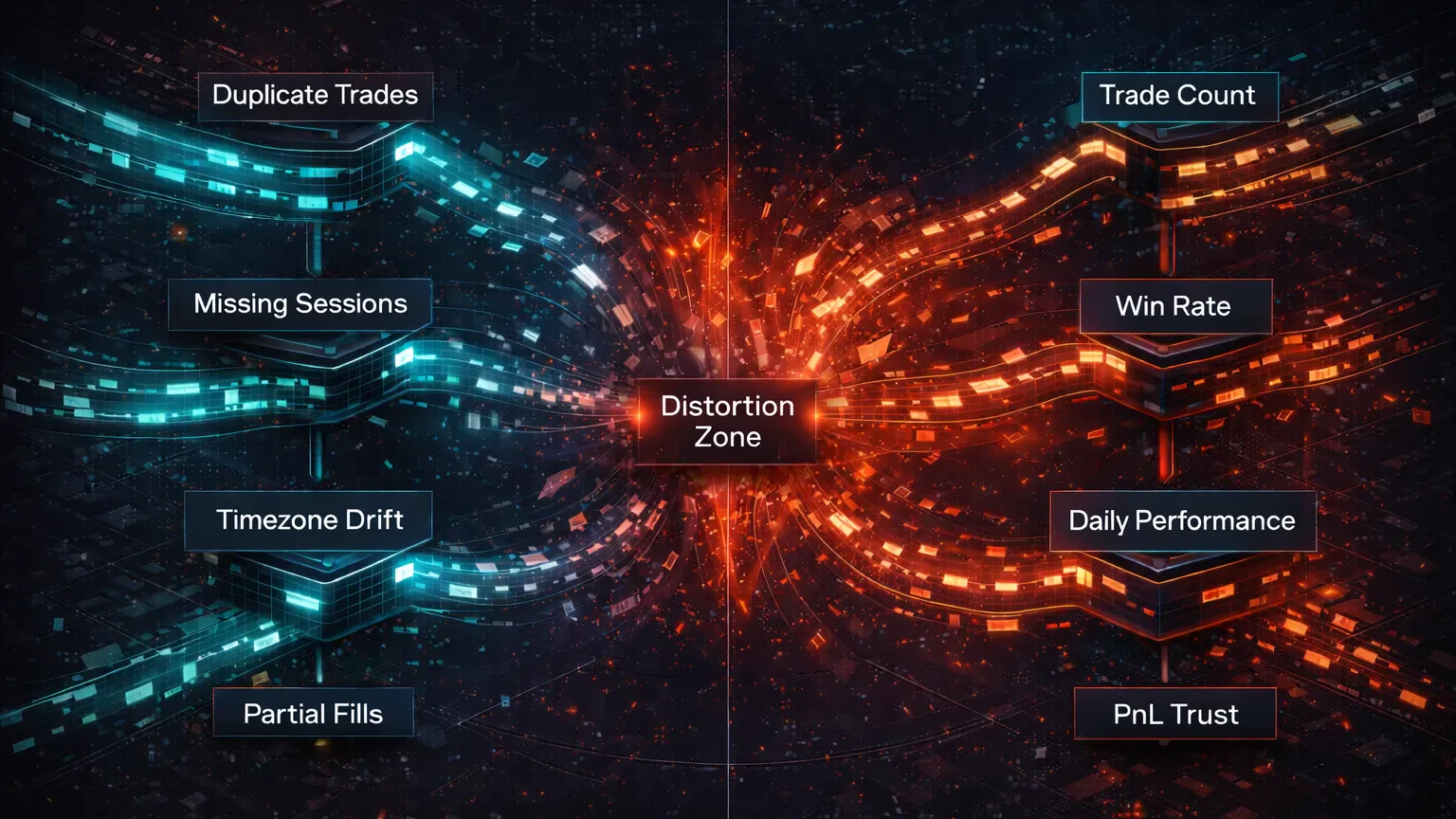
Futures traders face additional problems. Funding payments are often exported separately from trades. Liquidation-related adjustments are sometimes missing. Fees may be shown in different currencies across reports. When these elements are not unified, PnL accuracy suffers. A strategy that appears profitable can quietly bleed through fees and funding without being visible in the journal.
All of these issues share one trait. They do not announce themselves clearly. They accumulate silently. Over weeks and months, your journal drifts further away from reality. The danger is not that your data is slightly wrong. It is that you stop trusting your data entirely.
This is why integration quality is not a minor technical detail. It is the difference between using your journal as a decision tool and using it as a rough memory aid. Clean imports create confidence. Broken imports create hesitation. And hesitation is expensive in trading.
Matching Your Trading Style to the Right Import Method
The best integration method depends less on what is technically possible and more on how you actually trade. Different styles create different pressures on your data, and the wrong setup quietly undermines the value of your journal.
If you are a casual spot trader who places a few trades per week, CSV imports can be perfectly reasonable. Your trade volume is low, funding does not exist, and fee structures are simple. A monthly export and upload may be enough to keep your journal accurate. The risk of missing data is small, and the maintenance burden is manageable.
If you trade futures regularly, CSV imports start to struggle. Funding payments, partial fills, and leverage-driven position management introduce complexity that CSVs rarely capture cleanly. API connections become far more attractive because they pull the full financial picture automatically. Without that, your futures PnL is often only an approximation.
If you trade on multiple exchanges, the value of APIs increases dramatically. Managing separate CSV exports from Binance, Bybit, and OKX becomes repetitive and error-prone. Each platform uses different formats, currencies, and timestamp logic. APIs centralize this chaos into a single continuous data stream that your journal can normalize.
For traders who treat trading as a serious performance activity, automation is not about convenience. It is about reliability. When your journal becomes the basis for decisions like strategy selection, risk allocation, or scaling size, the cost of inaccurate data rises sharply. APIs support that level of trust far better than manual imports.
| Trader Profile | Typical Activity | Recommended Method | Reasoning |
|---|---|---|---|
| Casual spot trader | Low frequency, simple positions | CSV import | Minimal friction and low data complexity |
| Active spot trader | Daily trading, higher volume | API connection | Removes repetitive uploads and improves consistency |
| Futures trader | Leverage, funding, position-based accounting | API connection | Captures full financial picture automatically |
| Multi-exchange trader | Trades across 2+ platforms | API connection | Centralizes data and reduces normalization errors |
| Performance-driven trader | Uses stats to guide decisions | API connection | Higher data integrity and long-term reliability |
Choosing the right setup is not about using the most advanced option available. It is about using the option that protects the accuracy of your trading history without adding unnecessary friction to your workflow.
Turning Integration Into a Habit, Not Homework
The way your trades enter your journal quietly shapes how you behave as a trader. It determines whether journaling feels like a natural part of your routine or a task you keep postponing.
With CSV imports, journaling is always optional in practice. You have to decide to export, upload, and check your data before any analysis can happen. On busy weeks, that step is easy to skip. When you skip it once, skipping it again becomes easier. Over time, journaling turns into something you “catch up on” instead of something that runs alongside your trading.
API connections remove that decision point. Your data is already there. Reviewing becomes a question of when, not whether. This subtle difference has a large impact on consistency. Traders who use APIs tend to review more often because the barrier to starting is lower. They open their journal and the information is ready.
There is also a trust effect. When your data syncs automatically, you stop wondering if something is missing. You do not question whether yesterday’s trades were uploaded correctly. That confidence makes it easier to act on what the journal shows you. You are more willing to adjust position size, cut underperforming setups, or double down on what works.
Discipline in trading is rarely about willpower alone. It is about environment. A journal that is always current supports disciplined behavior. A journal that depends on manual updates slowly erodes it.
Making Setup Boring on Purpose: A Practical Integration Workflow
The setup process matters almost as much as the method you choose. A clean first import prevents most long-term problems and gives you confidence that your journal reflects reality.
Start by listing every exchange you actively trade on. This includes spot and futures accounts, and any platform where capital moves regularly. Many traders forget secondary accounts and later wonder why their stats feel incomplete. Your integration should represent your full trading activity, not just your main venue.
Next, decide which method fits each exchange. If an exchange supports stable API access, that should usually be your default. For older accounts or platforms you no longer use actively, a one-time CSV import may be enough. Mixing both methods is normal, as long as you understand why each is being used.
Before trusting any data, run a small verification check. Compare one or two recent trading days between your exchange and your journal. Check trade count, PnL, and fees. Look for missing funding payments if you trade futures. This takes a few minutes and saves weeks of confusion later.
Once accuracy is confirmed, treat your integration as locked infrastructure. Avoid re-importing historical CSVs unless something is clearly broken. Let the system build continuity. The goal is stability, not constant tinkering.

A simple workflow looks like this. Start by auditing your exchanges. Choose API or CSV per platform. Import or connect. Verify a small sample. Then let automation run.
Good integration setup is boring by design. When it works, you stop thinking about it and start focusing on your actual performance.
The Only Point That Matters: Your Journal Is Only as Strong as Its Data
The way your trades enter your journal determines how useful that journal can ever become. CSV imports and API connections both achieve the same basic goal, but they create very different long-term experiences. One relies on your discipline to stay organized. The other builds consistency into the system itself.
CSV imports are a practical starting point. They help you move away from manual tracking and begin working with real performance data. For light trading or early experimentation, they are often enough. But as your activity grows and your analysis becomes more serious, the limitations show up quickly. Gaps appear. Errors creep in. Confidence in your stats starts to fade.
API connections shift journaling from a task to infrastructure. Your data stays current. Your review process becomes lighter. Your trust in what you see increases. That trust is what allows a journal to become more than a record. It becomes a decision tool.
Platforms like TradeChainly are built around this automation-first mindset. Continuous syncing, normalized exchange data, and reliable performance metrics exist to remove friction from the process so your attention stays on trading, not on maintaining spreadsheets or uploading files.
Clean imports give you a history you can trust. Once you have that, the questions change. Which setups actually pay? Which exchanges create hidden drag through fees and funding? What does your data say when you remove the noise?