
Why Accurate Trade Data Changes Everything
Why does your journal say you are profitable, but your account balance tells a different story?
Most traders assume their journal is accurate because they are careful. They record their trades, update their spreadsheets, and try to be consistent. On the surface, it feels responsible and structured. But accuracy in trading data is not about effort. It is about how much of the real execution data actually makes it into your system without distortion.
Small errors compound fast. A missed fee here, a rounded position size there, a forgotten funding charge, or a manually adjusted entry price that felt close enough in the moment. Each one seems harmless on its own. Over time, they reshape your statistics. Your win rate drifts. Your expectancy becomes unreliable. Your risk per trade is no longer what you think it is. Eventually, you are optimizing decisions based on a version of your trading that never really happened.
That mismatch is why many traders feel confused when their journal says they are profitable, but their account balance tells a different story. The problem is not always discipline or strategy. Often, it is data integrity. When your inputs are noisy, your conclusions are unstable.

Crypto trading makes this problem even worse. Funding fees, partial fills, maker and taker fees, fast price movement, and different execution rules across exchanges introduce layers of complexity that manual journaling struggles to capture. A futures trader on Binance or Bybit experiences data that is far more dynamic than what a simple spreadsheet is designed to hold.
API-based journaling changes the nature of this problem. Instead of relying on memory and manual entry, your journal pulls real trade data directly from the exchange. Every fill, fee, timestamp, and funding payment is captured as it happened. You are no longer reconstructing your trading history. You are importing it.
It is not just about saving time. It is about upgrading the quality of your feedback loop. When your journal reflects reality with high fidelity, your metrics stop being estimates. They become diagnostic tools. That shift alone can change how you review, how you adjust, and how quickly you improve.
In this article, we will focus on one specific benefit of API-based journaling: data accuracy. Not convenience. Not speed. Accuracy. Because without accurate data, even the most sophisticated trading analytics become noise.
Build a Clear Picture of Where Manual Journaling Breaks
Manual journaling fails quietly. It rarely collapses in an obvious way. Instead, it degrades accuracy through small, repeated approximations that feel harmless in isolation but reshape your dataset over time. By the time a trader notices something is off, the journal is already describing a version of their trading that is only loosely connected to reality.
The most common issue is incomplete trade capture. Traders forget to log a trade, especially fast scalps, partial closes, or trades taken during high volatility. A single missing trade might not feel significant, but missing trades almost always have a bias. Traders tend to forget small losses, breakeven exits, or emotional revenge trades. Over a month, this subtly inflates performance metrics and masks behavioral problems that should be addressed.
Position sizing is another frequent source of distortion. In manual journals, size is often rounded or simplified. A trader might log 1.5 ETH when the actual execution was split into several partial fills at slightly different quantities. When that size is used to calculate risk per trade, R-multiple, or exposure by market, the numbers no longer reflect what actually happened on the account.
Fees are routinely underestimated or ignored. In crypto, fees are not a footnote. Maker and taker fees vary by exchange, VIP level, and market type. Futures fees are different from spot fees. Some exchanges rebate makers and charge higher takers. Manually estimating fees or applying a flat percentage introduces immediate error into net profitability, especially for scalpers and high-frequency traders where fees can decide whether a strategy is viable.
Funding payments are even more commonly skipped. Many traders only journal realized PnL from trade exits and forget that funding payments are part of the trade lifecycle. A position held through several funding intervals can accumulate meaningful cost or income. Ignoring this makes futures performance appear cleaner and more profitable than it truly is.
Timestamps are another subtle problem. Manual journals often record trades to the nearest minute or even the nearest five minutes. That might seem reasonable until you start analyzing time-based patterns like session performance, reaction to news, or trade clustering. Precision matters when you want to understand how execution timing affects outcomes.
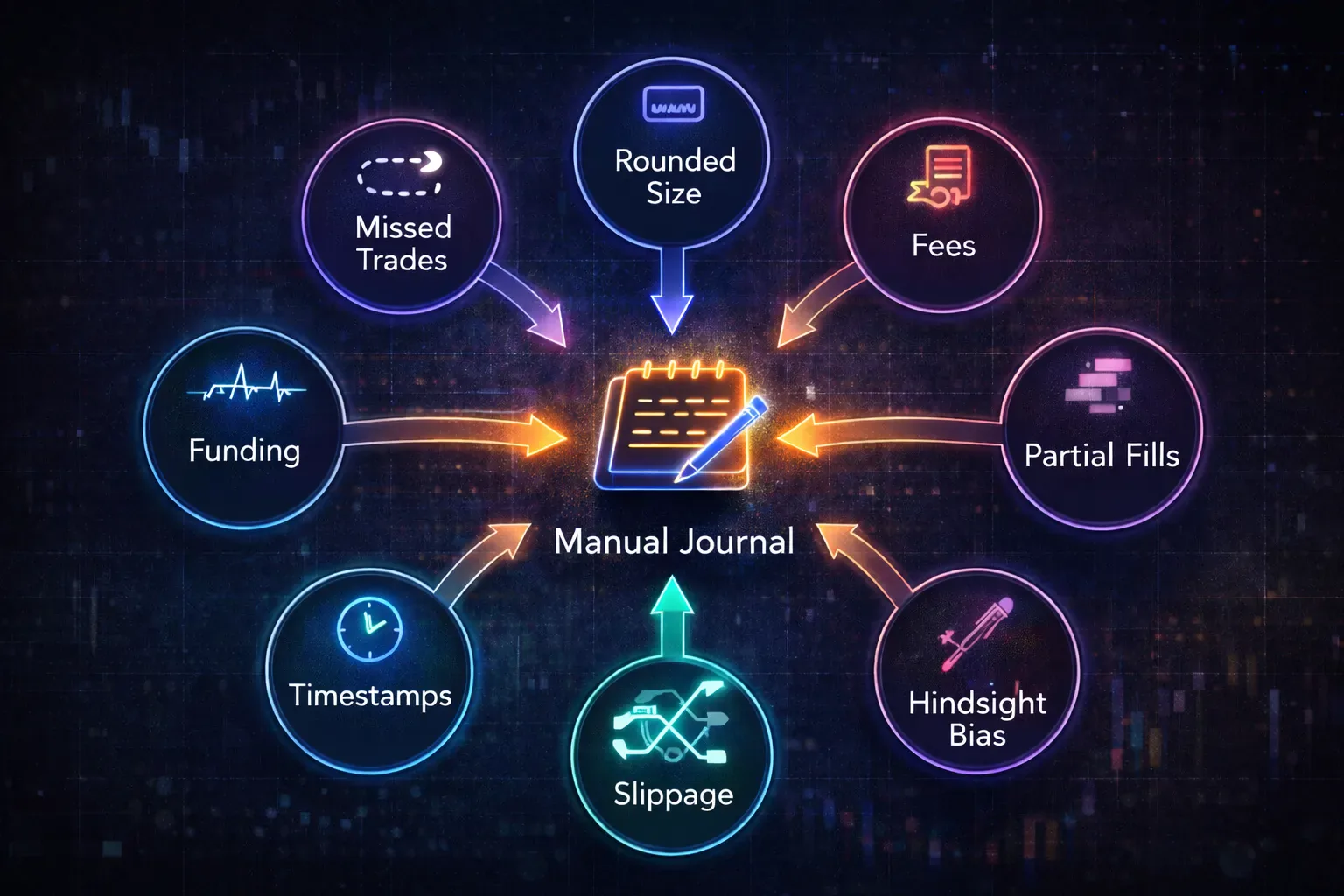
Partial fills create additional complexity. In fast markets, especially on futures, a single order may be filled across several price levels. Manual journaling usually collapses this into a single averaged price. That erases information about slippage and execution quality, which are critical for evaluating real-world performance.
There is also an emotional layer. Manual journaling is vulnerable to hindsight bias. Traders unintentionally adjust numbers to match how a trade felt rather than how it executed. An entry price might be nudged slightly. A stop loss might be remembered differently. These are not conscious deceptions. They are human attempts to simplify and rationalize chaotic execution.
By the time all of these distortions stack together, your journal becomes a polished summary, not a precise record. It feels organized, but it is no longer forensic. You cannot diagnose small performance leaks because the system itself introduces noise.
The structural weakness of manual journaling is simple. It relies on memory, approximation, and emotional interpretation. That is the opposite of what trading analysis needs.
Turn Exchange Executions into a Clean Trade Record
A crypto trading journal API is a direct communication bridge between your exchange account and your journaling platform. Instead of you reconstructing trades after the fact, the journal receives execution data exactly as the exchange recorded it. This includes every fill, every fee, every funding payment, and every timestamp down to the second.
When you connect an exchange like Binance, Bybit, Coinbase, OKX, or Kraken through an API key, you are granting read-only access to your trading history. The journal does not guess what happened. It pulls the raw data that already exists inside the exchange’s database. That difference is critical. Your journal stops being an interpretation layer and becomes a mirror of your account.
At a basic level, an API sync captures entry and exit prices for each fill. It captures exact position size and changes over time, timestamps with full precision, trading fees broken down by type, funding payments for futures positions, market type such as spot or perpetual futures, and symbol and contract specifications.
But the value is not just in the fields themselves. It is in how those fields stay connected. Each trade is reconstructed from actual execution events, not summarized from memory. A single position might contain ten partial fills and three funding payments. An API-based journal sees that as one structured dataset. A manual journal usually sees it as one averaged number.
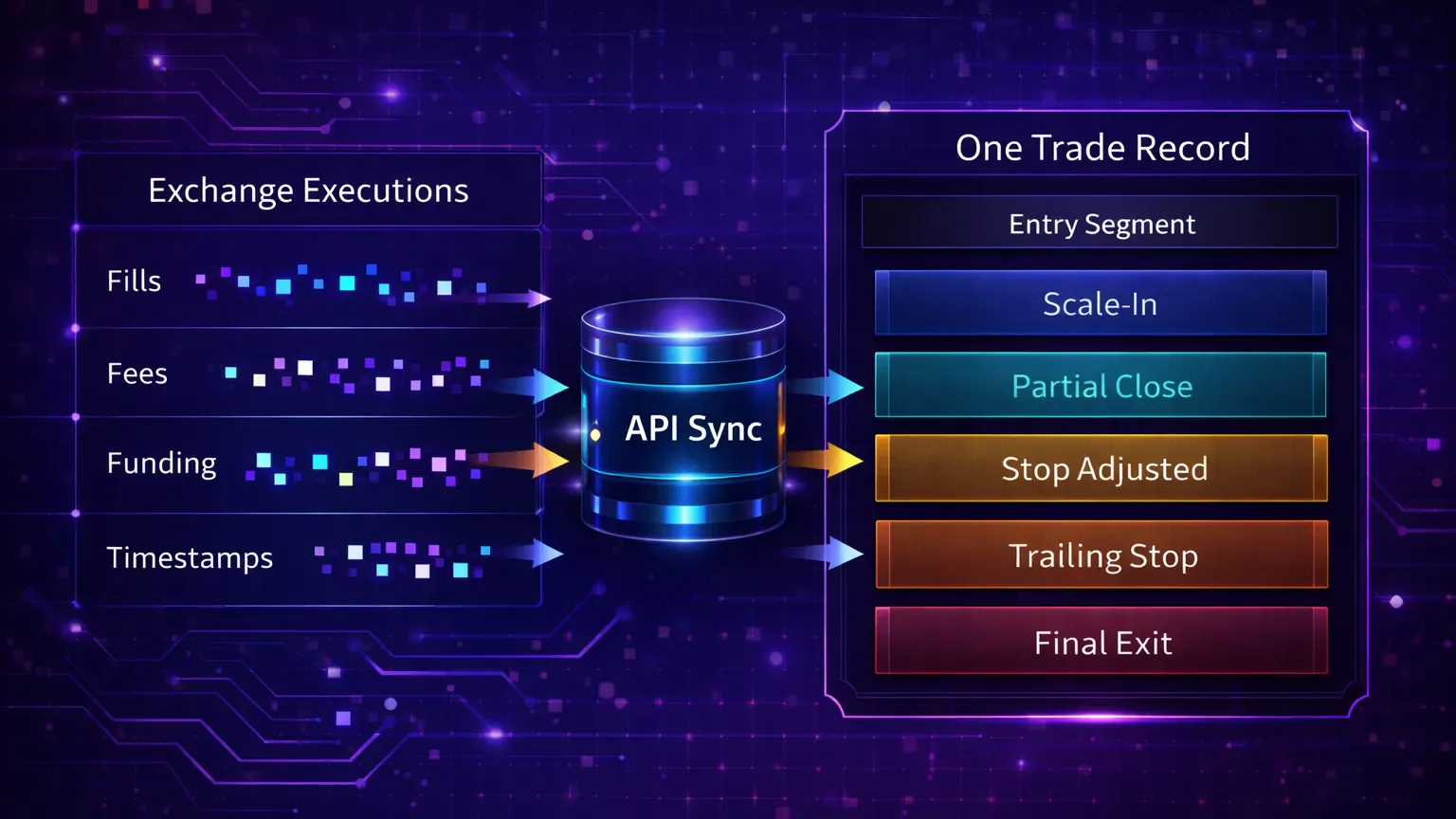
Exits change too. Many traders log one entry and one exit. In reality, exits often happen in pieces. Scaling out at multiple targets, closing partially during volatility, or having stops triggered on only part of the position are all common in crypto trading. API data preserves that structure. Your PnL reflects how you actually managed the trade, not how you remember closing it.
Another difference is API sync versus CSV imports. CSV files are snapshots. They require manual export, manual upload, and manual reconciliation. If you forget to upload for a week, your journal becomes outdated. APIs are continuous. Once connected, trades sync automatically. That means your journal remains current without extra effort, and no data is lost between sessions.
Consistency improves as well. When you trade across multiple exchanges, each one formats data differently. APIs normalize that information into a common structure. Your performance on Binance futures and Coinbase spot becomes directly comparable. That is almost impossible to achieve cleanly with manual logs.
An API-based journal does not make your analysis smarter by itself. What it does is remove the guesswork from your dataset. Your statistics are no longer built on approximations. They are built on execution truth. That alone raises the ceiling of what your analytics can reveal.
Fix the Metrics That Manual Data Quietly Distorts
Most traders look at their journal for answers. They want to know if their strategy works, if their risk is controlled, and if they are actually improving. The problem is that metrics only become meaningful when the data behind them is clean. API-based journaling changes the quality of your metrics because it removes the silent distortions introduced by manual input.
Win rate is the first number that usually gets corrupted. If a few small losing trades are missed or logged incorrectly, your win rate climbs without you realizing it. That can push you to increase size or take lower-quality setups because the data suggests you are more consistent than you really are. With API data, every trade is counted, including the ones you would rather forget. Your win rate stops being optimistic and starts being honest.
Expectancy is even more sensitive. Expectancy depends on three things: average win, average loss, and win rate. If any of those are distorted, the entire calculation becomes unreliable. When fees are underestimated, losses appear smaller. When partial exits are simplified, average wins become inflated. When funding payments are ignored, long-duration futures trades look more profitable than they truly are. API data brings all of those hidden variables back into the equation.
R-multiple is another metric that benefits from execution-level accuracy. R-multiple only makes sense when your position size, stop distance, and realized PnL are correctly aligned. Manual journals often break that alignment by rounding size or forgetting to update stops after partial exits. API data preserves the relationship between risk and outcome, which is the entire point of using R in the first place.
Net profitability is where traders usually feel the gap most clearly. Many manual journals track gross PnL and subtract an estimated fee. In crypto, that approach collapses under real conditions. Maker and taker fees, funding payments, and execution slippage all shape net returns. An API-based journal calculates profit after every cost. That makes the difference between a strategy that looks profitable on paper and one that actually grows your account.
Consistency metrics also become sharper. When timestamps are precise, you can analyze performance by session, by hour, or by volatility regime. When trades are grouped correctly, you can see how often you overtrade or cluster losses. Manual data often blurs these patterns because timing is rounded and trade structure is simplified.
| Metric Type | Manual Journal Output | API-Based Journal Output |
|---|---|---|
| Win Rate | Often inflated due to missed trades or selective logging | Exact, includes all trades and partial executions |
| Average Win | Usually overstated due to simplified exits | Based on actual scaled exits and real fill prices |
| Average Loss | Often understated due to ignored fees or funding | Includes all execution costs and funding charges |
| Expectancy | Unstable and overly optimistic | Stable and grounded in real account performance |
| R-Multiple | Inconsistent due to rounded size and stop assumptions | Precise alignment between risk and outcome |
| Net PnL | Approximate, based on estimated costs | Exact, based on real fees, funding, and slippage |
| Time-Based Analysis | Weak due to rounded timestamps | Strong, built on second-level execution timing |

The impact of this accuracy compounds over time. With manual data, your journal becomes a motivational tool. It helps you feel organized and productive. With API data, it becomes a diagnostic instrument. It shows you where your strategy leaks, where your execution fails, and where your edge is real.
This shift changes how you make decisions. Instead of asking “Does my journal say I am profitable?”, you start asking “Which parts of my trading account actually create profit, and which parts silently drain it?” That question is only answerable when your metrics reflect what truly happened, not what was convenient to record.
Make Tags, Notes, and Reviews Actually Pay Off
Accurate trade data is what gives meaning to everything you add on top of your journal. Tags, notes, emotions, mistakes, and setups only become useful when they are attached to trades that are structurally correct. If the underlying numbers are distorted, your qualitative analysis becomes unreliable, no matter how detailed your annotations are.
Many traders tag trades without realizing how dependent tagging is on clean execution data. If a position size is wrong, your “over-risking” tag loses precision. If funding fees are missing, your “held too long” tag stops reflecting the real cost of holding. If partial exits are collapsed into one number, your “scaled out too early” or “cut winners short” tag becomes guesswork.
API-based data makes tagging objective. Every tag becomes anchored to facts rather than memory. You are no longer saying, “I think this was a bad exit.” You are saying, “This exit produced a lower R-multiple because the fills occurred at worse prices during volatility.” That distinction matters. It moves your journal from reflection into analysis.
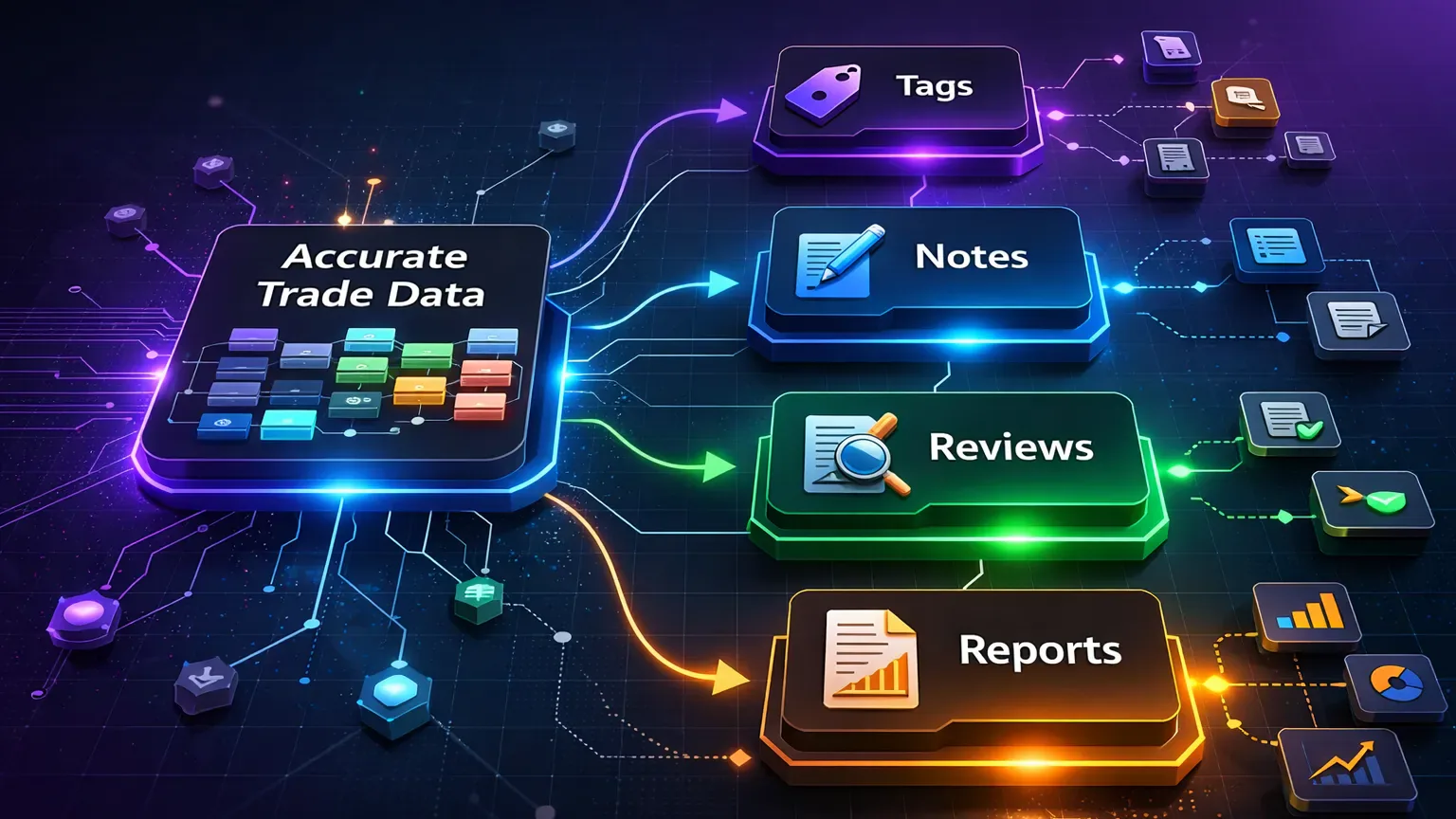
Notes become sharper for the same reason. When you review a losing trade, you are not trying to reconstruct what happened. You can see the exact sequence of fills, fees, and timing. That frees your notes to focus on decision-making rather than accounting. Instead of writing, “Not sure if this was slippage or bad entry,” you can write, “Execution slipped during low liquidity after news,” because the data confirms it.
This is also where structured analytics start to work. When trades are accurately recorded, your reports by tag, setup, or mistake stop being approximate. You can trust that the profitability of a tag reflects real execution, not missing costs or forgotten trades. Over time, this allows you to build a performance map of your behavior, not just your strategy.
Platforms like TradeChainly use this structure to connect API-synced trade data with tagging, notes, and reports in one workflow. The automation handles the raw data, so your attention stays on pattern recognition and decision improvement. The tool does not replace thinking. It protects the data your thinking depends on.
The impact shows up in practice. Your review sessions become calmer and more precise. You stop arguing with your own numbers. You stop questioning whether your journal is lying. The conversation shifts from “Is this data correct?” to “What is this data trying to show me?”
That shift is what turns journaling into a feedback system rather than a record-keeping task.
Measure Crypto-Specific Costs Instead of Ignoring Them
Crypto trading introduces data complexity that traditional markets rarely face. Funding rates, rapid volatility, partial fills, and dynamic fee structures are not edge cases. They are normal conditions. This becomes essential rather than optional.
Funding payments are a perfect example. In futures trading, your PnL is not only shaped by entry and exit. Every funding interval adds cost or income. Manual journals usually ignore this or treat it as a separate line item. API data embeds funding directly into each trade’s performance, which prevents futures strategies from looking artificially profitable.
Fees are another major distortion source. Crypto exchanges apply different maker and taker rates, and those rates change with volume tiers or promotions. A scalper trading on Bybit or Binance can see fees consume a large portion of edge. API data captures the exact fee paid on every fill. There is no estimating and no averaging.
Partial fills are also common in volatile markets. An order rarely executes at one clean price. It is often filled across multiple levels as liquidity shifts. API data preserves this structure, which means your execution quality is measurable. Manual journals flatten this information into an average that hides slippage.
Spot and futures trades also behave differently. Futures include leverage, liquidation risk, and funding. Spot includes simpler cost structures but still involves fees and partial fills. APIs separate these cleanly, which allows accurate performance comparison across market types.

| Data Element | Why It Matters | Manual Journal Limitation | API-Based Capture |
|---|---|---|---|
| Funding payments | Directly affects net futures profitability | Often ignored or tracked separately | Automatically attached to each position |
| Maker vs taker fees | Changes strategy viability, especially for scalping | Usually estimated or averaged | Exact fee recorded per fill |
| Partial fills | Reveals slippage and execution quality | Collapsed into one average price | Preserved at execution level |
| Execution timestamps | Enables session and volatility analysis | Rounded or approximated | Captured to the second |
| Market type (spot vs futures) | Separates risk profiles and cost structures | Often mixed in reporting | Explicitly labeled per trade |
| Exchange-specific rules | Different fee and contract structures | Difficult to normalize manually | Normalized through API data |
API accuracy aligns your journal with the realities of how crypto markets actually behave. It stops you from simplifying conditions that should be measured, not smoothed over.
Build a Workflow You Can Keep When Life Gets Busy
When your trades sync automatically, your journaling workflow changes in a subtle but important way. You stop spending energy on data entry and start spending it on interpretation. The journal becomes something you review, not something you maintain.
A reliable workflow with API sync usually starts with short, frequent check-ins. After a trading session or at the end of the day, you review what actually happened. The trades are already there. Position size, fees, funding, and execution details are complete. Your job is simply to add context. You tag the trade, write a short note about your decision-making, and move on.

Weekly or biweekly reviews become much more productive. Instead of reconciling missing data, you look for patterns. Which tags are consistently profitable. Which mistakes keep repeating. Which market conditions change your results. Because the numbers are accurate, you can trust the patterns that appear.
API sync also removes the fear of falling behind. With manual journaling, skipping a few days often means giving up entirely. With automation, the data keeps flowing even when you step away. That continuity matters for consistency.
This is where tools like TradeChainly fit naturally into a workflow. The API handles trade collection, while the platform organizes tags, notes, and reports around that data. The automation is invisible, but the structure it creates is what makes disciplined review possible.
When journaling stops feeling fragile, it becomes something you can rely on. And reliability is what turns a habit into a system.
Solve the Accuracy Problem Before You Optimize Anything Else
Most traders think automation is about convenience. It is not. It is about removing uncertainty from the one thing that controls every decision you make, your data.
When your journal is built on manual input, you are constantly negotiating with approximations. You estimate fees. You simplify fills. You round timestamps. Over time, that creates a version of your trading that feels organized but drifts away from what your account is actually doing. You end up improving a model of your trading, not your trading itself.
API-based journaling closes that gap. It reconnects your analysis to real execution. Every trade, every cost, and every timing detail is preserved. Your metrics stop being motivational and start being diagnostic. That changes how you review. It changes how you adapt. It changes how fast you grow.
Once accuracy is in place, everything else becomes more powerful. Tags become sharper. Reports become trustworthy. Patterns become visible. You no longer ask whether your data is lying. You ask what it is trying to teach you.
For traders who take improvement seriously, this shift is structural. It is not an upgrade to convenience. It is an upgrade to integrity.
Platforms like TradeChainly exist to make that shift accessible. By combining API-based trade syncing with structured analysis tools, the journal becomes a living record of real performance rather than a reconstructed story. That is what makes journaling a competitive advantage instead of a chore.
Accuracy is not a detail. It is the foundation.