
Why Confidence Turns Dangerous
Why do you trade worse when you feel confident?
Crypto day trading demands confidence. You are making fast decisions in a 24/7 market where price can move several percent in minutes, liquidation risk is always present, and leverage magnifies every mistake. If you hesitate, you miss the move. If you doubt yourself mid-trade, you exit too early. Confidence helps you execute your plan cleanly and accept both wins and losses without emotional chaos.
But there is a point where confidence quietly flips into something far more dangerous.
Overconfidence does not usually show up as wild, reckless behavior from day one. It creeps in after a strong run of wins. You start to trust your read a little too much. Position sizes drift higher. Stops get wider. You hold longer because “it will come back.” You feel less tension, but not because you are disciplined. You feel calm because your brain believes you cannot be wrong.
That shift is subtle, but the impact is brutal. In crypto, one aggressive trade into liquidation or a cascade move during high leverage can erase multiple winning days. Sometimes entire months.
The key point is simple. You rarely notice the change while it is happening. Your trading journal does.
The story is written in your notes, tags, position sizing, and session behavior. If you look honestly, the data almost always shows the moment where strong trading confidence drifted into fragile, ego-driven overconfidence.
And once you can see that line, you can manage it. Instead of blowing up after a winning streak, you can protect your edge and build consistency that lasts.

Building Real Trading Confidence
Real trading confidence is quiet. It is not hype, bravado, or conviction that you are right. Healthy confidence comes from repetition. You have seen similar setups play out hundreds of times across Binance, Bybit, OKX, or Coinbase. You know your rules. You know your risk. You know exactly what you will do before you click the button.
Confident traders do not feel invincible. They feel prepared.
Healthy trading confidence shows up in your behavior first, not your PnL.
You risk the same amount whether you are winning or losing. You scale size only according to rules you defined beforehand, not because you “feel hot.” Your leverage stays consistent. Position sizing is rational. If market conditions change, you adapt by adjusting selectivity, not by forcing trades.
Confident traders judge themselves on execution quality, not short-term outcomes.
If the trade followed your plan, you log it. You move on. You do not chase the market after a loss. You do not double size just because the last trade was green. There is no rush to make money faster. Confidence removes urgency.
Inside a trading journal, healthy confidence looks like:
- Consistent risk per trade.
- Clear reasons for entry repeated across trades.
- Stable win rate bands.
- Fewer emotional notes.
- Rational reflection instead of self-criticism.
You trust the process because you have the data to back it up. Even during volatility spikes. Even during overnight moves. Even when BTC sweeps both sides of the range before trending. Confidence does not eliminate stress, but it keeps execution stable through it.
Traders who have real confidence do not need the market to prove them right. They respect uncertainty. They know outcomes are random in the short term. They stay grounded.
That is the baseline you want to protect.

Overconfidence Shows Up In Execution First
Overconfidence feels different from the start, but it rarely feels dangerous. In fact, it often feels good. You are trading well. You are reading the market cleanly. You are stacking wins. Your internal dialogue shifts from “follow the plan” to “I’ve got this.”
Then the drift begins.
In crypto, that drift often shows up first in position size and leverage. You start bumping size slightly higher on Bybit or OKX because the last few trades worked. You get comfortable holding through deeper pullbacks because price “usually” comes back. You tighten stops less. You widen targets more. When funding flips, you convince yourself you know how price will react.
Your behavior changes before your results do.
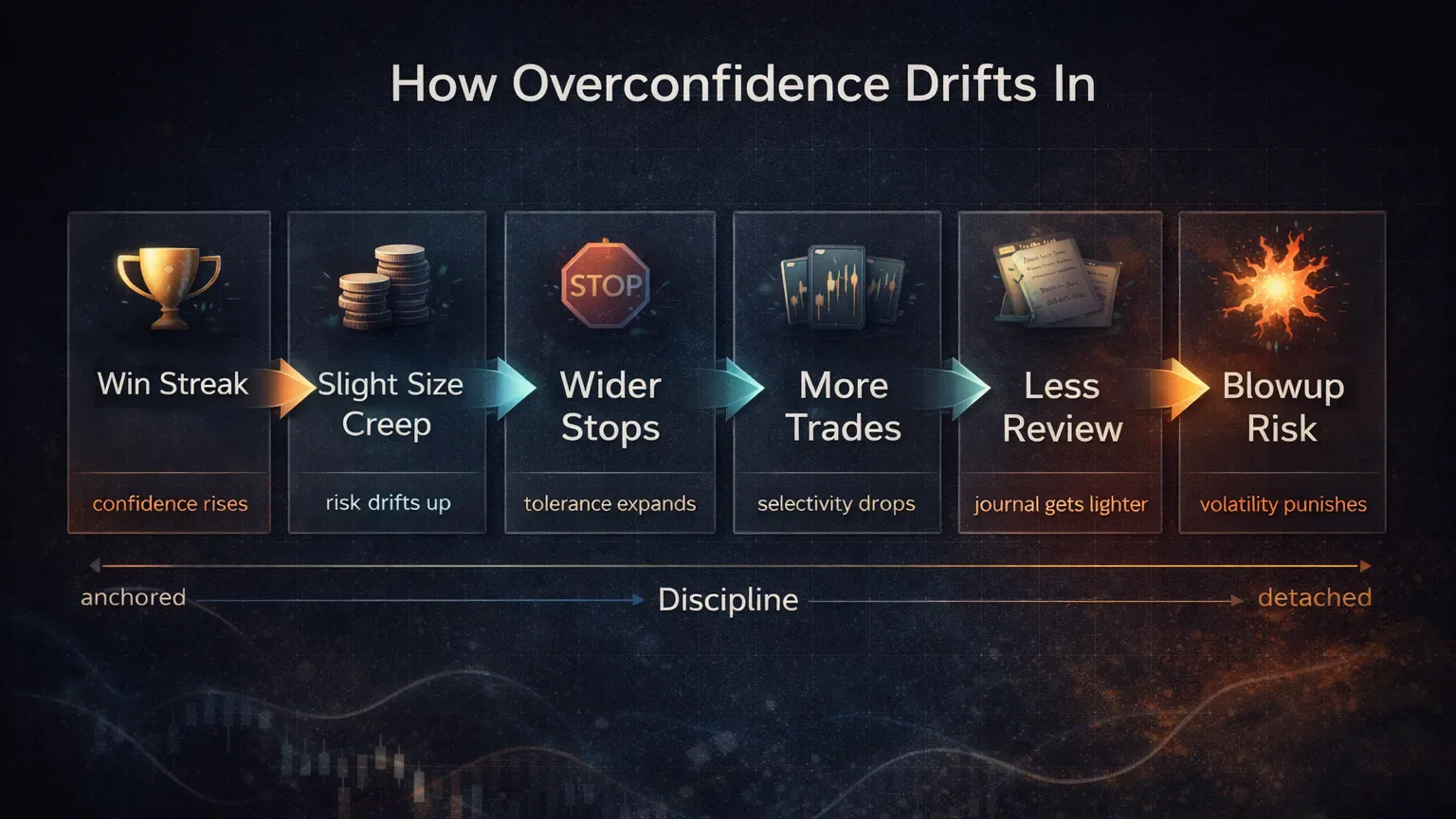
You also start trading more frequently. Instead of waiting for clean setups, you take “good enough” ones. Market chop that you would normally avoid suddenly looks tradeable. You enter faster. You journal less. Your edge did not change, but your discipline did.
Letting winners run is now less about structure and more about belief.
The psychological tone shifts too. You may notice phrases in your notes like “I knew it” or “I saw this coming.” You stop reviewing losses with curiosity. You explain them away. The market becomes something you expect to control.
And because crypto trades 24/7, the temptation never stops. There is always another opportunity. There is always another candle forming. That infinite market access makes overconfidence extremely expensive.
The problem is that overconfidence often works at first. You win bigger. You feel smarter. The streak continues.
Then the market regime shifts.
Volatility expands. Liquidity thins. A funding squeeze hits. A liquidation cascade runs through the order book faster than you expect. You are oversized. You hesitate to cut. The trade moves against you faster than your emotional state can adjust.
What would have been a normal red day becomes a serious drawdown.
And from the outside, it looks like “one bad trade.” Inside your journal though, the pattern usually started several days earlier.
Turning Your Journal Into a Confidence Detector
The difference between confidence and overconfidence is often invisible in real time. You only see it clearly when you review your journal. The truth shows up in patterns. Not in one trade, but across sequences of trades, usually after a winning stretch.
If you keep a detailed trading confidence journal, the first signal is usually position sizing drift. Your recorded risk per trade starts to creep upward. Maybe you normally risk 0.5% of account equity. After a streak, you start risking 0.7%, then 1%, then more. None of these jumps feel dramatic, but the trend is obvious in the data.
The second pattern is frequency. Winning streaks often lead to more trades per session. Your journal timeline shows days where you took twice as many trades as normal. Many of those trades are lower-quality setups: late entries, breakout chases, or forced scalps during chop. Your execution standards slipped, but only slightly at first.
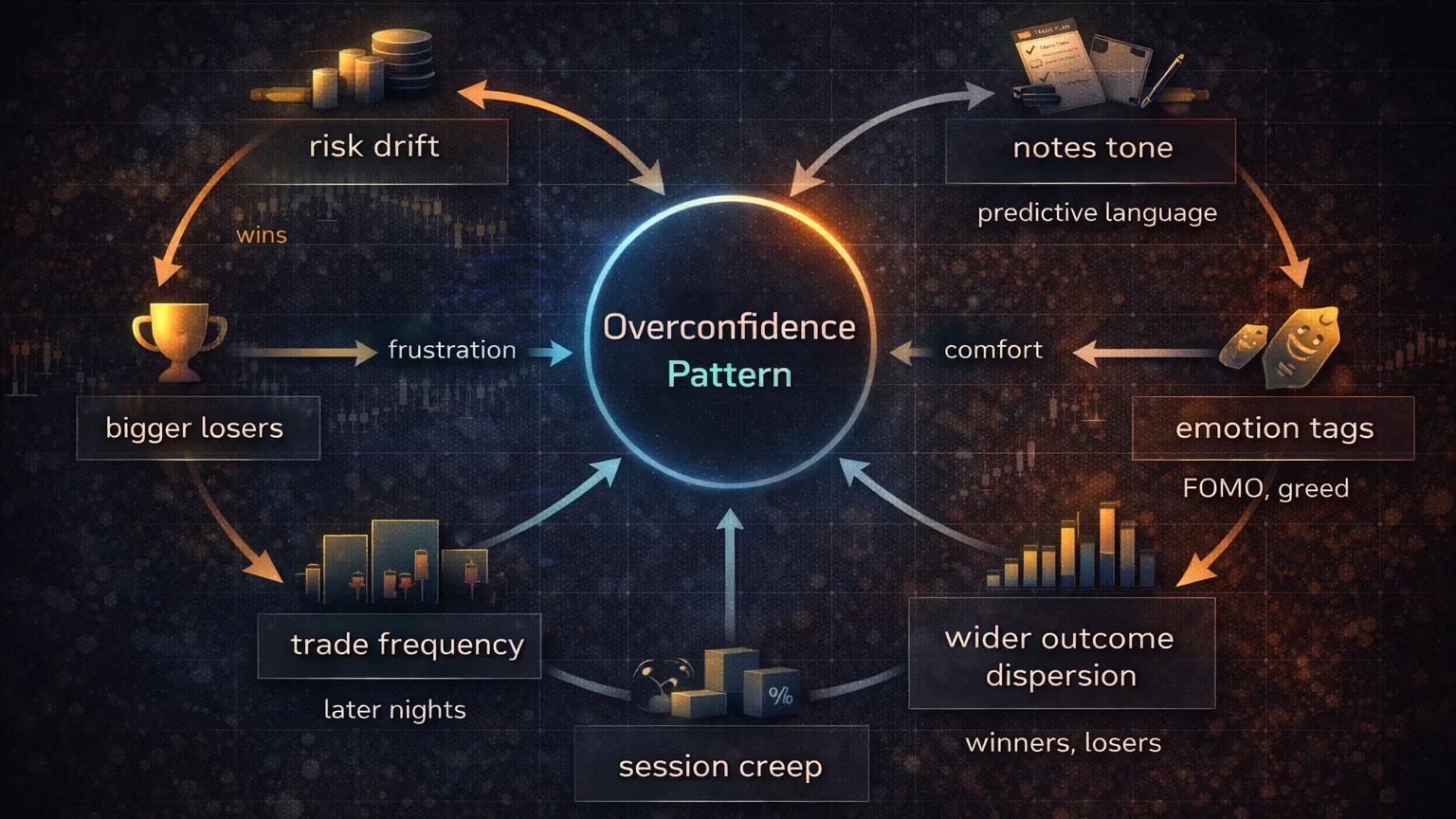
You may also see changes in your leverage usage. Especially on perpetual futures. On Binance or Bybit, leverage can creep higher as your confidence grows. The journal exposes that escalation even when the trades were still profitable. That matters, because risk exploded long before PnL turned negative.
Another major signal is outcome dispersion. Your winners become much larger, but your losers do too. The distribution widens. You start holding losers longer. You cut winners later. This shows up clearly in MAE and MFE metrics if your journal tracks them. The numbers reveal a trader who believes they can manage any situation.
Then there are the notes.
A trading journal captures psychology better than any metric. Review your own writing. Look at how your tone changes after a green streak. You may see slightly arrogant language. Or impatient language. Or emotional language. Confidence speaks in calm, structured terms: “Good entry, acceptable structure, risk controlled.” Overconfidence speaks in assumption-heavy terms: “Obvious rally,” “easy long,” “should have held more.”
Emotion and behavior tags tell the same story. You might see increases in FOMO, greed, overtrading, or revenge trading after wins, not losses. That is the paradox. Success becomes the trigger for poor execution.
Session behavior shifts too. Later nights. Longer sessions. More screen time. More reactive decisions.
Taken together, your trading confidence journal becomes a mirror. It shows when your mindset switched from respecting uncertainty to trying to control the market. Even if you were still profitable at the time.
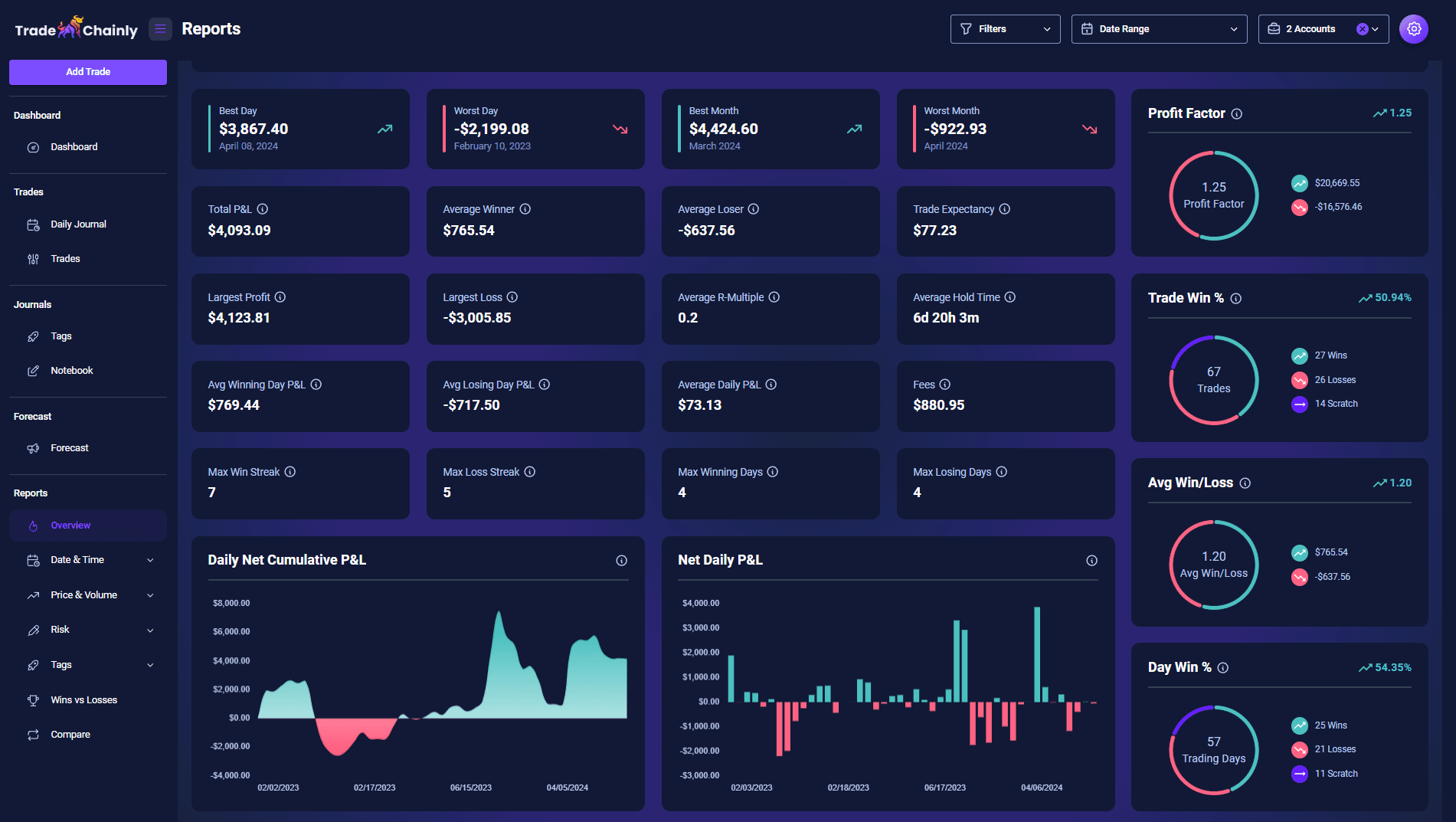
A crypto-only journal like TradeChainly makes these patterns easier to see because trades are synced automatically and tagging becomes part of your normal workflow. Review becomes consistent rather than optional. That consistency is what reveals the turning point before it becomes expensive.
Once you learn to read those signals, you stop seeing overconfidence as random. It becomes predictable. And predictable risk can be managed.
A Real Sequence From the Market
Let’s look at a realistic example.
A full-time crypto day trader is trading BTC and SOL perpetuals on Bybit. He has been consistent for a few months. Nothing spectacular. Just steady gains with controlled risk. Most trades risk around 0.5% of equity. He trades only during the London and early New York sessions. He logs everything in his trading journal, including emotions and trade logic.
Then he hits a streak.
Five winning days in a row. Clean reads. Strong momentum. Good trend structure. The journal shows a high execution score almost every day that week. Confidence is high, but still grounded.
Then the drift starts.
On day six, he increases size slightly. He tells himself it is rational scaling. Still profitable. Still feels controlled.
On day seven, he adds a few midday trades outside his normal session. That is new. He used to stop after his plan-based window. The trades are still green, so he doesn’t think twice.
His journal notes that he “saw the move forming” and “didn’t want to miss it.”
By day ten, the streak is large. He is up several R. Leverage is higher. Position sizing is inconsistent. He is entering faster and reviewing less. He stops tagging emotions because he feels fine.
Then the market changes.
BTC shifts into an unstable range with fake breakouts and liquidity sweeps. Funding flips neutral to positive. Open interest rises into resistance. Wick volatility picks up. This environment normally tells him to reduce size.
But he doesn’t.
He enters a breakout continuation trade with more size than usual. The trade goes green at first, then snaps back hard. He hesitates to cut. He believes the trend will resume. It doesn’t. The move accelerates into a liquidation cascade. Slippage increases. The loss is larger than any previous loss in his journal.
One trade erases six trading days of gains.
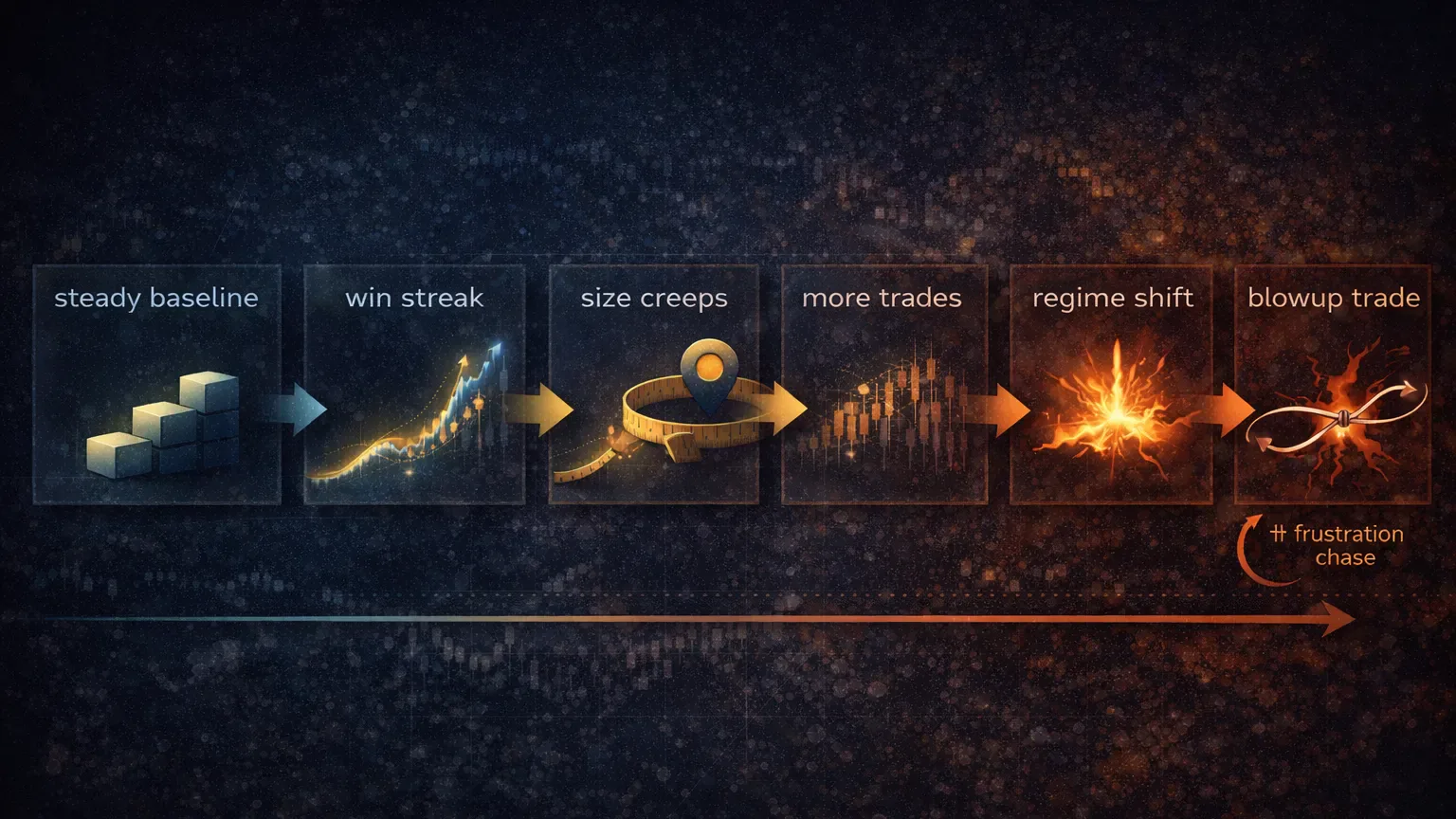
The next day, frustration kicks in. He tries to make it back. Execution quality falls further. The drawdown deepens.
When he finally stops and reviews his trading journal, the pattern is obvious. The psychological shift began when he was still winning. The data shows an increase in risk per trade, more trading hours, more frequency, more conviction-driven entries, fewer structured notes.
He was not “unlucky.” He was overconfident.
And the journal revealed it after the fact.
The real lesson is that this did not need to become a deep drawdown. If he had been reviewing weekly instead of only after disaster, he would have seen the warning signs long before the blowup trade.
Building a Weekly Confidence Self-Audit
Knowing the theory is one thing. Catching yourself drifting into overconfidence in real time is something else entirely. A structured self-audit helps. The goal is straightforward: review your journal regularly and look for small changes before they turn into large consequences.
Think of this as a weekly calibration ritual rather than a punishment review.
Start with risk stability. Ask yourself one question: is my position sizing consistent with my plan? If your risk per trade has crept up without a predefined rule, that is a yellow flag. If risk now changes based on how confident you “feel” about a setup, that is a red flag.
Next, review trade frequency. Compare this week to your baseline. Are you taking more trades than usual? Are more of them reactive compared to planned setups? If your number of trades per session increases while your selectivity decreases, confidence is drifting into impulse.
Session discipline is another key signal. If you normally trade certain hours but suddenly expand into late nights, weekends, or fatigue windows, your journal should capture that shift. Confidence respects constraints. Overconfidence ignores them.
Then evaluate your notes. Read the language, not just the metrics. Do you still describe structure and risk, or do your entries sound predictive and certain? If your journal becomes lighter, less reflective, or more ego-driven, you are moving away from process.
Now look at emotional tags. If your journal allows you to track states like FOMO, greed, tilt, fear, confidence, and hesitation, study when those tags increase. Many traders assume these emotions follow losing streaks. In reality, they often ramp up after strong wins.
Finally, review outcomes through distribution, not just totals. If your winners are getting much bigger and your losers are expanding too, that often means you are holding both sides longer. That widening distribution is a signal that conviction is replacing structure.
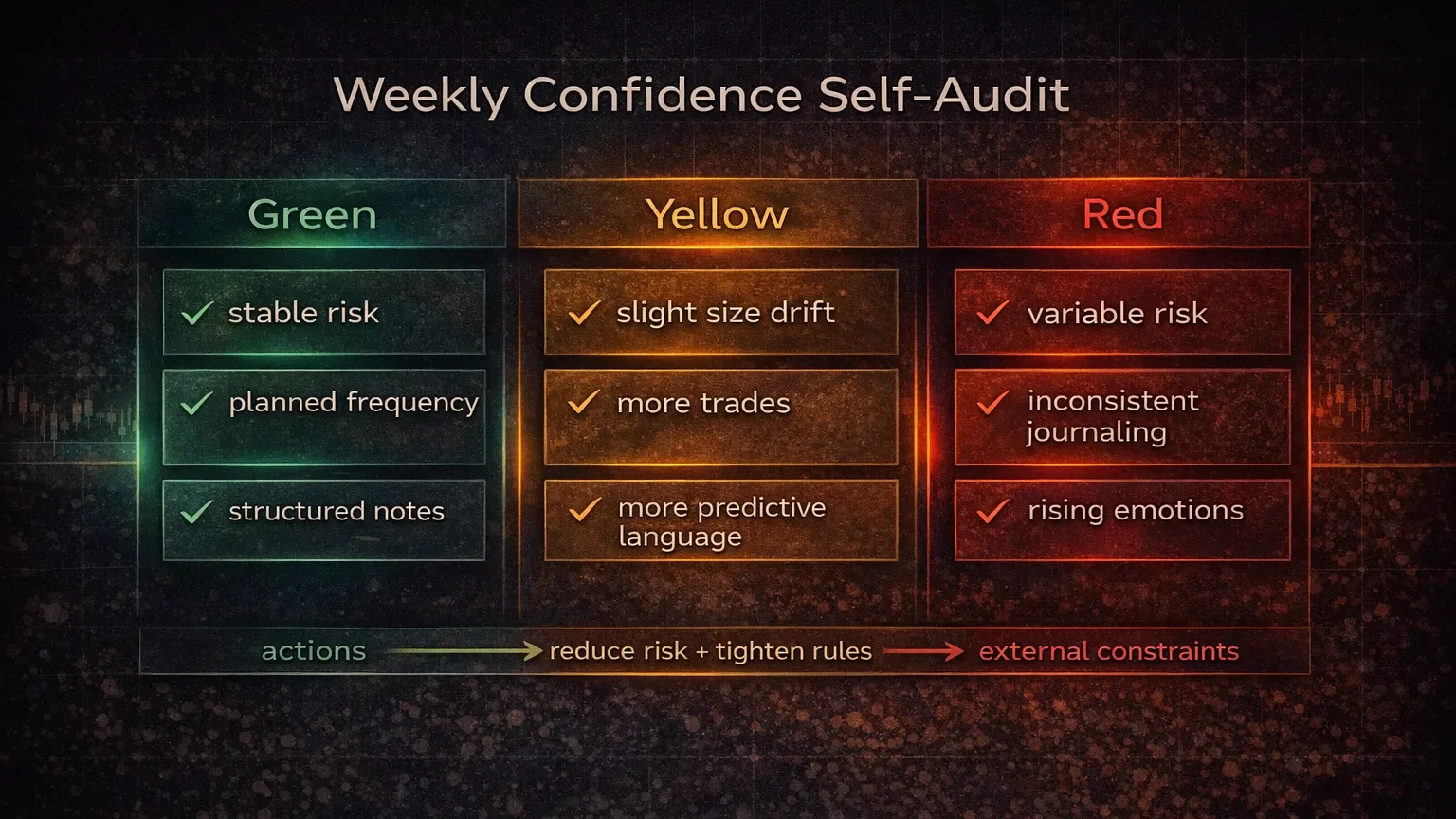
You can simplify all of this using a traffic-light model.
Green means your risk, frequency, and mindset remain stable. You are confident because your process is steady.
Yellow means drift. Slightly bigger size. Slightly more trades. Slightly more predictive language in your notes. This is where awareness fixes the problem.
Red means ego-driven execution. Risk is variable. Journaling is inconsistent. Emotions are rising. This is where external constraints become necessary until discipline returns.
The point is not to eliminate confidence. You need it to trade. The goal is to make sure your confidence stays attached to your process instead of your ego.
Turning Insights Into Stable Execution
Awareness only matters if it changes behavior. Once your trading confidence journal reveals that you are drifting toward overconfidence, the next step is to bring your execution back to its stable baseline. The goal is not to punish yourself. It is simply to remove unnecessary risk until your mindset realigns with your process.
Start with a temporary size reduction. Even if your edge is still valid, cutting risk per trade lowers emotional pressure and stops ego from running the show. Many professional traders have a rule where risk automatically decreases after strong winning streaks, not just after drawdowns. That rule protects them from themselves.
Next, tighten your execution structure. Define when you trade, how you trade, and what conditions you require. If you drifted into nonstop trading across sessions, go back to your original trading windows. Reduce noise exposure. Let boredom return. Discipline often follows.
Make journaling non-negotiable again. Record every trade. Record your reasoning. Record your state of mind. The act of writing forces awareness. When you skip the journal, you remove the only mirror that reflects your mindset accurately.
Use tags intentionally. Label mistakes and emotional drivers honestly. If greed, FOMO, impulsive entries, or thesis attachment are increasing, acknowledge them instead of rationalizing them. Awareness is what brings you back to neutral.
Then zoom out and review your statistics. Look at your win rate, average R, MAE, and MFE. Look at behavior before and after win streaks. The more data you study, the harder it becomes to believe your ego’s story about control.
Tools help here. A crypto-focused journaling platform like TradeChainly makes this process much easier because trade import, tagging, and review become part of your natural routine instead of extra work. When review friction drops, reflection becomes consistent. Consistency builds maturity.
Over time, you develop a new type of confidence. Not “I am right.” More like “I know what I will do in any situation.” That stability is what keeps you alive through liquidation cascades, weekend liquidity traps, regime shifts, and hype cycles.
Confidence supported by structure compounds. Overconfidence collapses.
Your journal is what keeps you on the right side of that line.

Confidence Built on Data, Not Ego
Confidence is not the problem. You need confidence to survive as a crypto day trader. You need it when the market rips through levels. You need it when liquidation cascades hit. You need it when you take three losses in a row and still follow your plan on the fourth trade.
The real danger is when confidence detaches from process and attaches to ego.
That shift rarely shows up in a single moment. It develops slowly through streaks of success. Risk drifts higher. Selectivity weakens. Emotional ownership of outcomes increases. Then one oversized trade collides with crypto volatility and the account pays the price.
Your trading confidence journal is what keeps that from happening.
It shows you when your mindset is anchored, and when it begins to drift. It exposes the small changes in position size, leverage, frequency, language, and emotional tone that you often miss while trading in real time. It lets you correct course early instead of reacting after damage is done.
Over the long run, the traders who last are not the ones who always believe they are right. They are the ones who respect uncertainty, measure behavior honestly, and build routines that keep their ego in check.
If you want to do this well, use a journal you can maintain consistently. TradeChainly is built specifically for crypto traders, so your trades sync automatically and tagging becomes part of your normal workflow. That makes reflection far easier to sustain.
Confidence supported by data becomes a strength. Confidence driven by ego becomes a liability.
So what does your journal say about you after your last winning streak?