Why Most Traders Forget the Day and Stay Stuck
Most traders think they will remember what happened during the trading day. You tell yourself you will recall why you sized up on that breakout, why you hesitated on that Bybit short, or why you ignored your stop on ETH futures. But once the day is over, the details fade. All that remains is the P&L. Green feels good. Red feels painful. The lesson gets lost.
That is where daily trading journal notes come in. They force you to slow down and actually look at how you behaved in the market. Not just the entries and exits, but the mindset behind them. The level of discipline. The emotional drivers. The risk decisions you made in real time.
When you add notes consistently, you begin to see patterns. Maybe you trade better early in the London session. Maybe you take impulsive revenge trades after your first loss. Maybe your best results happen when you strictly follow your plan on BTC, but your worst days come from random scalps on altcoins. You would never see this clearly without journaling.
TradeChainly makes this process simple. Inside the Daily Journal page, each day already has your trades, metrics, and performance summarized for you. All you need to do is add your reflections. No spreadsheets. No manual logging. Just honest feedback with data to support it.
If you take daily notes seriously, they will become one of the highest ROI habits in your trading. Not because they magically make you profitable overnight, but because they help you understand yourself as a trader. And improvement always starts with awareness.
Why Daily Notes Matter More Than You Think
Most traders believe their decisions are logical. You look at the chart, you see the setup, you execute. But trading rarely happens in a neutral state of mind. You are influenced by fear, greed, confidence, stress, boredom, or the pressure to make back losses. In crypto, this effect is even stronger because the market never sleeps. There is always another candle forming, another move happening on Binance or Bybit, and another reason to jump back in.
Your brain does not record events accurately when emotions are involved. It rewrites the story later to protect your ego. A losing trade becomes “unlucky.” A winning scalp becomes “skill.” Over time, you forget the small decisions that actually shaped the outcome. This is why so many traders repeat the same mistakes for months or even years.
Daily trading journal notes break that cycle. They capture what really happened on the day it happened. You record the truth before it fades or gets edited in your memory. Over time, these notes turn into a mirror. You do not just see your strategy. You see your habits, reactions, and tendencies.
Crypto trading magnifies small weaknesses. Leverage punishes hesitation or overconfidence. Funding rates and sudden moves test your patience. When the environment is this intense, your psychological edge matters just as much as your technical edge.
TradeChainly helps you track all of this without friction. Your trades, fees, P&L, and win rate are already organized on the Daily Journal page. When you add your daily notes on top, you are no longer guessing about why your performance changes. You can actually connect decisions to outcomes.
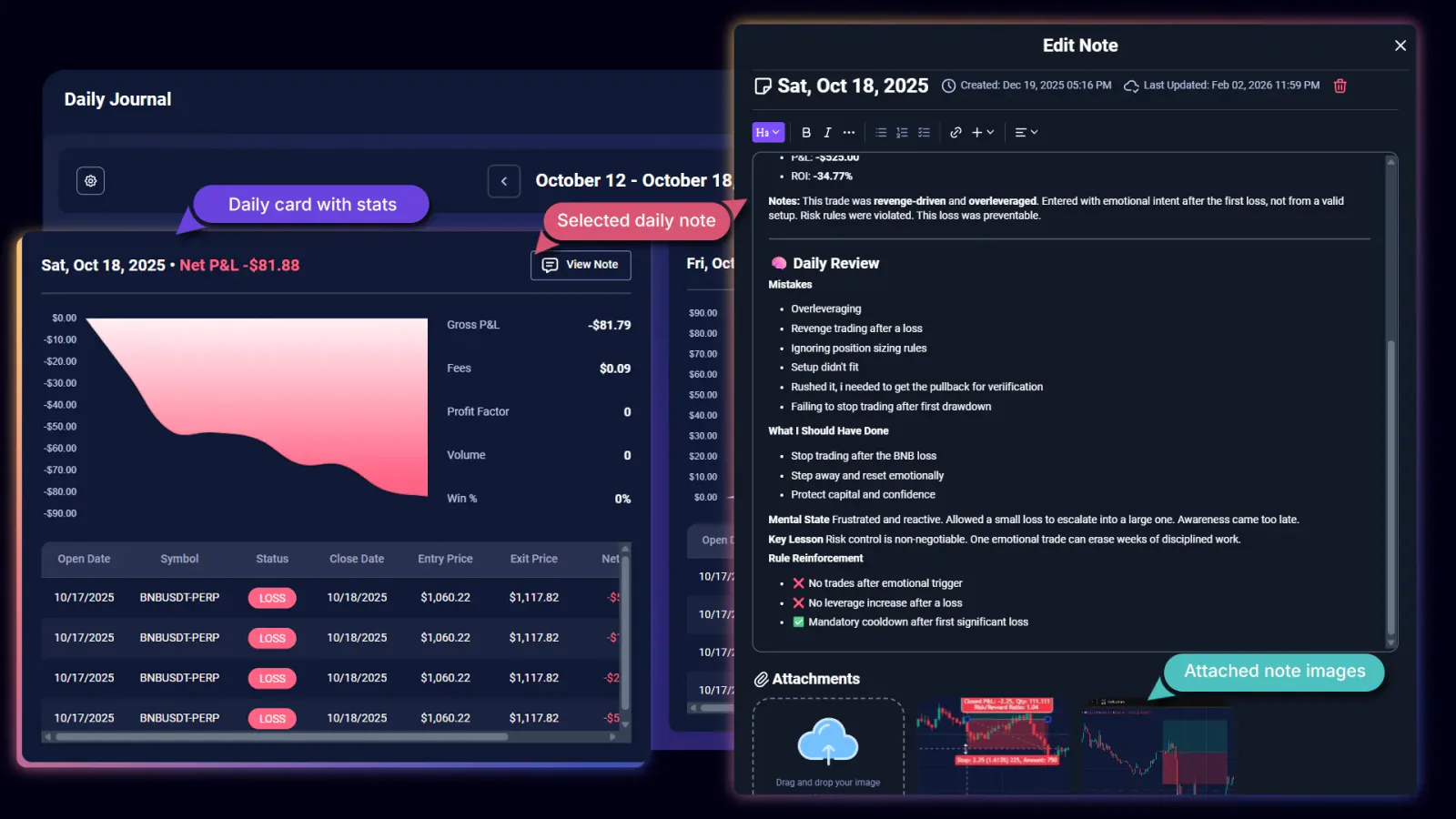
That is when awareness turns into improvement. You start noticing that chasing breakouts late in the move hurts your consistency. Or that trading when tired leads to sloppy execution. Or that revenge trading quietly erases your best days.
Daily notes do not judge you. They simply reveal the truth about how you trade. And once you see the truth clearly, you can finally start making better decisions.
What to Capture in Your Daily Trading Notes
A lot of traders overcomplicate journaling. They either write nothing at all, or they write long emotional essays that don’t actually help them improve. The goal of daily trading notes is simple. Capture the key details that explain how you traded, why you made certain decisions, and what you learned from the day.
Here is what matters most.
Start with the market conditions you traded. Was Bitcoin trending or chopping? Were altcoins following BTC or trading independently? Did volatility expand or contract? Context matters, because the same setup can perform very differently in different conditions.
Then write honestly about your mental state. Did you feel calm and focused? Or stressed, impatient, distracted, or tilted after an early loss? Your emotions often explain your execution quality more than the chart does.
Risk behavior is another big one. Did you respect your stop? Did you size up randomly on a “feeling”? Did you hold losers too long or take profits early out of fear? These are patterns that quietly control your results.
You should also reflect on execution discipline. Did you follow your plan? Did you wait for confirmation? Or did you chase moves because you felt like you were missing out? Crypto scalping especially punishes impatience. Writing this down keeps you accountable.
Finally, capture the main lesson of the day. Keep it practical and simple. Something you can actually apply tomorrow.
Inside TradeChainly, this becomes very natural. Each day in the Daily Journal already shows you:
- Net P&L
- Gross P&L
- Win rate
- Profit factor
- Fees
- Volume
- All trades from that day inside the same view
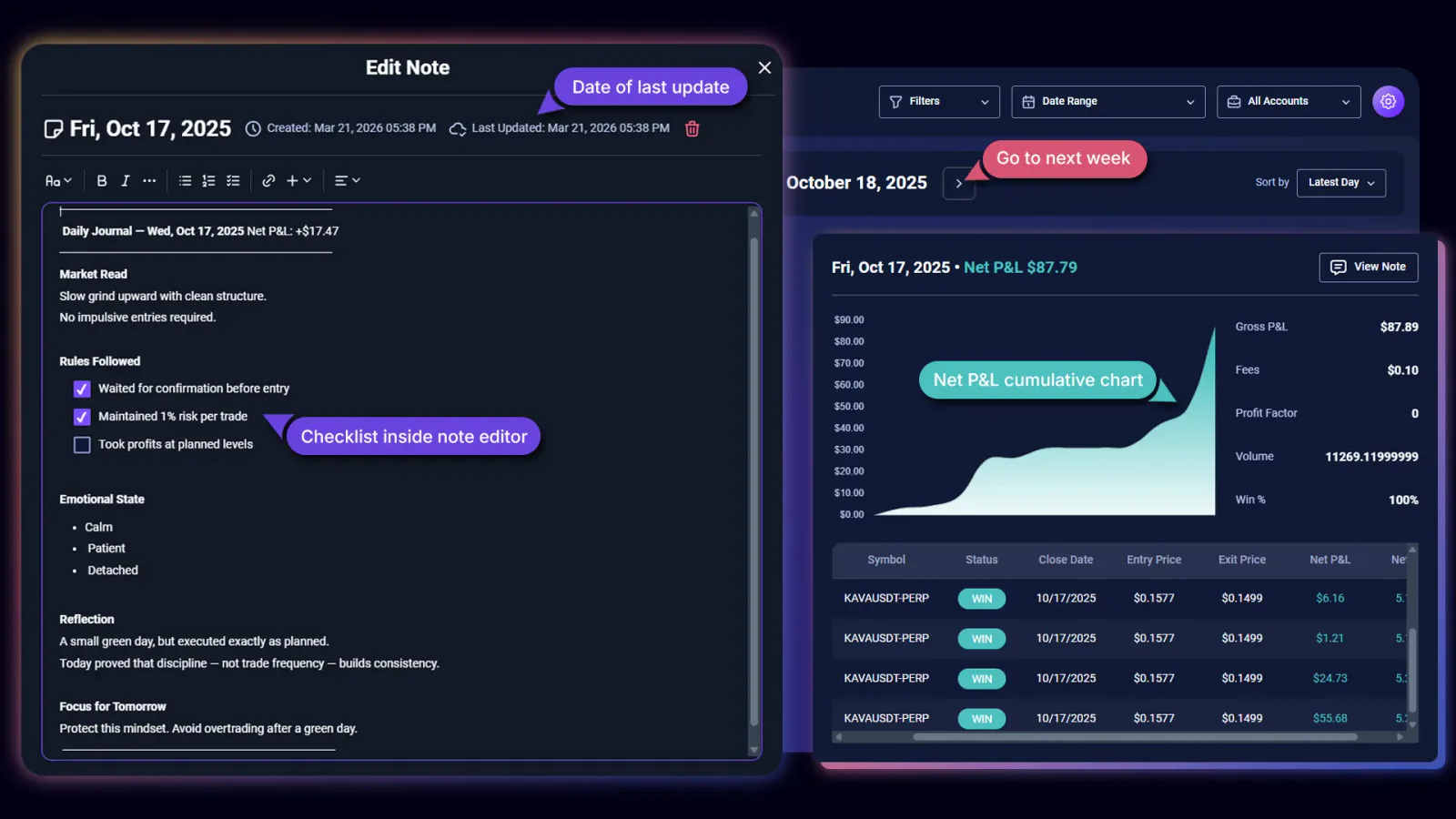
So instead of trying to remember what happened, you are reviewing the day with real data in front of you. Then you just add your reflections beside it.
A simple note structure that works well looks like this:
- What went right
- What went wrong
- What I will do differently tomorrow
You are not trying to sound smart. You are simply telling the truth.
Over time these notes help you see repeating themes. Maybe you notice that you perform best when you sleep well. Or that most big losses come from boredom trades. Or that your best trades happen when BTC is trending cleanly.
Those insights are what journaling is really about. Clarity, self awareness, and continuous improvement. TradeChainly gives you the structure so you can focus on the thinking, not the admin work.
Inside TradeChainly’s Daily Journal (Feature Walkthrough)
A lot of traders like the idea of journaling, but they quit because the process feels slow and manual. Copying trades. Formatting spreadsheets. Trying to line up notes with performance. It becomes work instead of a tool for improvement.
TradeChainly was built to remove that friction. The Daily Journal page gives you a clean, organized view of your trading days so you can review performance and write notes without wasting time on admin.
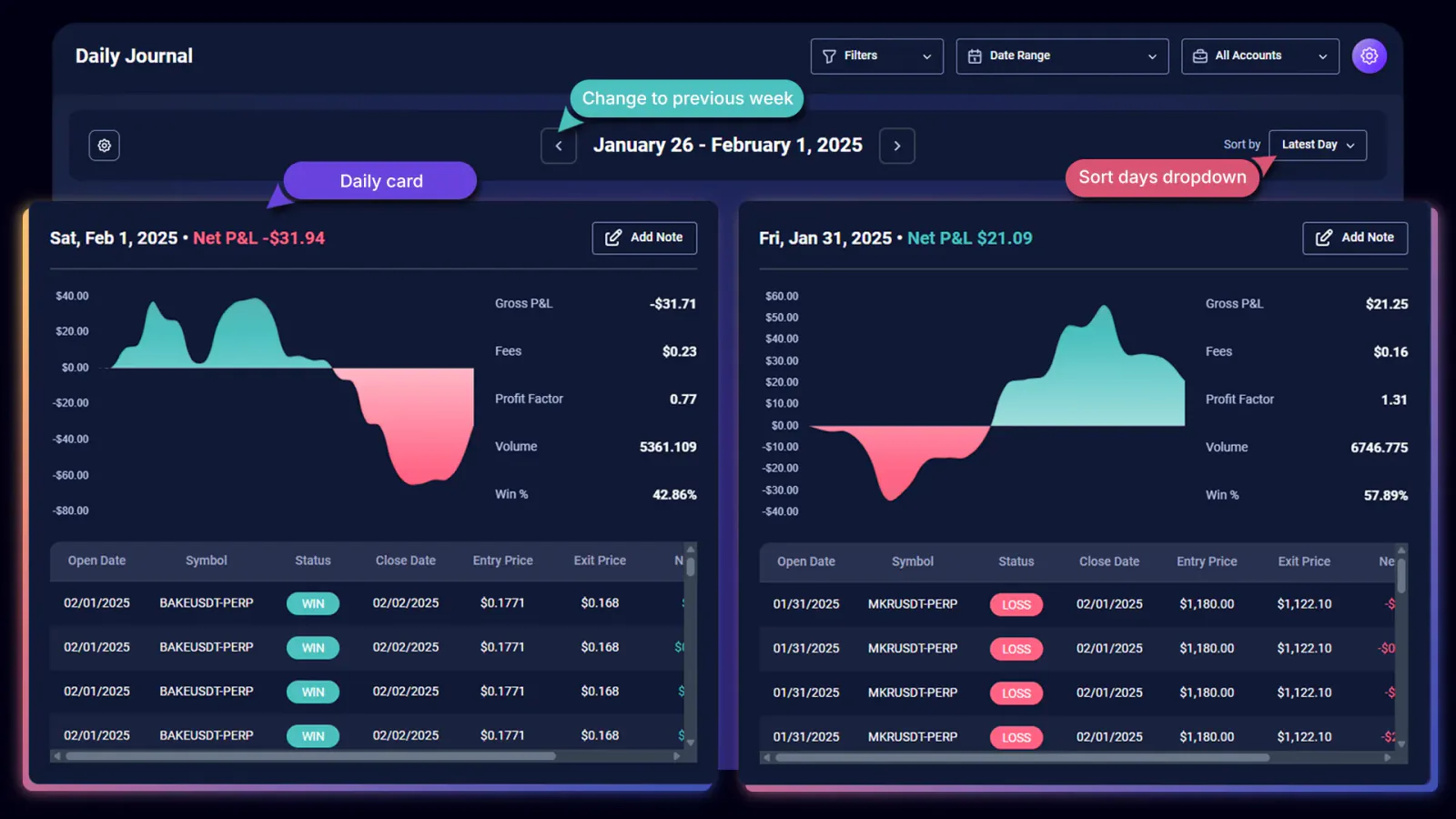
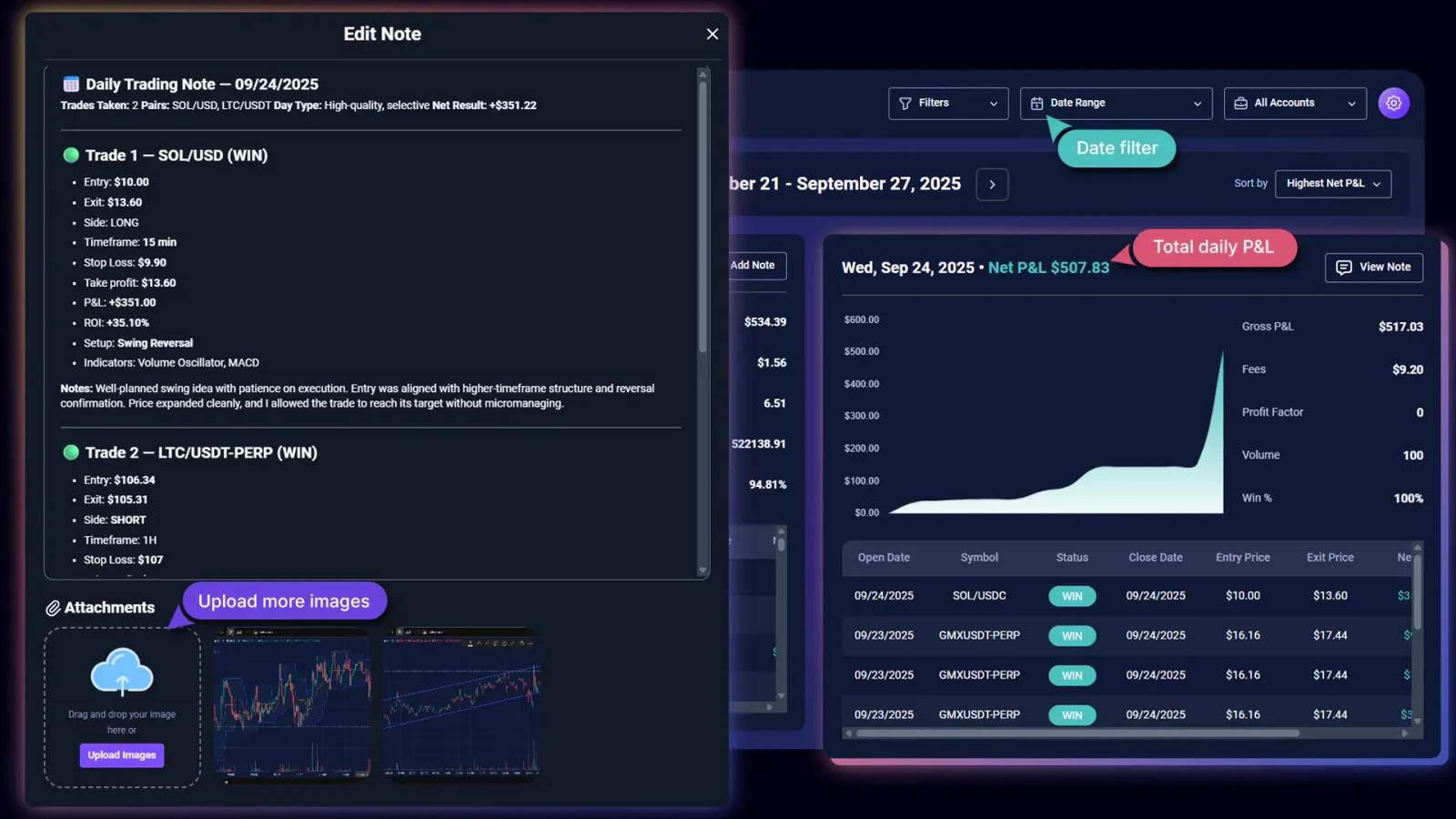
When you open the Daily Journal, you see your trading week laid out for you. Each day is shown as its own card. You can move forward and backward through weeks, so it is easy to review your recent trading history or look back months later.
Each daily card already includes the key stats you care about:
- Net P&L
- Gross P&L
- Fees
- Profit Factor
- Win %
- Volume
You are not guessing how the day went. You see it objectively in numbers.
Below that, the full trade list for that day is displayed. Every entry, exit, and position is grouped automatically. You can even customize which columns you want to see in the table. If you care about entry price, trade side, size, ROI, or fees, you can choose to display it. If you want a cleaner view, you can hide the noise.
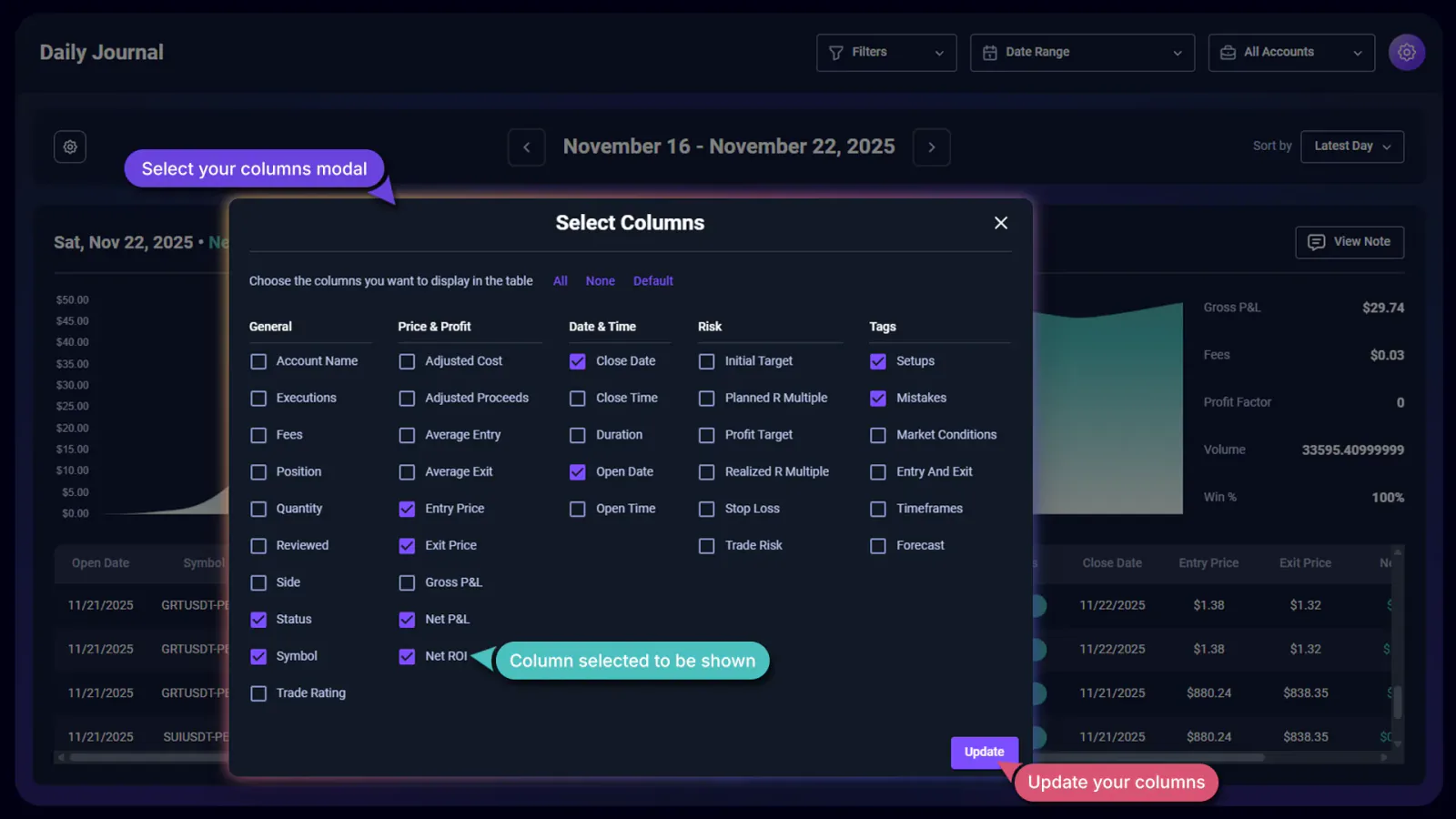
This makes daily reflection much easier. For example, you might see that most of your losing trades happened during low volume chop. Or that your best trades were early in the session. Or that you paid more in fees than you expected on high-frequency scalps.
Right beside all of this data is where your daily notes live.
You simply click into the day and add your reflection. No separate app. No clutter. Your thoughts sit next to your performance, which means you always have context.
Another powerful feature is sorting. TradeChainly lets you sort the days in a week by:
- Highest net P&L
- Lowest net P&L
- Highest win %
- Lowest win %
- Earliest day
- Latest day
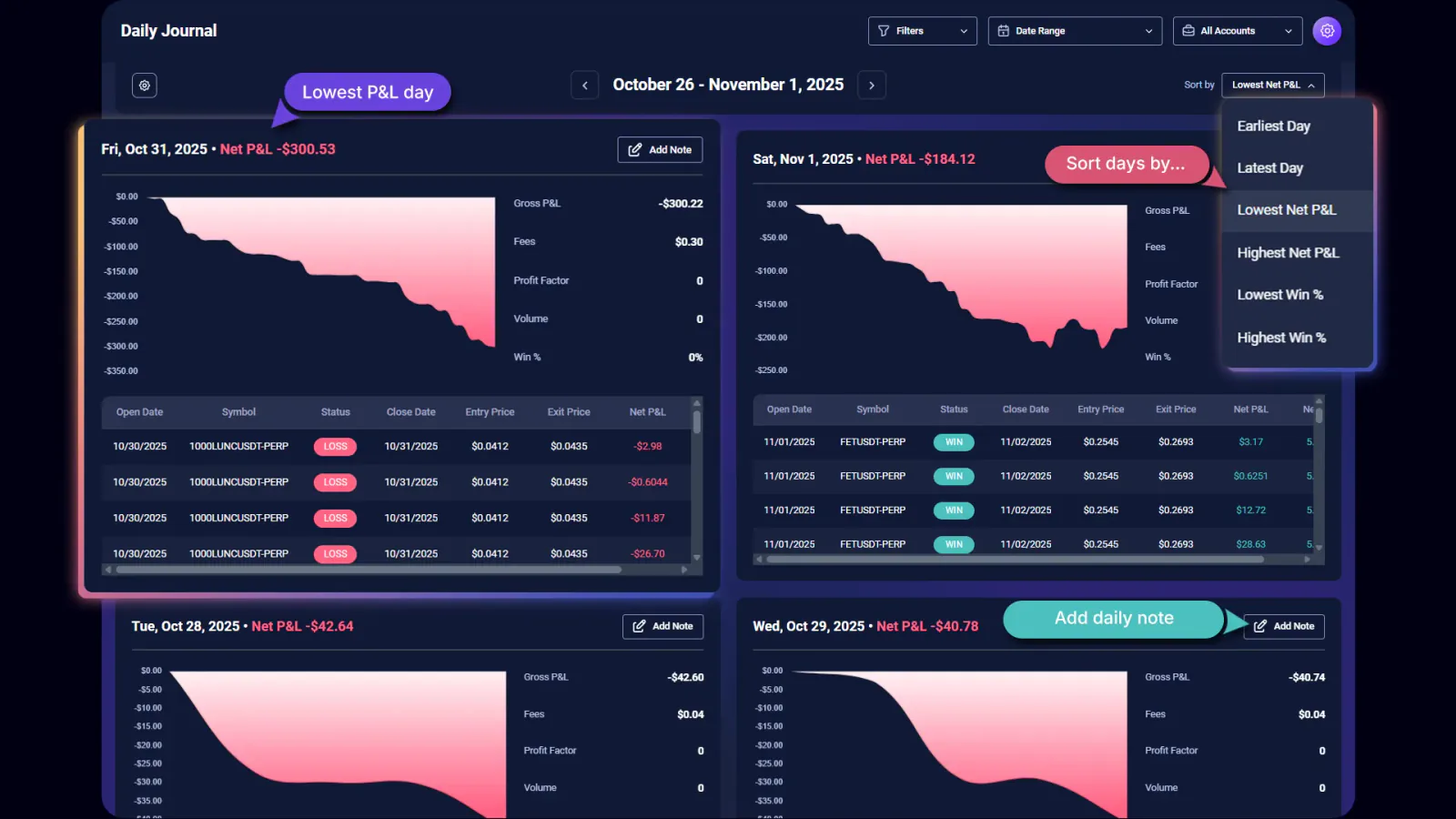
This sounds simple, but it changes how you review performance. You can quickly line up your best and worst days and compare your notes. You may notice that your highest P&L day happened when you were patient and followed your rules. Your largest losing day may show clear signs of emotional trading.
Because everything is structured and connected, your journal becomes more than a diary. It turns into a professional trading review process. You are not guessing what happened. You are analyzing your behavior with real data supporting your reflection.
And since TradeChainly supports major exchanges like Binance, Bybit, Coinbase, Kraken, KuCoin, Crypto.com, and OKX, your trades import automatically. That means journaling becomes something you can actually stick with long term.
The easier the process, the more consistent you will be. And consistency in journaling leads directly to consistency in trading.
Building a Repeatable End-of-Day Review Routine
The real power of daily trading notes comes from repetition. One great review session will not change your trading. But a simple routine that you follow every trading day can slowly reshape your habits, discipline, and awareness.
A good end-of-day review does not need to take more than 10 to 15 minutes. The goal is not to overthink every tick on the chart. The goal is to understand how you behaved as a trader and how that behavior affected your results.
Here is a simple routine that works well for crypto day traders and scalpers.
Start by reviewing your trades inside TradeChainly. Open the Daily Journal and look at the trades you executed that day. Notice the entries, exits, and sequence of decisions. Pay attention to whether the setups actually aligned with your trading plan, or whether you drifted into random trades.
Then review the key metrics for the day. Look at your Net P&L, Gross P&L, win rate, and Profit Factor. These numbers tell the truth about execution quality. You may feel like you traded well, but the data will show whether that feeling matches reality.
Next, reflect on your mindset. Did you feel pressure to make money today? Did you chase after missing a move? Did leverage make you nervous? Crypto markets move fast, which means emotions can escalate quickly. Your notes should capture this honestly.
After that, write down one clear improvement for tomorrow. Keep it specific and realistic. Something like:
- “Only trade BTC and ETH tomorrow.”
- “Wait for confirmation before entering.”
- “Respect my stop size.”
One improvement per day compounds over time.
Finally, end with a short summary of the day. A few sentences are enough. The goal is to close the trading session mentally, instead of carrying it with you into the evening.
TradeChainly makes this review flow natural. Your trades, stats, and notes all live in one place. You do not need to hunt for screenshots or exports. You simply open the journal, review the data, and write your reflection.
If you stay consistent with this, something interesting happens. You begin trading with more intention. You make decisions knowing that you will later review and write about them. That extra layer of accountability often reduces impulsive behavior.
Small daily improvements eventually become big changes. That is the foundation of long-term trading performance.
Turning Notes Into Performance Insights
Writing daily trading notes is only half of the process. The real value comes when you go back and read them. That is when patterns start to reveal themselves. You begin to see the connection between your mindset, your decisions, and your results.
Most traders only review charts and P&L. Very few review their own behavior. But behavior is what drives outcomes. If you only look at numbers, you miss the story behind them.
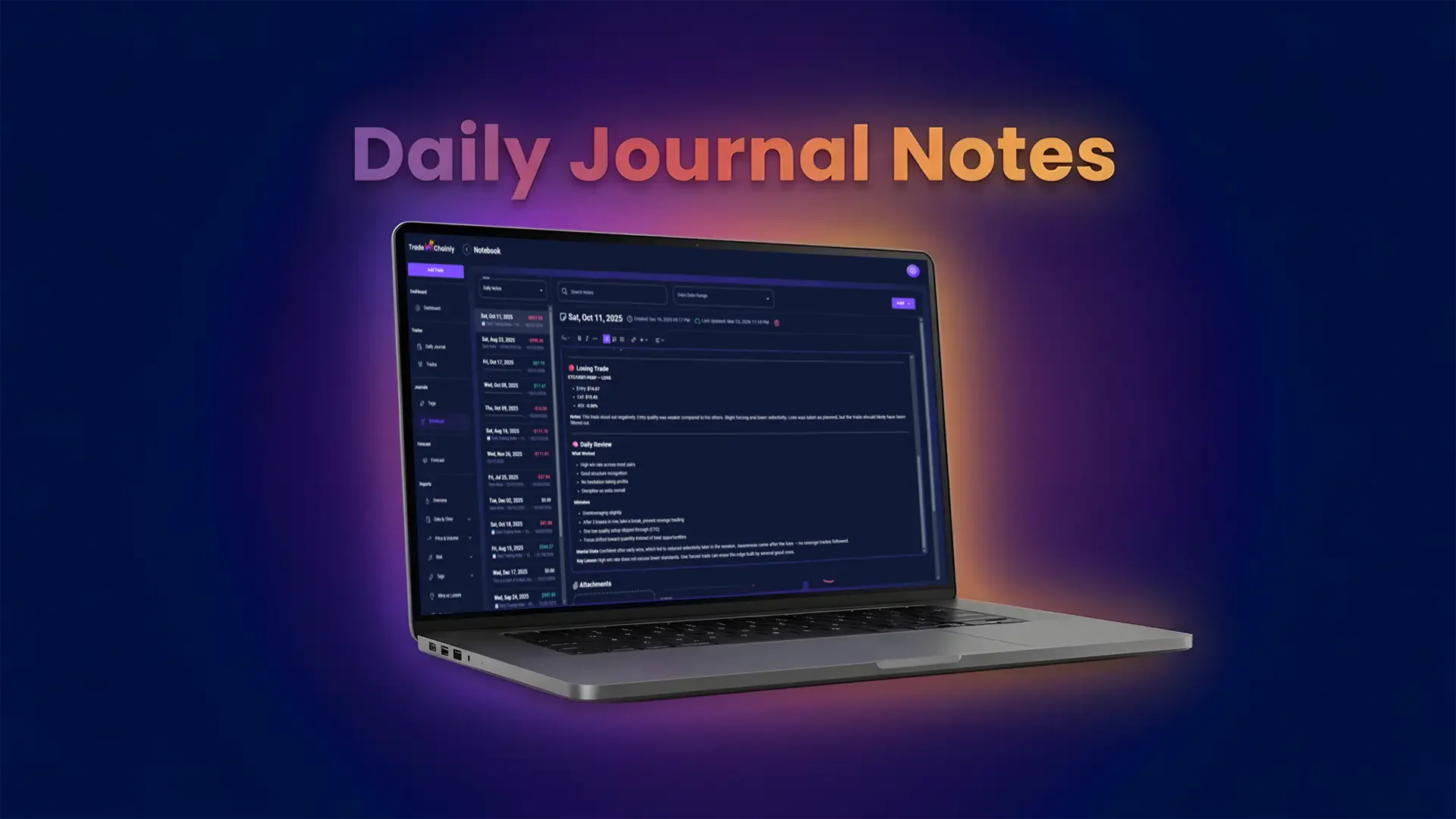
Inside TradeChainly, your daily notes sit right alongside your metrics. This makes it easy to reconnect what you wrote with what actually happened in your performance. You can scroll through previous weeks and quickly notice recurring themes.
Maybe you see that your losing days often include words like “rushed,” “forced,” or “overconfident.” Or that your best days mention “patient,” “focused,” or “followed plan.” Those words matter. They describe how you showed up mentally.
You can also cross reference your notes with specific stats. If your win rate drops sharply for a few days, reading your notes often reveals why. Maybe you were distracted by life stress. Maybe you tried trading new altcoins you were not familiar with. Maybe you increased leverage without adjusting risk.
Patterns like these quietly shape your trading career. Once you become aware of them, you have the power to change them.
TradeChainly’s tagging system makes this even more powerful. When you tag trades for setups, mistakes, or emotions, you are building another layer of insight. Your notes show the story. Your tags show the data. Together they paint a complete picture.
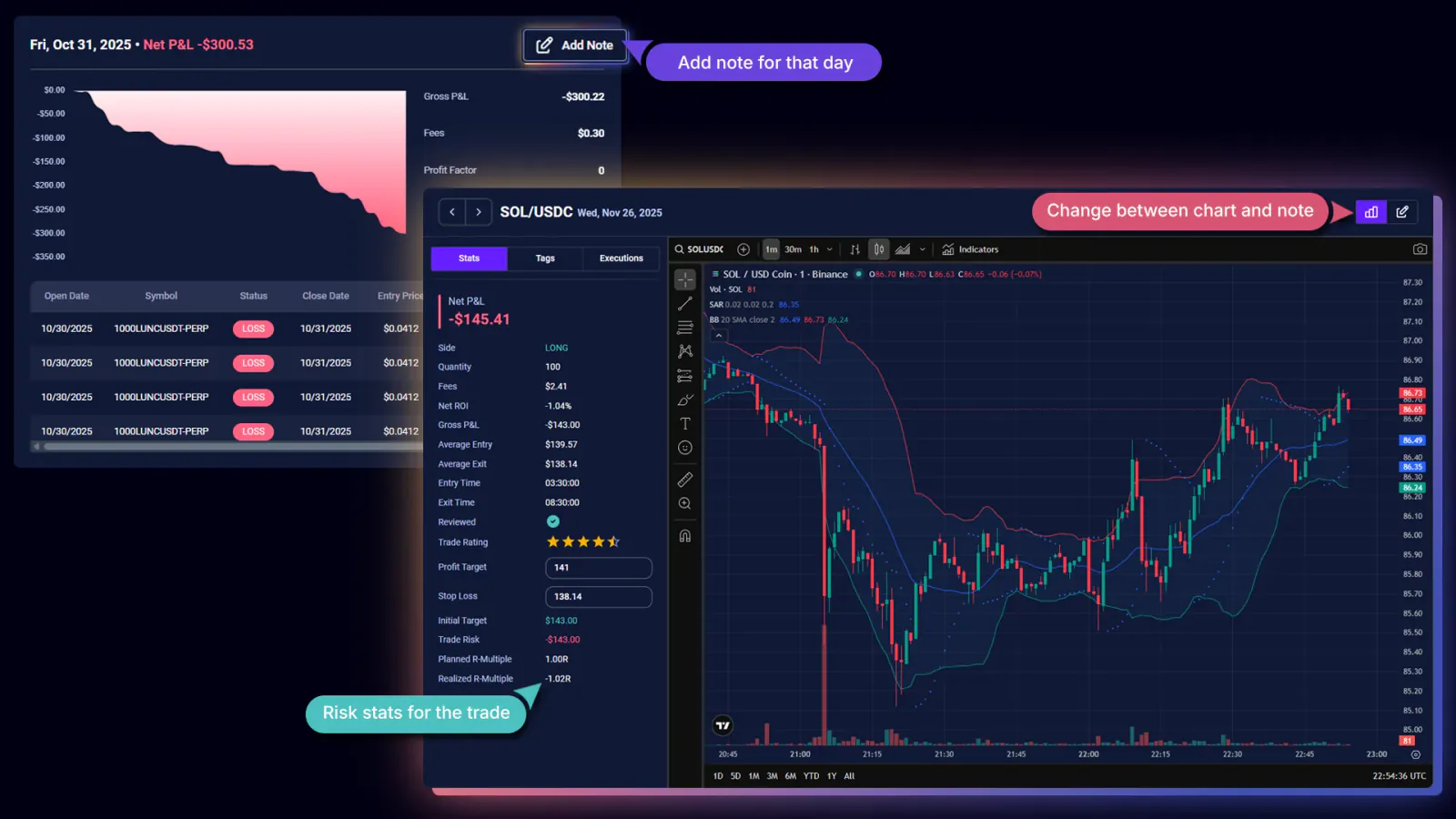
For example, you may discover that most of your losing days include the “revenge trading” mistake tag. Or that your best periods align with a specific setup you trade well. This is how traders move from randomness to structured improvement.
Over time, your journal becomes a database of your trading behavior. Not just trades, but thought patterns. Not just outcomes, but causes. This level of self awareness is rare, and it is one of the biggest advantages you can build.
If you treat your notes like a real performance tool instead of a school assignment, they will repay you many times over. Because they help you answer the most important question in trading:
“How do I really trade when money is on the line?”
And when you know that, you can finally start improving with clarity instead of guesswork.
Common Mistakes Traders Make With Journaling
Even traders who start journaling with good intentions often fall into habits that limit the value of their notes. If you know these mistakes ahead of time, you can avoid them and get far more out of your daily reviews.
One common mistake is only writing notes when you have a losing day. This turns journaling into a punishment instead of a tool. You miss half the story, because your winning days often reveal just as much about your behavior. Sometimes profits hide bad habits that will hurt you later. Consistency comes from reviewing both sides.
Another mistake is being too vague. Writing things like “Trade better” or “Be more disciplined” might feel productive, but it does not give you anything actionable to work with. Your notes should be specific. Describe what you did, how you felt, and what you will change next time.
Some traders go to the opposite extreme and over-analyze everything. They write paragraphs of emotional commentary that make it hard to identify the actual lesson. Keep your notes honest, but simple. The goal is clarity, not drama.
A subtle mistake is never reviewing past notes. If you only write but never read them, you miss out on the pattern recognition that truly improves performance. The value of journaling increases over time. That is when you begin to see the repeating behaviors that shape your results.
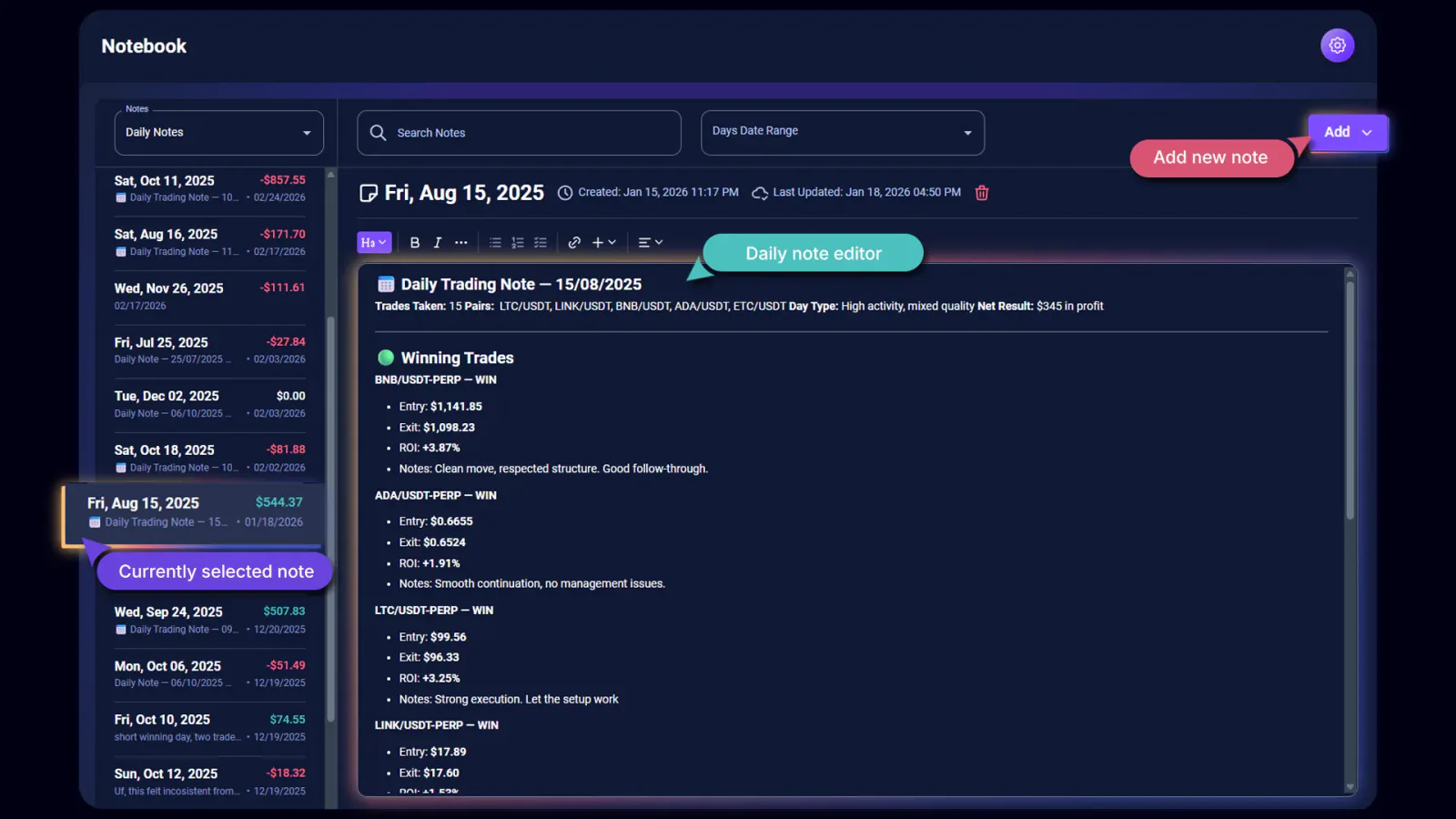
Another issue is treating journaling as something optional. You only do it when you feel like it. But the whole point is to build consistency. Trading rewards routine. TradeChainly is designed to make daily notes easy so you have fewer excuses to skip them.
Finally, some traders try to shortcut the process by logging only P&L and stats without real reflection. Numbers tell you what happened. Notes explain why it happened. You need both if you want to grow.
If you can avoid these common traps, your journal becomes a massive edge. TradeChainly gives you the structure. Your honesty and consistency do the rest.
Realistic Example: A Crypto Scalper Using Daily Notes
Sometimes the easiest way to understand the value of journaling is to see how it looks in real life. So let’s walk through a simple example of a crypto scalper using TradeChainly to track daily notes.
Imagine a trader who scalps BTC and ETH perpetuals on Binance. He trades during the London and early New York session, usually taking several small trades per day. Some days he does well. Other days he gives back profits because he gets impatient or emotional.
Before using TradeChainly, he kept everything in his head. He judged his performance based on whether the day was green or red. If he made money, he assumed he traded well. If he lost money, he blamed the market. There was no real review process.
Once he started using TradeChainly, that changed.
Now each day automatically appears inside the Daily Journal. His trades import, the P&L is calculated, and his performance metrics are summarized by day. Instead of guessing, he sees the truth clearly in front of him.
On a winning day, his notes might look like this:
“What went right: waited for clean trend continuation on BTC. Took only three trades. Followed plan. Stayed calm and patient. Good risk management.
What went wrong: took partial profits too early on one trade.
What to change tomorrow: hold winners closer to target when structure is strong.”
Then on a losing day, the notes might read:
“What went right: identified the right levels.
What went wrong: forced trades during chop. Increased size after first loss. Felt frustrated and emotional. Did not respect stop properly.
What to change tomorrow: size smaller and wait for strong momentum only.”
After a few weeks, he scrolls back through old entries.
He notices something important.
Most of his losing days include words like “forced,” “frustrated,” or “sized up.” His winning days almost always mention “patient,” “calm,” or “followed plan.”
That realization hits hard.
It becomes clear that the biggest factor in his results is not the market. It is his discipline and emotional state.
This awareness slowly changes how he trades. He starts the day knowing he will write a review later. That keeps him more focused and intentional. He also becomes more aware of early warning signs, like frustration or impatience.
TradeChainly becomes his accountability partner. The journal reminds him of the trader he wants to be, not just the trades he takes.
Over time, the wild swings smooth out. His losing days become smaller. His winning days become more consistent. He stops chasing every move and starts trading only when conditions match his plan.
Nothing mystical happened. He simply built awareness through structured reflection.
That is the true power of daily trading notes when they are combined with real data inside TradeChainly.
This Is Where Consistency Actually Comes From
Daily trading journal notes are not about writing poetry or documenting every tiny detail of your day. They are about building awareness. Awareness of your mindset. Awareness of your risk decisions. Awareness of the habits that either support or damage your trading consistency.
Crypto trading rewards discipline. It punishes emotional decisions, stubbornness, and ego. Without a structured review process, it is very easy to drift into bad habits without even realizing it. That is why so many traders repeat the same mistakes month after month.
When you write daily notes, you stop trading on autopilot. You start connecting your behavior to your results. You can see that your best days usually come from patience and plan execution. You can see that your worst days come from chasing, revenge trading, or boredom trades. Once you see that clearly, you can begin changing it.
TradeChainly makes this entire process simple. Your trades import automatically from exchanges like Binance, Bybit, Coinbase, Kraken, KuCoin, Crypto.com, and OKX. Your Daily Journal organizes each day into performance cards with P&L, win rate, fees, and all your trades. All you need to do is add your reflections.
If you treat journaling seriously, it becomes one of the most valuable trading habits you will ever build. Not because it instantly increases your win rate, but because it helps you understand yourself. And once you understand yourself, you can begin improving with intention instead of guesswork.
If you are ready to trade with more clarity and consistency, start using daily trading notes inside TradeChainly.
Your future self will thank you for it.