Why Reviewing Trades Actually Matters
Most traders think improvement comes from finding a better indicator, a new setup, or a fresh strategy they saw on YouTube. In reality, the biggest performance gains usually come from something far less exciting: a consistent trade review process.
Crypto trading makes this even more important. The market is open 24/7. Price moves fast. Leverage amplifies every mistake. You can easily stack up dozens or even hundreds of trades across Binance, Bybit, Coinbase, Kraken, KuCoin, Crypto.com, or OKX. If you are not actively reviewing what you are doing, your trading quickly becomes guesswork.
Here is the real problem. Most traders believe they are reviewing their trades, but what they are actually doing is glancing at P&L. Green day feels good. Red day feels bad. Then they move on. That is not a review. That is just reacting to the outcome.
A proper trade review process looks deeper than profit and loss. It examines decision quality, risk, execution, and mindset. It asks why something happened, not just what happened. That is how you build awareness and real improvement over time.
TradeChainly exists to make that possible without the frustration of spreadsheets or screenshots scattered across folders. Since your trades sync automatically into the platform, you always have clean data ready to analyze. From there, you can review trades, tag setups and mistakes, write notes, track performance trends, and see exactly where you are improving or slipping.
This guide will show you how to use TradeChainly to create a structured, repeatable trade review process. Whether you scalp BTC perpetuals or day trade altcoins, you will learn how to turn your trading history into actionable insight instead of random noise.
What a Proper Trade Review Process Looks Like
A good trade review process is simple, repeatable, and focused on the right things. It is not about overanalyzing every tiny detail or spending hours staring at charts after the fact. The goal is to understand your decisions, measure your execution, and spot patterns that either help or hurt your results.
Most traders benefit from reviewing trades on three levels. Daily reviews help you stay aware of short-term execution. Weekly reviews help you spot trends in behavior and performance. Monthly reviews help you step back and look at the bigger picture without getting emotional about one or two trades.
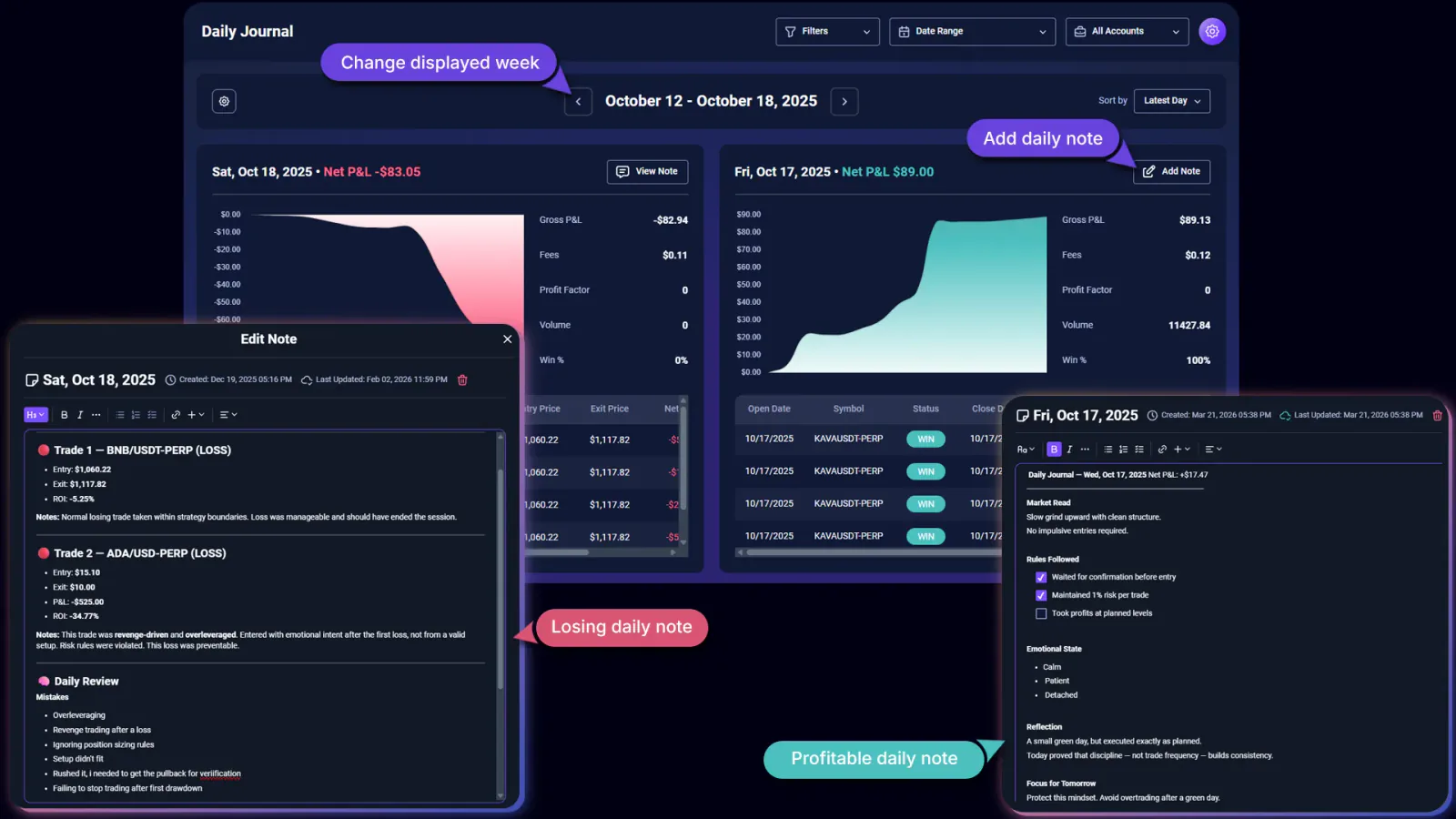
A proper review does not start with P&L. It starts with questions like:
Did I follow my plan? Was my risk appropriate? Was the entry valid? Did I manage the trade well? What did I feel during the trade?
Once those answers are clear, then you look at the outcome.
When you break it down, a strong trade review process usually includes five core elements.
Outcome. What happened in the trade in terms of result, not just money. Win, loss, breakeven, size of the move, and quality of the exit.
Decision quality. Whether the trade idea was valid based on your system. This is where you separate good trades that lost from bad trades that won.
Risk. How much you risked relative to your account, and whether that risk was controlled or emotional.
Execution. How well you followed your plan in real time. Entry timing, scaling, stop-loss discipline, profit targets, and adjustments.
Mindset. What you were thinking and feeling during the trade. Stress, fear, confidence, revenge, hesitation, boredom, and overexcitement all matter.
Crypto trading makes all of this harder because the market never sleeps. You can trade any time of day across multiple assets and perpetual markets. Without structure, your review quickly becomes chaotic.
This is exactly where TradeChainly helps. Instead of trying to collect screenshots, timestamps, and results from different exchanges, everything is stored and organized automatically. You can look at your trades by date, symbol, strategy, tag, or performance metric, which makes the review process clear and repeatable.
By the end of this guide, you will have a trade review structure that fits into your daily and weekly routine without feeling forced. The goal is not perfection. The goal is progress that compounds over time.
Start With the Dashboard: Big Picture Performance
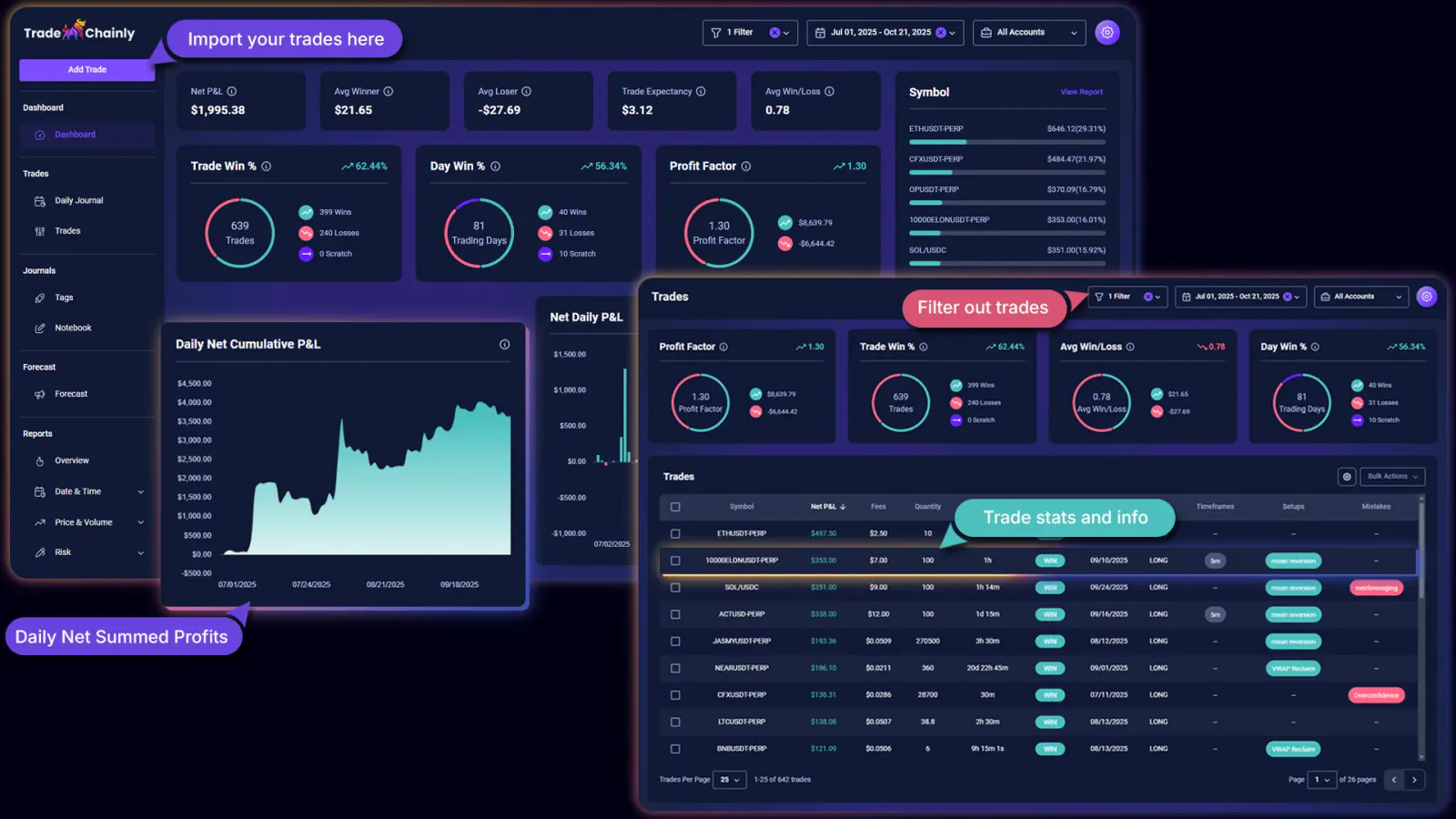
When you log in to TradeChainly, the Dashboard is usually the best place to begin your review. This is where you get a clear view of how you are actually performing as a trader, not just how the last session felt.
Most traders judge performance emotionally. A red day feels like everything is going wrong. A green day feels like you are finally “getting it.” The problem is that feelings rarely match the data. TradeChainly removes the guesswork by giving you clean metrics that tell the truth about your trading.
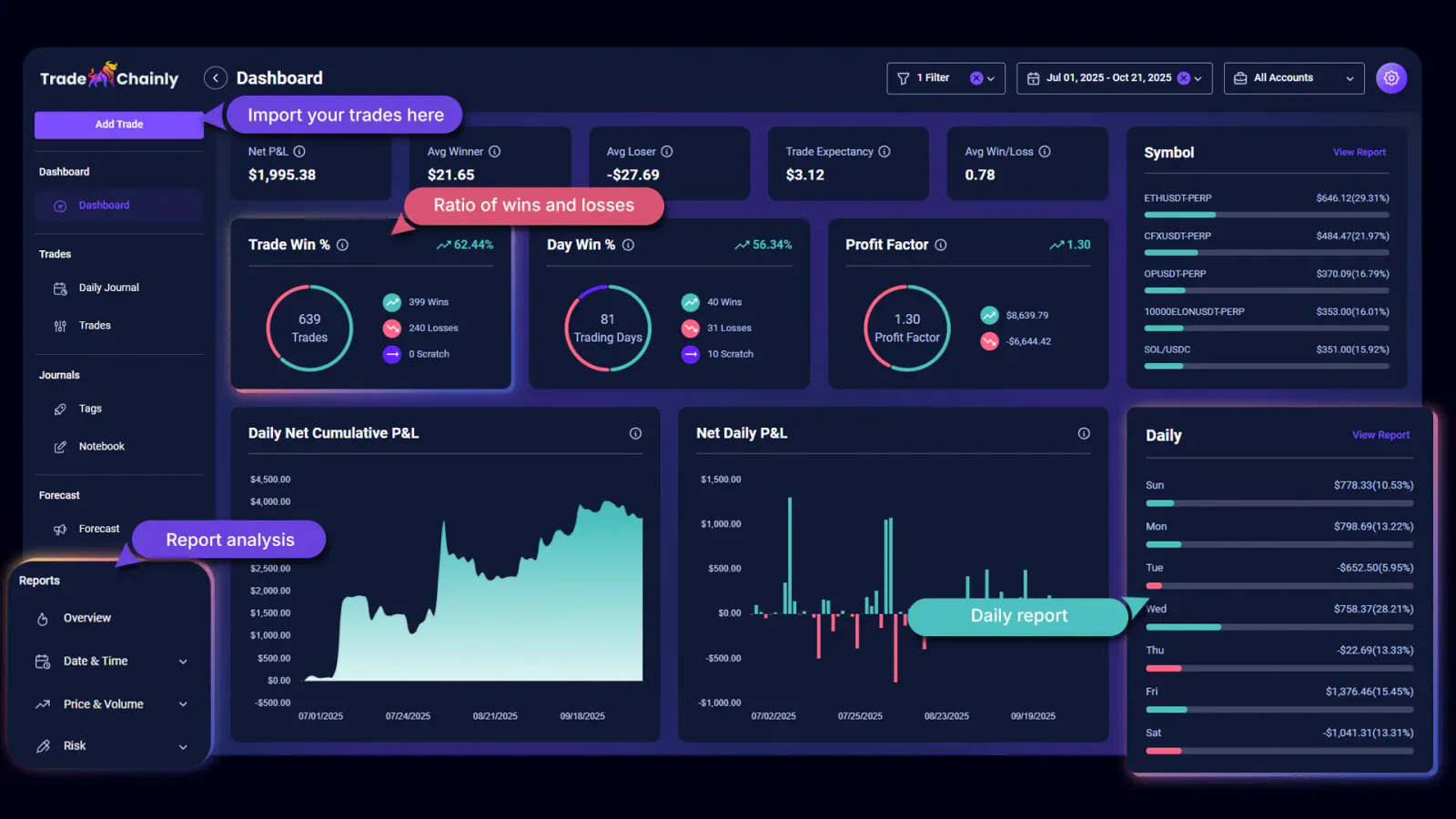
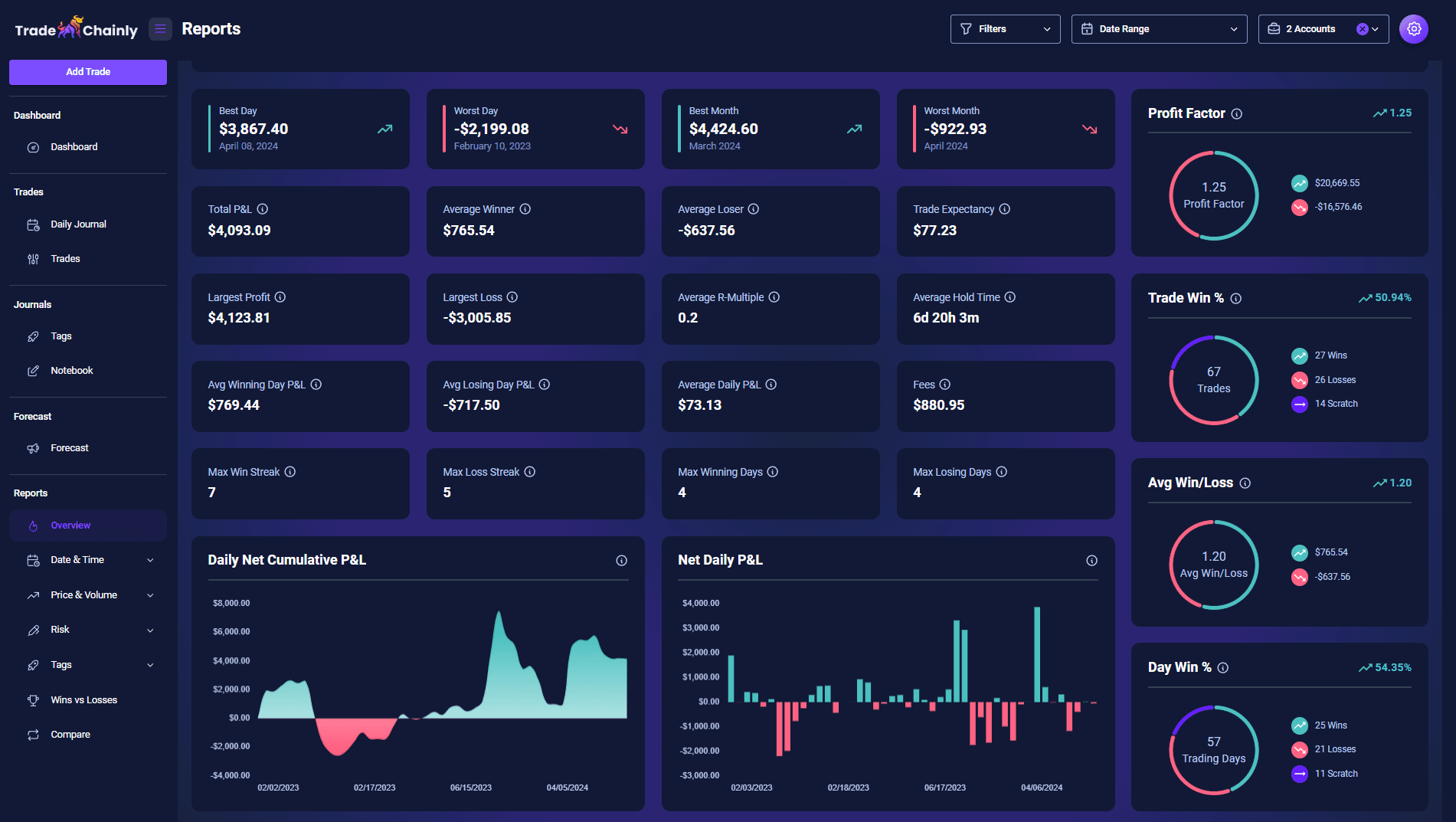
The first place most traders look is Net P&L. This is your total realized profit or loss across all trades. It shows whether you are actually making money overall. But Net P&L alone is not enough. You also want to see how efficiently you are trading.
That is where Trade Win %, Day Win %, Profit Factor, Average Winner, and Average Loser help you understand the real story behind your results.
Trade Win % shows what percentage of your trades are profitable. Day Win % shows how many of your trading days end positive. A trader can have a moderate win rate but still be profitable if winners are larger than losers. Profit Factor makes this relationship clear by comparing total profit to total loss.
Average Winner and Average Loser help you see whether your winning trades are meaningful or whether small gains are being wiped out by large losses. Many traders discover that their average loss is much bigger than they thought. That awareness alone can change trading behavior.
Beyond the metrics, the Dashboard also shows your cumulative P&L over time, your daily results, and performance snapshots by symbol. This makes it easy to see whether your equity curve is trending upward, chopping sideways, or drifting downward.
If you mainly scalp perpetuals on Binance or Bybit, you might notice that certain pairs consistently perform better for you. Or you may realize that you bleed slowly over several days, then try to “win it back” with oversized trades. Patterns like this become obvious once you look at the Dashboard consistently.
The goal at this stage is not to judge yourself harshly. It is simply awareness. You want to see what is happening at a high level before you zoom into individual trades.
TradeChainly gives you that overview in seconds, without needing spreadsheets or manual tracking. Once you understand the big picture, you can move into reviewing specific trades with clarity instead of guesswork.
Reviewing Individual Trades in TradeChainly
Once you understand the big picture from the Dashboard, the next step is to zoom into individual trades. This is where real learning happens. You are no longer looking at totals and averages. You are studying each decision to see what actually took place.
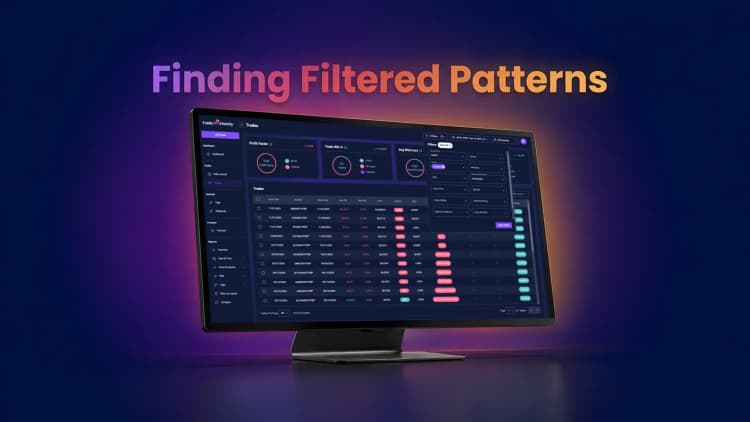
In TradeChainly, the Trades page is the starting point. Here you can see all of your executed trades, along with key metrics like Net P&L, ROI, side, symbol, dates, and fees. You can sort, filter, and review trades across multiple accounts and exchanges without switching spreadsheets or tabs. If you take dozens of trades per week, this organization matters a lot.
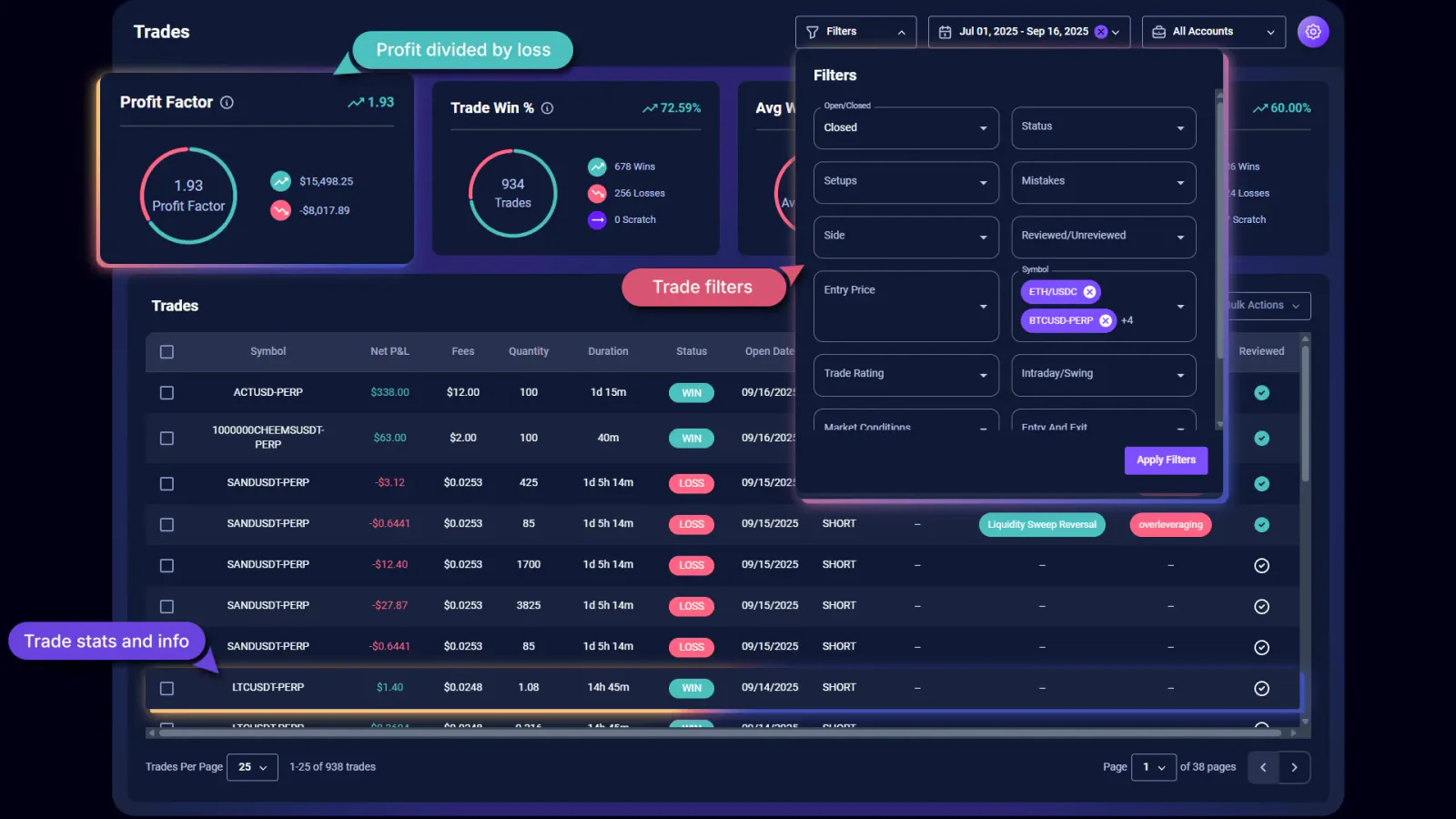
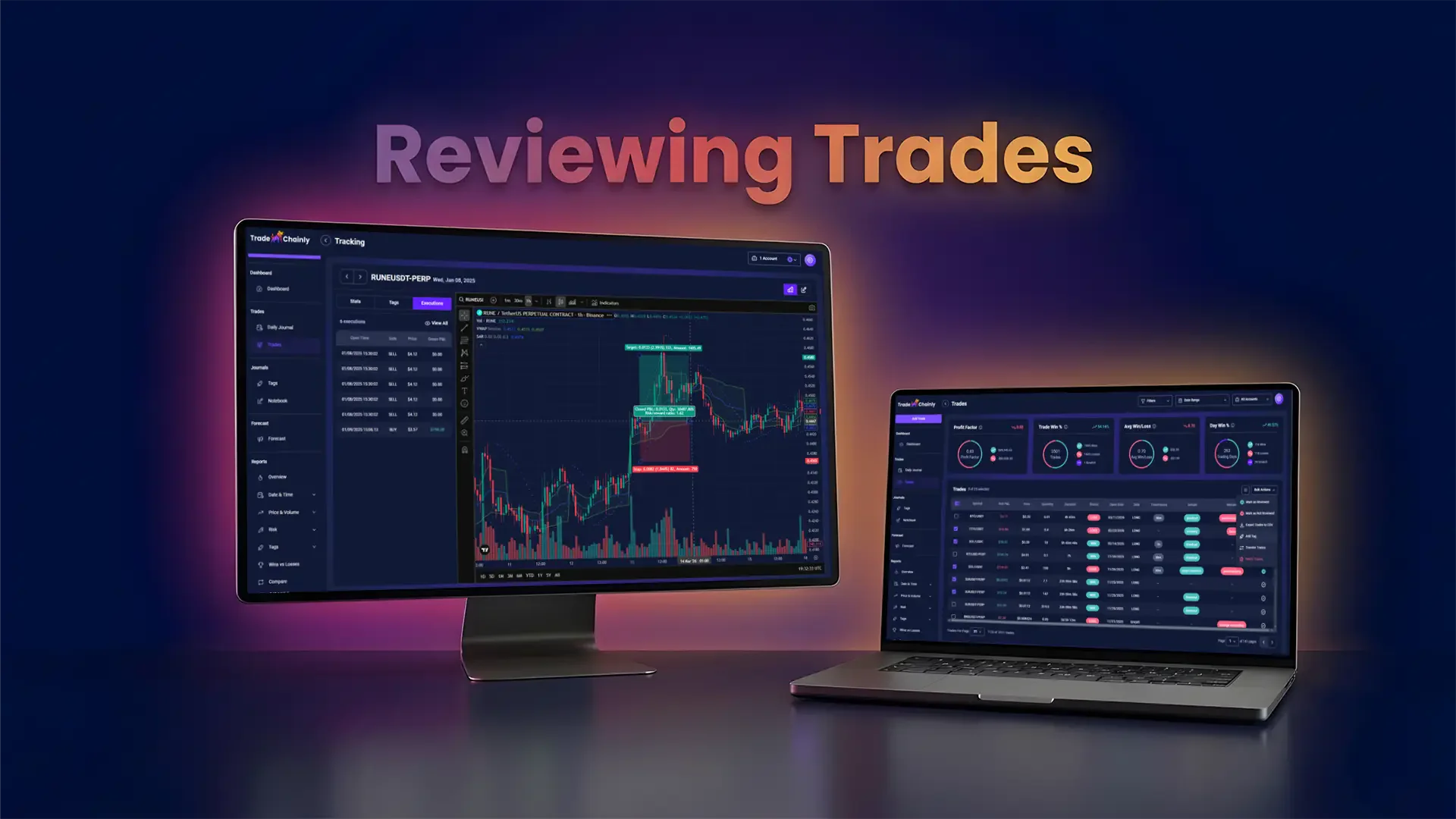
When you open a specific position, the Trade Details page gives you a complete breakdown. You will see the Net P&L, Gross P&L, ROI, entry and exit information, fees, and total volume. You can also view the TradingView chart for that exact trade, which helps connect your decision-making to the actual market movement.
From there, you can begin your review.
First, look at the basic outcome. Was this a win, loss, or breakeven trade? Was it part of your usual strategy? Did the trade size make sense relative to your account?
Then look at the execution. Did you enter where you planned to? Was the stop loss placed correctly? Did you move it emotionally? Did you stick to your profit target or exit early because you were nervous?
TradeChainly also lets you mark trades as reviewed, rate them, and document the thinking behind the trade in the Notes area. This is where honest reflection happens. Many traders skip this step because it forces them to confront uncomfortable truths. But this is exactly where growth happens.
Attaching screenshots of your chart can be incredibly powerful for pattern recognition. Over time, you start to notice what your best trades really look like. You also notice the red flags that usually lead to losses, like chasing a breakout or entering after liquidation wicks.
You can also navigate between trades quickly using the forward and back controls. This makes it easy to review an entire session or day without losing focus.
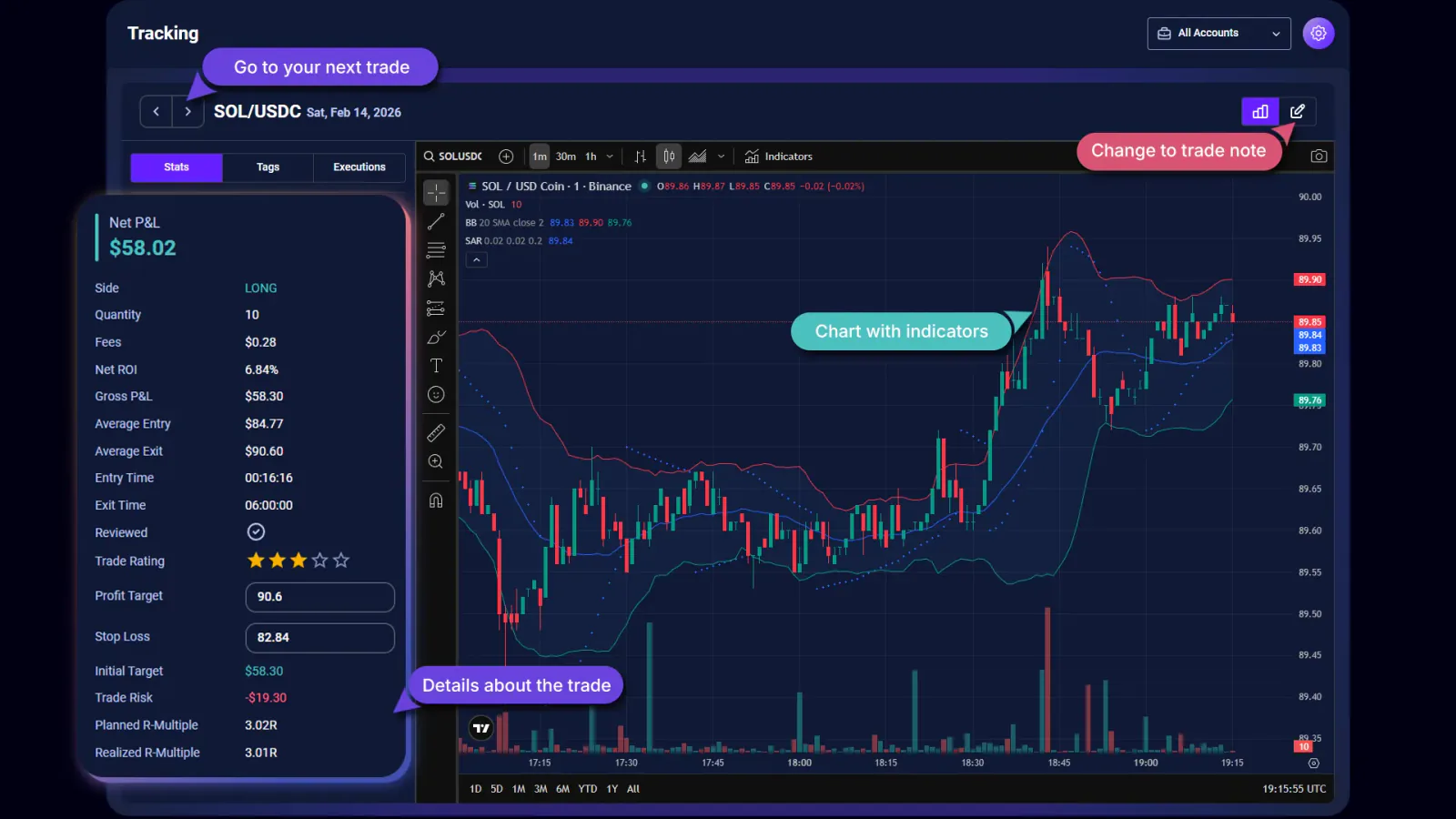
The goal here is not to shame yourself for mistakes. It is to understand your behavior in real market conditions so that you can refine your process going forward. Reviewing individual trades inside TradeChainly gives you the structure needed to do that consistently, even when you are trading across different crypto exchanges and pairs.
Using Tags to Diagnose Strengths and Weaknesses
If you only look at raw P&L, you will always miss part of the story. Two trades can make the same amount of money but come from completely different decisions. One may be a clean breakout setup that followed your plan. The other might be a revenge trade after a loss. The result is the same, but the quality is not.
This is where tagging inside TradeChainly becomes incredibly powerful.
Tags allow you to label trades by setup, mistake type, emotion, or any other category that matters to your strategy. For example, your setups might include breakout trading, scalping momentum, or reversal trades. Your mistakes might include overleveraging, chasing, trading bored, or ignoring stops. You can also track emotional states like fear, FOMO, or tilt.
The key idea is simple. You want to connect performance to behavior, not just outcomes.
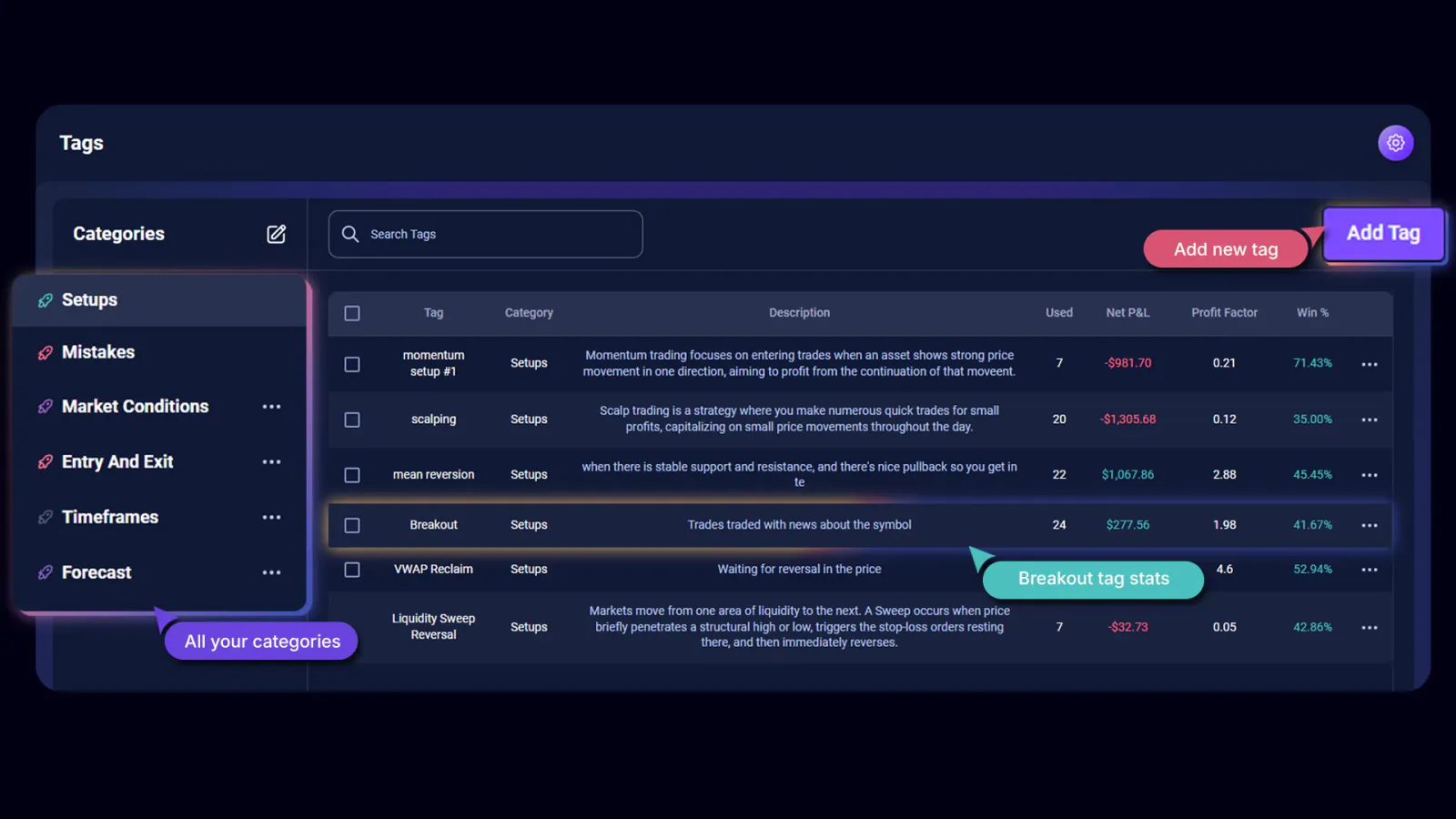
Once your tags are applied to trades, TradeChainly gives you a dedicated Tags page where you can see how each tag performs over time. You can instantly see which setups are driving your profitability, which patterns are costing you money, and which mistakes keep repeating.
This is where traders often have eye-opening moments.
You might discover that your highest P&L comes from one or two specific setups, while everything else barely breaks even. Or you might realize that most of your losing days come from the same recurring mistake, like refusing to cut losses or sizing up emotionally after a win.
When you click into a specific tag, the Tag Details page gives you a full performance breakdown for that behavior or setup. You can see Net P&L, Win %, Profit Factor, Average Winner, Average Loser, and more. You can also review all trades attached to that tag. This turns vague “I think this is working” guesses into objective data.
For crypto traders who scalp frequently or trade multiple perpetual pairs, tagging is one of the fastest ways to separate signal from noise. It helps you answer questions like:
Which setups should I double down on? Which mistakes cost me the most? Which emotional states lead to bad decisions? Which market conditions suit me best?
Once you know the answers, you can start aligning your trading behavior with what actually works. TradeChainly gives you the tools to make that level of awareness part of your normal workflow instead of an occasional reflection session.
Turning Reviews Into Action Using Reports
A trade review process is only useful if it leads to practical changes in how you trade. Data without action is just information. The goal is to turn what you see in your trading journal into decisions that improve your edge over time.
This is where the Reports inside TradeChainly become incredibly valuable.
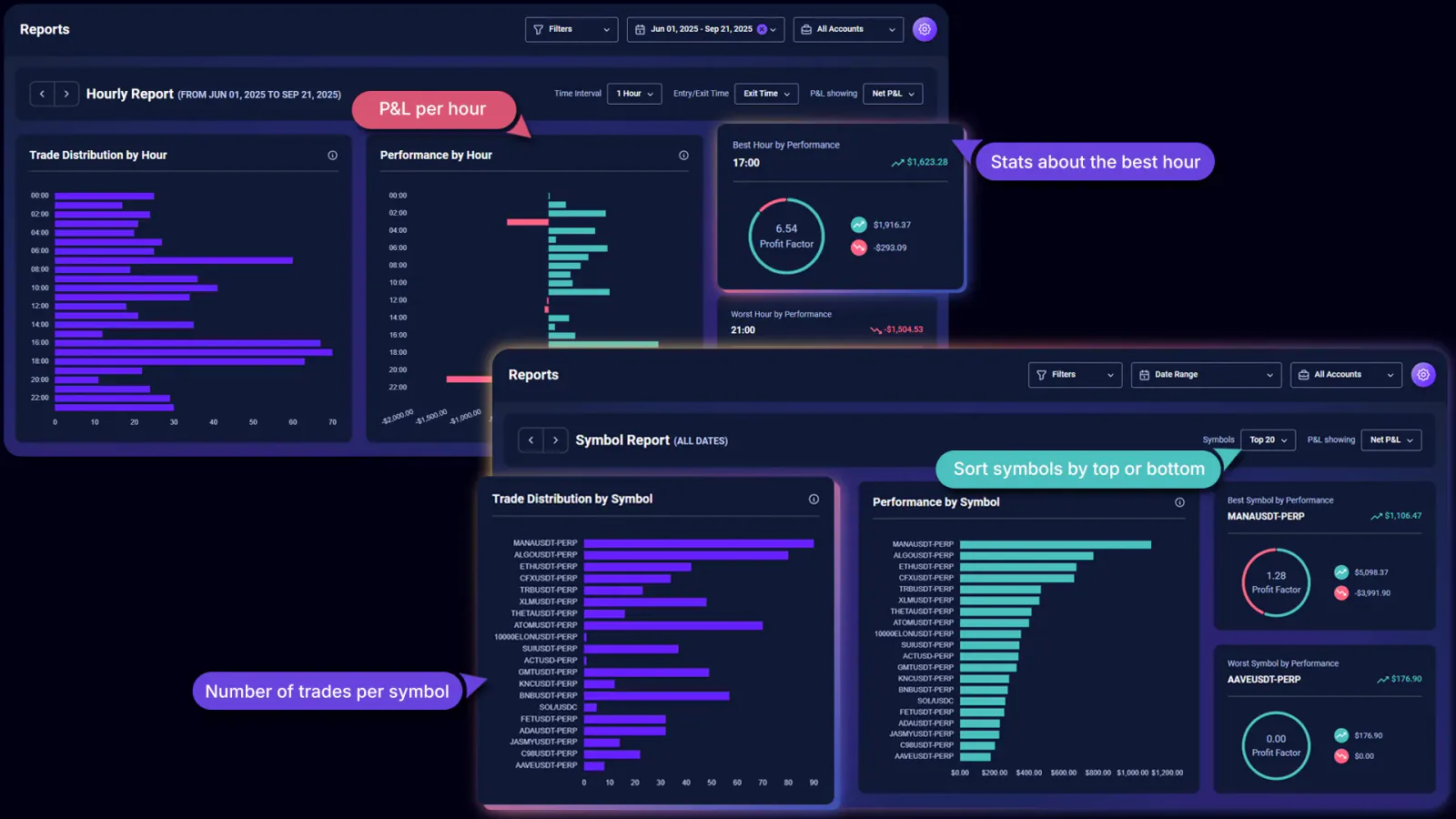
Reports allow you to break down your trading performance from many different angles, not just by trade or tag. You can analyze results by hour, day, month, symbol, duration, position size, R-multiple, and more. This helps you spot structural patterns in your trading that would be almost impossible to notice by memory alone.
For example, you might think you trade well during all market sessions. But once you open the Hourly Report, you may discover that most of your profits come from a specific time window, while another period consistently produces losses. Maybe you trade well early in the London session but struggle later in the day when volume fades. That single insight can change your schedule and improve your results without altering your strategy.
The Symbol Report can reveal which assets actually fit your trading style. Many traders assume they perform best on BTC or ETH, only to realize that smaller altcoins or specific perpetual pairs produce better returns for them. Instead of forcing trades on instruments that do not suit you, you can double down on what works.
Reports also help you evaluate your risk management. The R-Multiple or Position Size reports can show whether you are taking oversized losses or whether your risk-to-reward relationships are healthy. If your losers are much larger than your winners, the data will make that reality impossible to ignore.
Trade duration is another powerful lens. Some traders discover that most of their profitable trades are short, fast scalps. Others realize that their best trades would have benefited from a longer hold. Seeing this laid out in numbers helps you align execution with your natural strengths instead of fighting against them.
All of these insights become even more useful when combined with the tagging system and the Trade Details page. You are not just seeing numbers. You can click through to the trades behind those numbers and understand the real decisions that created the results.
The point of TradeChainly’s reporting is not to overwhelm you with analytics. It is to give you clean, actionable information so you can make smart adjustments. Over time, your trading stops being a string of isolated decisions and becomes an evolving system that improves through feedback and reflection.
Building a Repeatable Review Routine Inside TradeChainly
A review process only works if you actually stick to it. Consistency matters more than intensity here. You do not need to spend hours reviewing every tiny detail. You just need a simple routine that you can repeat, even on busy days.
TradeChainly is designed to fit naturally into that kind of workflow.
A good starting point is a daily review. At the end of your trading session, open the Trades page and review the trades you executed that day. Mark them as reviewed, tag them accurately, and write a short note about what went well and what did not. If you took screenshots, attach them so you can study context later. This entire review can take ten to fifteen minutes once it becomes a habit.
Weekly reviews help you zoom out. The Dashboard and Reports pages are perfect for this. Look for trends in P&L, win rate, risk efficiency, and behavior. Ask yourself whether you are improving, stagnating, or drifting off-plan. This stops you from going weeks or months in the wrong direction.
Monthly reviews let you reflect at a higher level. Which strategies worked best? Which mistakes repeated? Where did emotions interfere? The Tags and Reports sections inside TradeChainly make these questions easier to answer because the data is already organized for you.
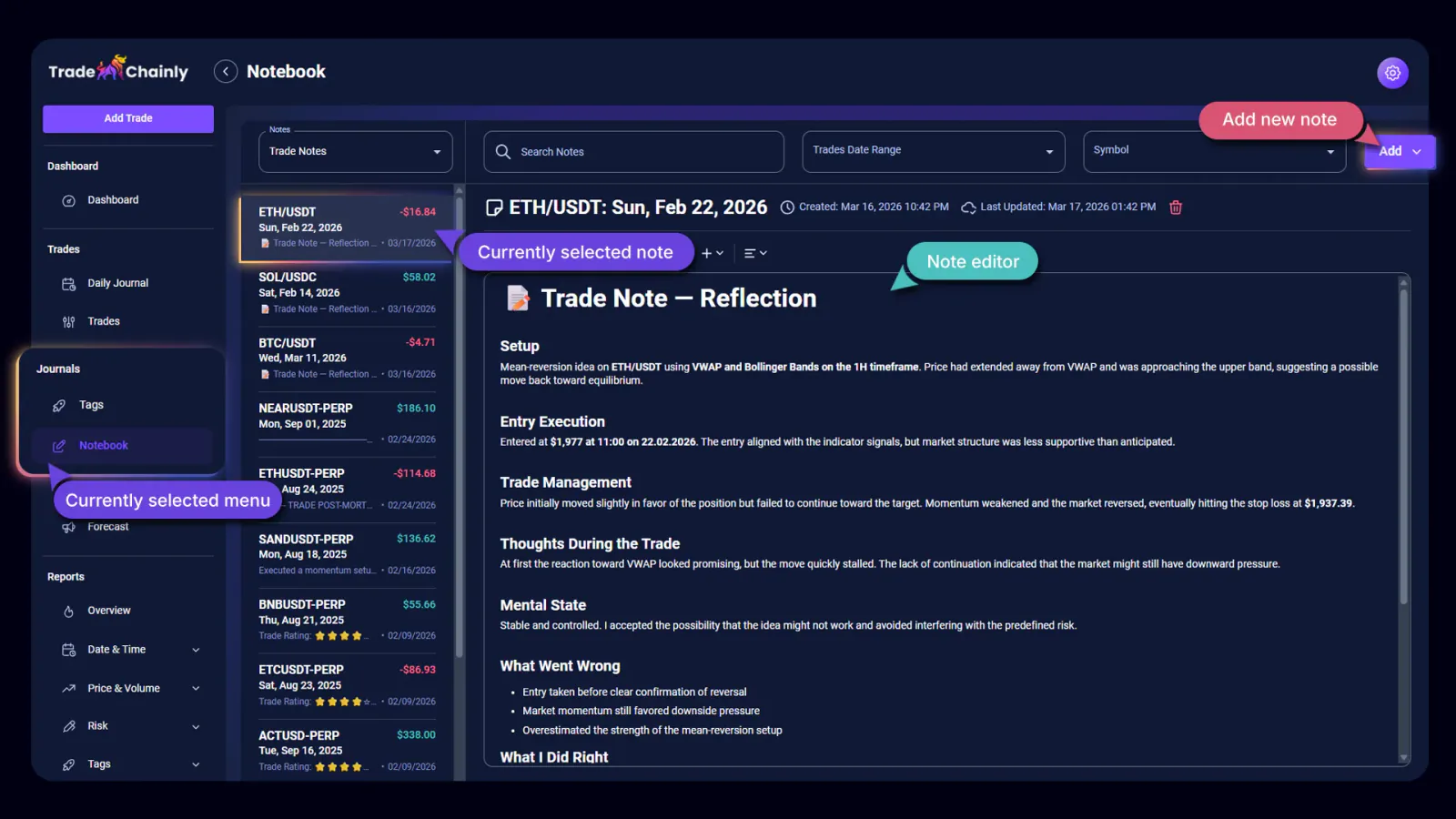
The Notebook page is useful here as well. You can store trade notes, daily reflections, and broader performance insights in one place, without scattering them across random files or apps. Over time, you build a personal archive of lessons that comes directly from your own trading history.
Remember that crypto is a fast and emotional environment. Leverage, volatility, funding rates, and constant price movement can easily push you into reactive trading. A structured review routine gives you an anchor. It keeps you grounded in data instead of emotion.
Your goal is not to eliminate losses or become perfect. Your goal is steady, measurable improvement that compounds over time. TradeChainly simply gives you the structure and tools to make that improvement process part of your normal trading workflow.
Turning Your Trading History Into an Edge
Most traders think their edge comes from entries, indicators, or watching more charts. In reality, a big part of your edge comes from learning faster than the average trader. That only happens when you have a structured way to review your decisions and turn experience into insight.
TradeChainly is built to support that process for crypto day traders and scalpers. Your trades sync automatically. Your data stays organized. Your performance is broken down in a way that actually makes sense for how you trade. Instead of guessing what works, you can see it in front of you.
If you commit to a simple review routine, your trading stops feeling random. You begin to recognize the setups that truly fit you. You notice the mistakes that quietly drain your account. You gain confidence in your process instead of relying on hope or emotion.
You do not need to change everything overnight. Start small. Track your trades. Tag them honestly. Review your Dashboard and Reports. Reflect on what you see. Over time, these small habits create real improvement.
TradeChainly simply gives you the tools to make that improvement easier, clearer, and more consistent. If you want to trade with data instead of guesswork, building a proper trade review process is one of the best investments you can make in your trading future.