
Why Do You Keep Skipping Your Trading Journal Even When You Know It Helps?
Most crypto traders know they should keep a journal. Few do it consistently. The problem is not discipline or motivation. It is design. Most journaling systems are built like accounting projects. They feel heavy, slow, and disconnected from real trading flow.
Journaling fails when it becomes a chore instead of a feedback loop. Traders try to record everything, every metric, every emotion, every chart. After a few days, it starts to feel pointless. The journal becomes something you avoid rather than something that helps you trade better.
Crypto makes this even harder. Markets move fast. You might take ten trades in a session. Futures traders deal with leverage, funding, liquidation risk, and rapid shifts in volatility. Spot traders juggle multiple pairs and timeframes. A journal that takes too long will not survive a crypto routine.
The goal of a daily trading journal is not perfection. It is continuity. Small entries done daily beat detailed entries done once a week and abandoned.
A 15-minute routine changes everything. It gives your journal a time limit. It removes pressure. It forces clarity. You focus only on what actually moves your performance forward.

In this guide, you will learn a simple daily process that fits real trading life. It is fast, structured, and designed specifically for crypto traders who want consistency without turning journaling into another full-time job.
Turning a Daily Journal Into a Feedback System
Most traders treat a journal like a storage vault. They think its purpose is to save information. Dates, entries, exits, PnL, screenshots, maybe a few notes. That is not wrong, but it misses the real function. A journal is not a record. It is a feedback system.
If your journal does not change how you trade, it is just documentation. The point is to understand why things happened and what you should do differently tomorrow. That shift makes journaling feel lighter and more useful.
In crypto, this feedback loop matters because conditions change quickly. Volatility expands and contracts. Liquidity shifts between sessions. News and funding dynamics can change behavior overnight. A daily journal keeps you aligned with what the market is doing now.
Your journal should answer three simple questions every day: “What did I do?”, “Why did I do it?”, and “What will I change next time?” Everything else is secondary.
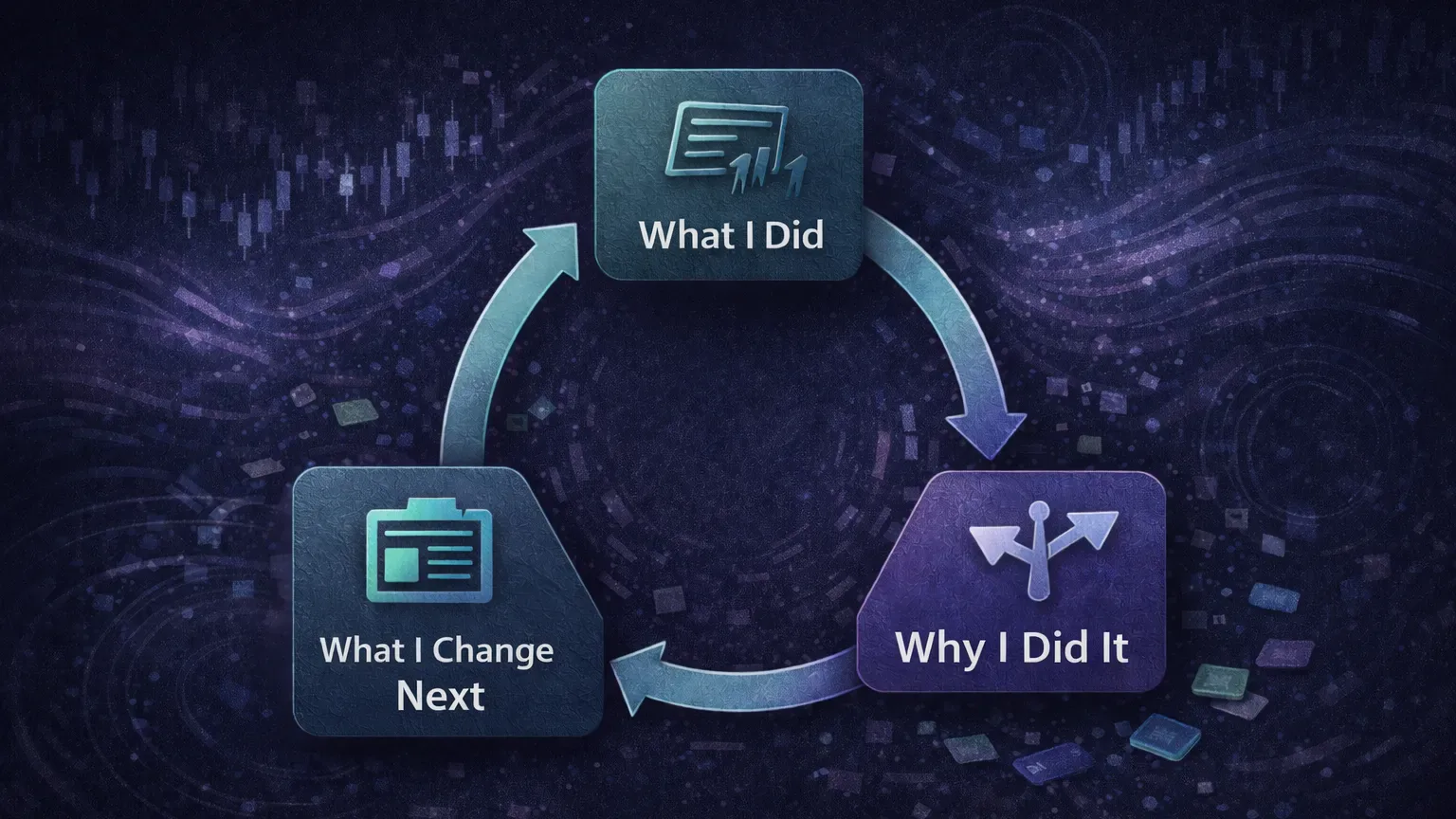
A daily journal is not meant to analyze your entire career. That is what weekly and monthly reviews are for. The daily layer is tactical. It captures decision-making while it is still fresh, and it catches small behavioral patterns before they become expensive habits.
For example, you might notice that on high volatility days you rush entries. Or that after one losing trade, you size up emotionally. Or that during low volume sessions, you trade out of boredom instead of edge. These are not things a PnL chart will tell you. They show up in your daily notes and tags.
Another mistake traders make is thinking a daily journal has to be deep. It does not. Depth comes from consistency, not complexity. Journal lightly but daily and patterns still emerge. Journal deeply once a week and most context is gone.
Crypto traders also deal with higher trade frequency than most traditional traders. A scalper on Binance or Bybit might take fifteen trades in a session. That means your journal must prioritize signal over detail. You cannot write essays for every position.
So focus on decision quality, process, and recurring mistakes and strengths. Do not get trapped in stats for their own sake.
When you see your journal as a feedback loop instead of a database, the 15-minute routine makes sense. You only need enough information to guide the next session.
Using a 15-Minute Timer to Remove Resistance
Most journaling routines fail because they are open-ended. When you sit down to journal, you do not know if it will take five minutes or forty. That uncertainty creates resistance. A time-boxed routine removes that friction.
This routine is not about squeezing everything into a small window. It is about focusing only on what matters. You are building a daily checkpoint for your trading behavior.
The 15 minutes are split into three phases. You Capture, then you Review, then you Adjust. Each phase has a strict time limit. When the time is up, you stop.
| Phase | Time | What You Do | Why It Matters |
|---|---|---|---|
| Capture | 5 min | Log trades, notes, screenshots, emotions | Preserves context while it is still fresh |
| Review | 5 min | Scan for mistakes, patterns, and behaviors | Turns data into insight |
| Adjust | 5 min | Choose one small change for next session | Converts insight into action |

Capture is about speed and honesty. Collect raw material. Do not analyze yet.
Review is where you connect dots. You are looking for repeating behaviors, emotional triggers, and decision flaws.
Adjust is where improvement happens. One clear change beats ten vague intentions.
This structure mirrors how traders learn. First you experience. Then you reflect. Then you adapt. The routine compresses that learning loop into a daily habit.
Fifteen minutes also creates psychological safety. You know the cost. It is smaller than scrolling Twitter or checking funding rates again.
You might feel like fifteen minutes is too short to improve seriously. It is not. Most breakthroughs come from small behavioral corrections repeated over time. If you want deeper work, do it in weekly or monthly reviews. The daily routine stays lightweight.
This framework adapts to both spot and futures. A spot trader might focus on patience and structure quality. A futures trader might focus on leverage discipline, liquidation proximity, and emotional reactions to fast price movement. The structure stays the same.
Minute 0–5: Getting the Raw Session Out of Your Head
The first five minutes are about one thing: getting the session out of your head and onto something stable. This is memory preservation. The longer you wait, the more details you lose or distort.
Capture just enough so that tomorrow you can understand what you were thinking, not just what you did.
At minimum, log your executed trades, save any screenshots that show entry logic or mistakes, and write one or two short notes about how you felt during key moments. No essays. No performance breakdowns.
Automation matters here. If you have to manually copy trades from Binance, Bybit, or OKX every day, the routine will break. Your journal should already know your trades. Your job is to add context, not rebuild history.
Speed matters more than beauty. Messy but honest notes are useful. Polished but delayed notes are not.
Think in triggers, not stories. Instead of paragraphs, write small signals like “Chased breakout after missing first entry,” “Upsized after two wins,” or “Entered during low volume chop.” These lines unlock memory later.
Crypto adds context worth marking quickly. Were you trading during high volatility or a slow session? Was funding close to flipping and affecting bias? Were you trading around news or market open hours? Mark it, then move on.

Spot and futures traders will emphasize different details. Spot traders often benefit from noting patience and structure quality. Futures traders benefit from noting leverage use, liquidation distance, and emotional response to fast price movement.
If you use a platform like TradeChainly, this step becomes mostly about adding meaning. Trades are already synced. Your five minutes go into tagging setups, marking mistakes, and writing a couple of behavioral notes.
When the timer hits five minutes, stop. Do not clean it up. Do not analyze. Clarity comes next.
Minute 5–10: Hunting for Repeats Instead of Judging the Day
This is the most important part of the routine. Capture preserves what happened. Review explains why it happened. The goal is not to judge yourself or fix everything at once. It is to notice patterns that repeat.
Most traders review emotionally. They look at PnL first. Green feels good. Red feels bad. Then they stop. A proper review ignores the color and focuses on decision quality.
Scan your notes and trades with one question: “What did I do more than once today?”
Patterns matter more than single mistakes. One bad entry is noise. Five similar entries are information.
Common repeats include entering too late on breakouts, trading during low-volume chop, oversizing after a win or a loss, cutting winners early out of fear, and holding losers because of hope. Name them. Do not solve them all.
Tagging helps because it turns patterns into categories you can see. “Late entry” stops being a feeling and becomes something that shows up again and again. That is when improvement becomes measurable.
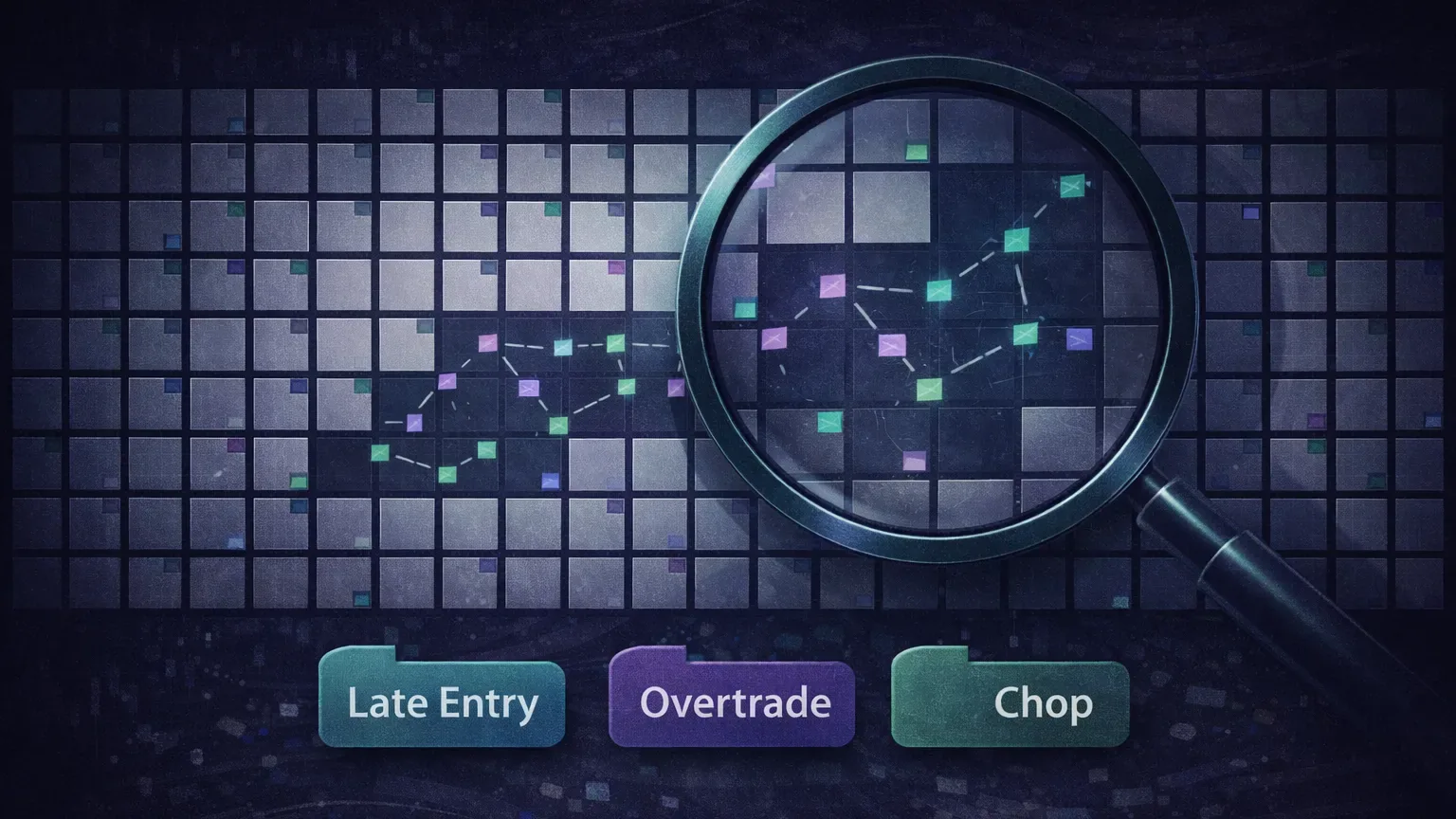
Crypto traders often uncover behavior like overtrading when volatility compresses, becoming aggressive during funding flips, avoiding good trades after a fast loss, and trading smaller pairs emotionally instead of structurally. These are not things you learn from indicators. They come from reviewing behavior.
| Review Question | What It Reveals |
|---|---|
| Did I follow my setups or chase price? | Discipline vs impulse |
| Did I change size emotionally? | Risk control stability |
| Did I trade because of boredom? | Patience and selectivity |
| Did I respect invalidation levels? | Technical execution quality |
| Did I trade during bad conditions? | Market awareness |
Keep this phase fast. You are not running statistics. You are scanning for friction in your process.
The biggest mistake is trying to fix everything. That creates overwhelm and kills momentum. Identify one dominant pattern, not ten small ones.
As tags accumulate and notes become searchable, the review shifts from memory-based to data-supported. You stop guessing and start seeing.
By the end of minute ten, you should have one clear sentence in your head: “Today, my biggest issue was ______.”
Minute 10–13: Turning Insight Into One Clear Rule
Most journals break down here. Traders identify problems but never turn them into behavior change. Awareness without action feels productive, but it does not improve results.
You only choose one adjustment. Not three. Not five. One.
Your brain wants to fix everything at once because it feels efficient. In reality, it creates confusion. When you try to change multiple things, you change nothing.
The adjustment must be specific and testable. “Trade better” is useless. “Be more patient” is vague. You want something you can clearly follow or clearly break.
Examples of good adjustments include: “Skip the first 15 minutes of the session,” “Reduce leverage on the first trade by 25%,” “Stop trading after two losing trades,” “Only trade A setups today,” and “Wait for candle close before entering.” These are rules you can obey or violate.
Crypto creates many adjustment opportunities because conditions shift constantly. On high volatility days, the adjustment might be slowing down. On slow days, it might be not forcing trades. After a liquidation scare, it might be distance to invalidation. The journal gives context to the rule you choose.
This phase is short for a reason. You are nudging behavior. Improvement is directional, not instant.
Write the adjustment down daily and you build a personal rulebook. Over time, you will see which adjustments move performance and which ones were noise.
Tomorrow you will know whether you respected your adjustment or ignored it. That clarity improves discipline.
When adjustments are logged alongside trades and tags, you can later see which rules improved execution and which had no impact. Your journal becomes an experimentation engine, not just a memory log.
Three minutes. One decision. That is all it takes to turn reflection into progress.
Minute 13–15: Protecting the Routine on Messy Days
The final two minutes are about continuity. A good journaling system only works if it survives busy days, losing streaks, and emotional sessions. Remove friction and make the habit automatic.
Anchor the routine to something that already happens. For most traders, that is the moment you close your charts, shut down your platform, or step away from the screen. Journaling should feel like part of trading, not something extra.
Keep the environment simple. Open the same page. Use the same structure. Avoid choices.
Keep the bar low. If a day was chaotic or exhausting, your journal can be messy. A few notes are enough. The habit matters more than the quality of the entry.
Reinforce identity. You are not journaling because it is a task. You are journaling because this is how serious traders operate.
Many traders quit after bad days. That is when it matters most. A short entry on a losing day protects you from emotional distortions later.
If you ever skip a day, do not compensate with a long session later. Return to the routine the next day. Consistency beats intensity.
How a Daily Habit Turns Into a Performance System
A daily journal is not just about improving today’s trades. Its power shows up when entries stack. What feels small on a single day becomes meaningful over a few weeks. Patterns stop being opinions and start becoming evidence.

When you journal consistently, your notes, tags, and adjustments form a story about how you actually trade, not how you think you trade. You see which setups perform, which mistakes repeat, and which conditions bring out your worst decisions.
Daily reviews feed naturally into weekly and monthly analysis. The issues you identify in ten minutes each day become the themes you explore deeper later. A habit that starts with behavior evolves into a performance system.
Structure matters. If your journal is just a collection of text notes, scaling becomes difficult. When trades are tagged, adjustments are logged, and behavior is categorized, your data becomes searchable and comparable. You are working with evidence.
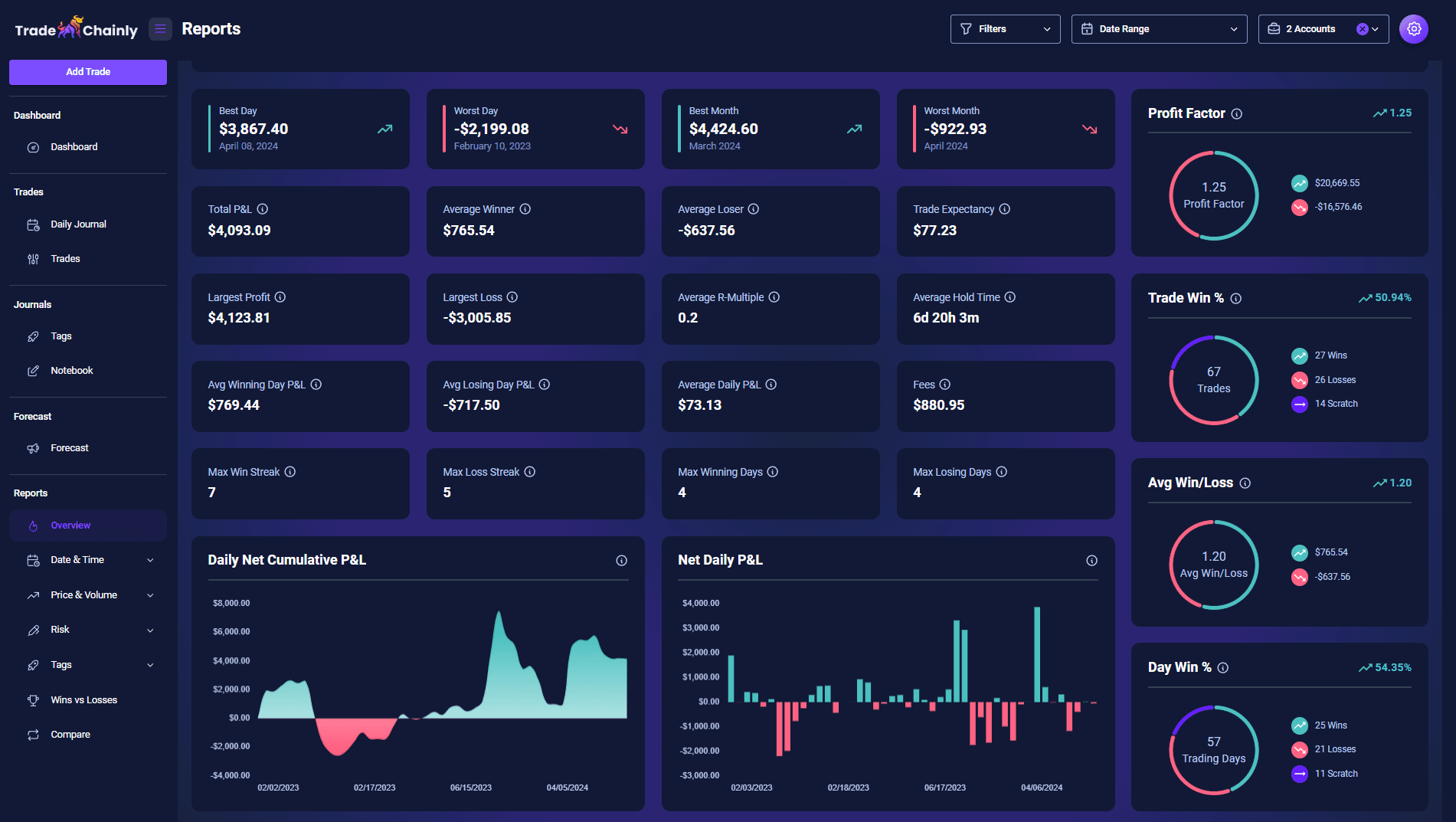
Platforms like TradeChainly make this progression easier because the daily routine connects directly to reports and dashboards. Trades are already synced. Tags accumulate automatically. What starts as a quick daily reflection turns into a full performance map of your behavior.
Over time, you stop asking, “What went wrong today?” and start asking, “What pattern am I improving this month?” That shift is massive. It is the difference between reacting to trades and refining a process.
A 15-minute routine might feel small, but it is the foundation of everything that follows. Serious trading systems are built from small behaviors repeated with intention.
Journaling as a Daily Edge
A daily trading journal does not need to be complicated to be powerful. It just needs to be consistent. A clear structure and a fixed time limit makes journaling feel like part of trading.
The 15-minute routine works because it matches real trading life. You capture what matters, review for patterns, and make one small adjustment. Over time, those small adjustments shape discipline, patience, and decision quality.
You do not need perfect entries. You need honest ones. You do not need deep analysis every day. You need direction.
If you stay with this routine for a few weeks, you will notice something shift. Your trading becomes calmer. Your mistakes become clearer. Your improvements become measurable.
If you want to make this process easier, a platform like TradeChainly can handle the heavy lifting by automatically syncing trades, organizing tags, and turning your daily notes into usable performance insights. But regardless of the tool you use, the routine is what matters most.
Set a timer after your next session and run the loop once. Capture, review, adjust. Then do it again tomorrow.