
Why Do You Trade Your Worst When You Already Know What You Should Be Doing?
Why do you trade your worst when you already know what you should be doing?
If you have traded crypto intraday for any meaningful stretch of time, you already know that discipline is the real edge. Not the entry trigger. Not the indicator. Not even the strategy itself. The ability to execute the same process repeatedly, even when the market feels like it is trying to drag you into emotional decisions, is what separates stable traders from those constantly resetting accounts.
Crypto makes that harder than almost any other market.
It trades 24/7. There is no closing bell that forces you to stop and reset. You can be tired, stressed, bored, or already in drawdown, and the market is still there offering you the next setup. Add leverage and the possibility of liquidation, and every position carries emotional weight that stock traders rarely experience. A small move on BTC or ETH perp can swing unrealized PnL enough to trigger fear or greed instantly.
You might start the session with a clear plan. Defined risk. Specific entries. A limit on the number of trades you will take. Then the market speeds up. A wick runs stops. Someone posts a chart on Twitter. Funding shifts. Your heart rate rises and suddenly you are chasing a move that was never part of the plan.
The problem is not knowledge. Most traders already know what they should be doing. The problem is execution under pressure.
That gap between intention and behavior is where accounts are built or destroyed. In crypto, that gap widens faster than most traders expect. Which is exactly why discipline cannot be left to “trying harder next time.” It needs structure. It needs awareness. And it needs a way to measure what actually happens when you are in the trade, not just what you planned to do before it started.
What Counts as Discipline in a Crypto Day Trade?
Traders talk about “discipline” all the time, but the word becomes almost meaningless if you never define it. In crypto day trading, discipline is not motivation, confidence, or mindset in some abstract sense. It is simply the ability to behave consistently according to a predefined plan, even when your emotions are pulling you somewhere else.
For a crypto scalper or intraday futures trader, discipline shows up in very specific places. It is choosing not to chase a breakout candle on BTC because it moved without you, even though the chart looks like it might explode higher. It is sticking to the position size that fits your risk model instead of doubling size after a loss “to get it back.” It is keeping your stop in place when price wicks toward it, instead of dragging it wider to avoid being stopped out.
You can see discipline in your trade history. It leaves a footprint.
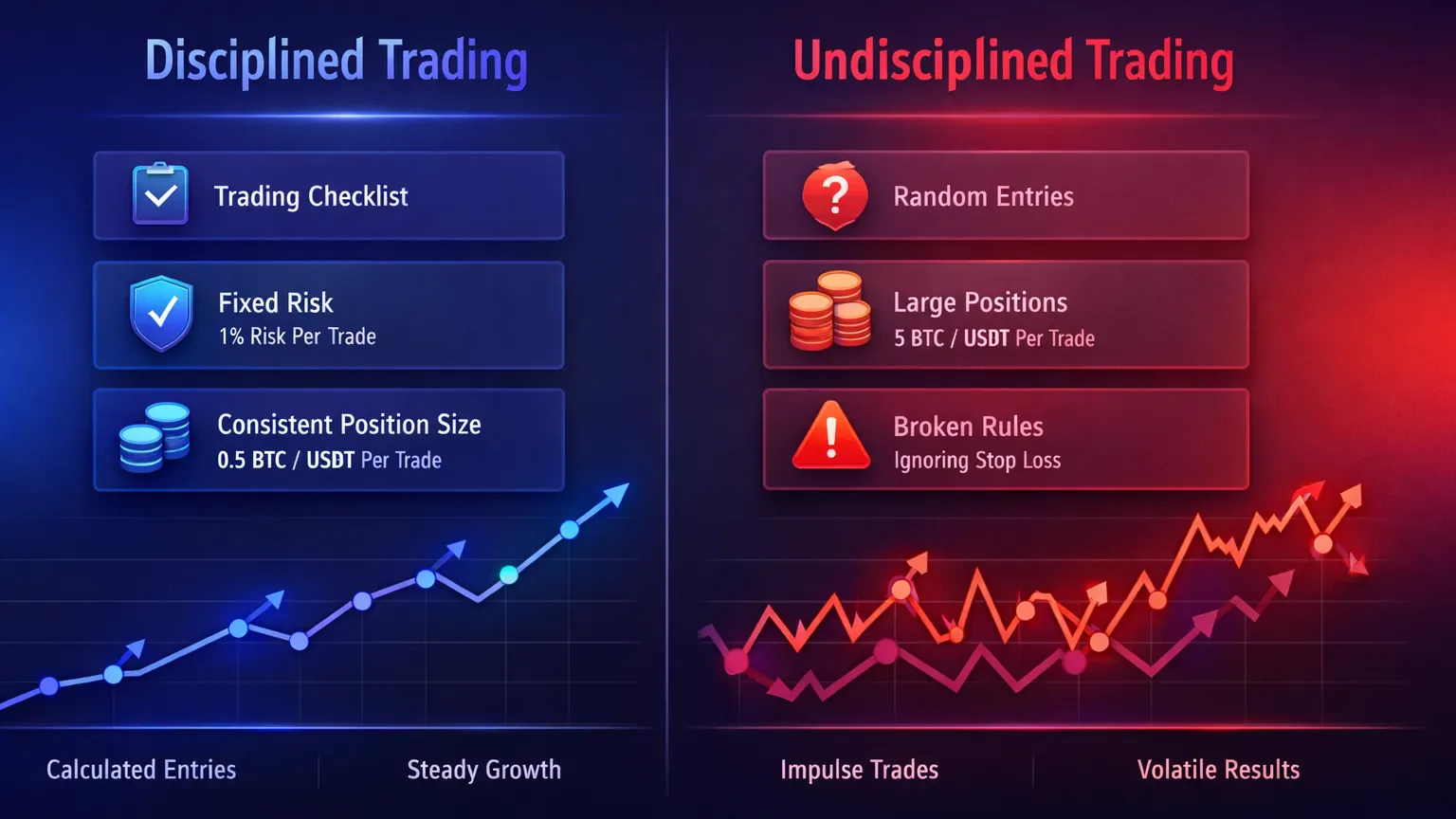
Disciplined trading looks like:
- You only take trades that match your plan
- Your risk per trade stays stable
- You do not overtrade during chop
- You do not move stops without a defined rule
Undisciplined trading looks like emotional scaling, random entries, trading boredom, and ignoring planned exit rules.
This matters because profitable strategies still fail without disciplined execution. The same setup that works over hundreds of trades becomes unprofitable if you constantly change your sizing, skip stops, or enter too early because you felt like price might run.
So when we talk about discipline here, we are not talking about personality traits. We are talking about visible, trackable trading behavior that either aligns with your plan or drifts away from it.
Why Does Willpower Break Down in Crypto?
Most traders try to fix discipline problems with willpower. You tell yourself you will “be stronger next time,” or “stick to the plan tomorrow.” That approach almost always breaks down in crypto, because the market is specifically structured to push emotional buttons all day, every day.
Volatility creates constant urgency. A 1% move on BTC or ETH perp can happen in seconds. Liquidation cascades happen fast. Funding payments tick in and out. Social feeds light up every time price spikes. All of this keeps your brain in a reactive state, where short-term survival instincts override long-term logic.
Then there is fatigue. Crypto does not respect your timezone. If you trade Asia, London, or New York sessions, you might already be tired when good moves happen. Sleep debt lowers impulse control. That is not mindset weakness. It is physiology.
Losses amplify it further. A stop-out on Bybit or Binance can trigger a strong urge to get the loss back immediately. Many traders slowly increase size or take lower-quality trades without even realizing that their behavior has changed. By the time they notice, the damage is already in the PnL.
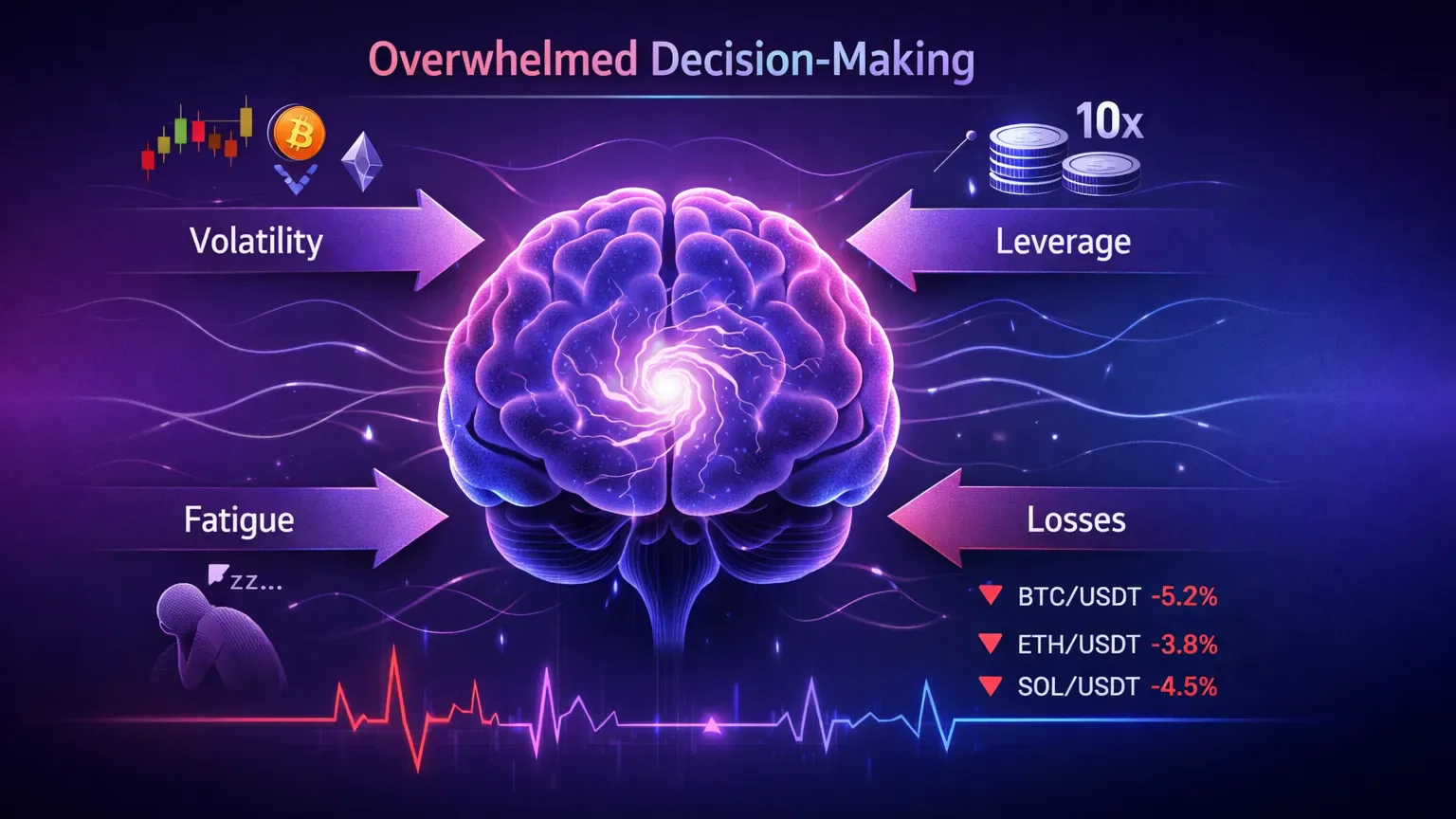
You don’t need to become superhuman. You need external structure that keeps you grounded when your emotional state shifts. A trading journal becomes that structure, because it lets you see when your execution changes long before the account balance forces you to notice.
How Do You Turn Discipline Into Measurable Behavior?
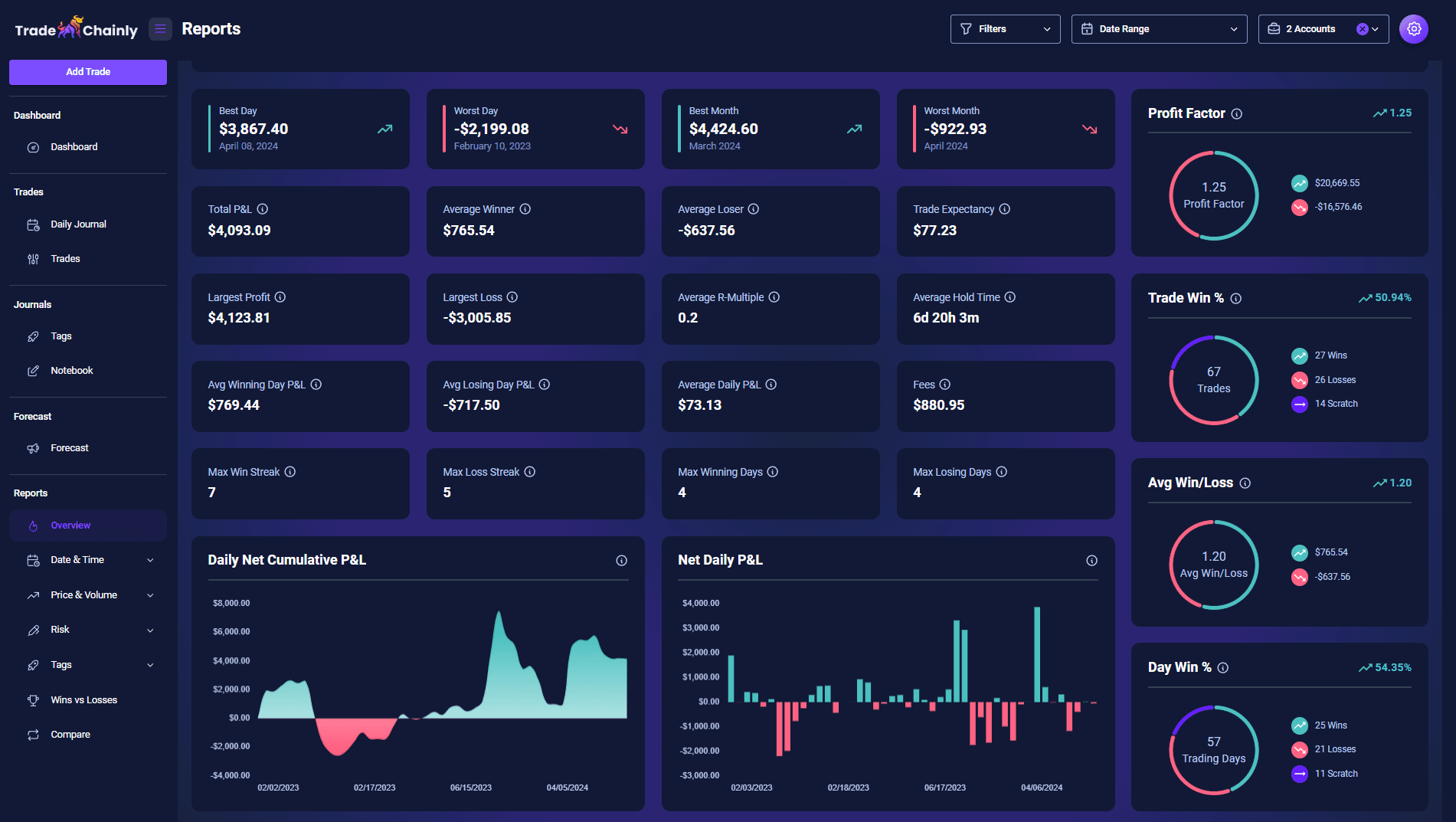
Discipline sounds like a mindset problem, but it is really a behavior problem. And behavior can be measured. That is where a trading journal becomes more than a notebook of screenshots. It becomes a tool for tracking whether you actually did what you said you would do.
When your trades are recorded and reviewed, everything you do leaves a trail. You can see when you followed your rules, and you can see when emotion took over. Over time, that trail becomes data.
Most traders think they are disciplined until they look back over a month of trades and realize how often they deviated from the plan. They doubled size after losses. They re-entered immediately after a stop-out. They skipped valid setups after a drawdown. None of these felt extreme in the moment. They were tiny emotional decisions. But those decisions add up.
A solid crypto trading journal workflow usually has a few key elements.
You tag trades by setup type, market condition, and sometimes by emotion or mistake type. You write brief notes on why you took the trade, what you expected, and how you managed it. You review metrics like maximum adverse excursion and risk consistency. When your journal imports trades automatically from exchanges like Binance, Bybit, OKX, or Coinbase, the data is already there waiting for you. A platform like TradeChainly is designed to make that part effortless so the focus stays on the review, not the admin work.
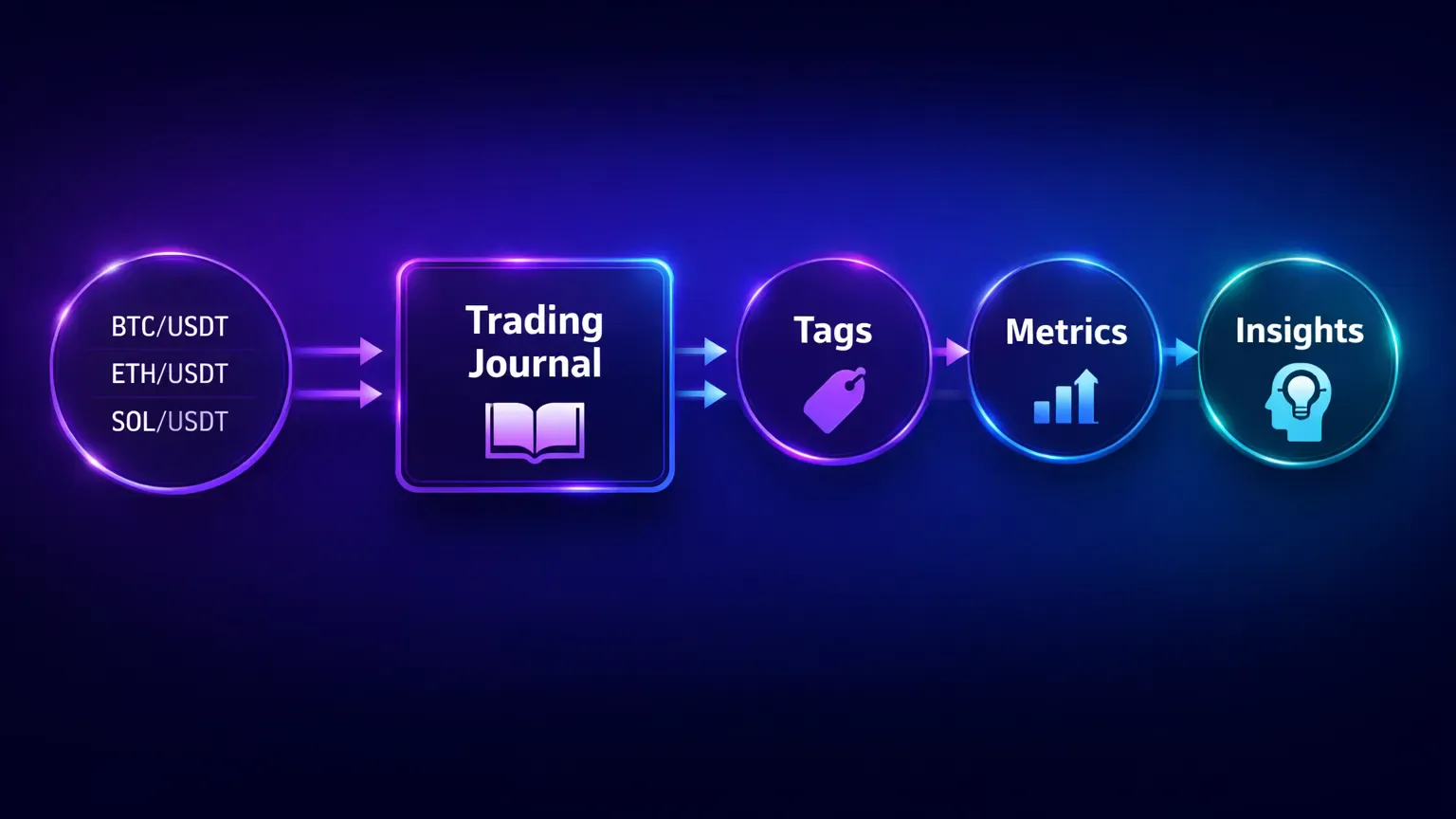
The result is clarity you cannot get in real time. You start to see patterns. Maybe you perform well during London, but fall apart during late-night scalping. Maybe your best trades respect a strict 1R risk cap, while your worst losses come from position size creep. Maybe your win rate does not matter as much as your ability to avoid one large emotional loss each week.
Once discipline becomes measurable, it also becomes coachable. You stop guessing about mindset. You start working with facts. And that shift changes everything about how you improve.
What Does This Look Like in Practice?
A realistic example.
Imagine a futures trader scalping SOL and ETH perpetuals on Binance and OKX. He trades intraday, usually during London and early New York. His strategy is fine. He trades break-and-retest setups, keeps risk around 1R per trade, and occasionally catches strong trend continuation moves.
His problem is discipline.
Whenever he takes two losses in a row, something shifts. He starts forcing trades. He widens stops so they “have more room.” He occasionally doubles size to make the loss back faster. Some days he ends up overtrading into chop. Other days he holds losers too long to avoid realizing the loss. Over the course of a month, one or two emotional sessions wipe out a lot of clean days.
So he starts journaling properly.
Trades are imported automatically. Every trade gets tagged for setup, session, and mistake type. He adds a simple note describing what happened and why. He also starts tagging emotions like frustration, impatience, or FOMO.
After three weeks, a pattern jumps out.
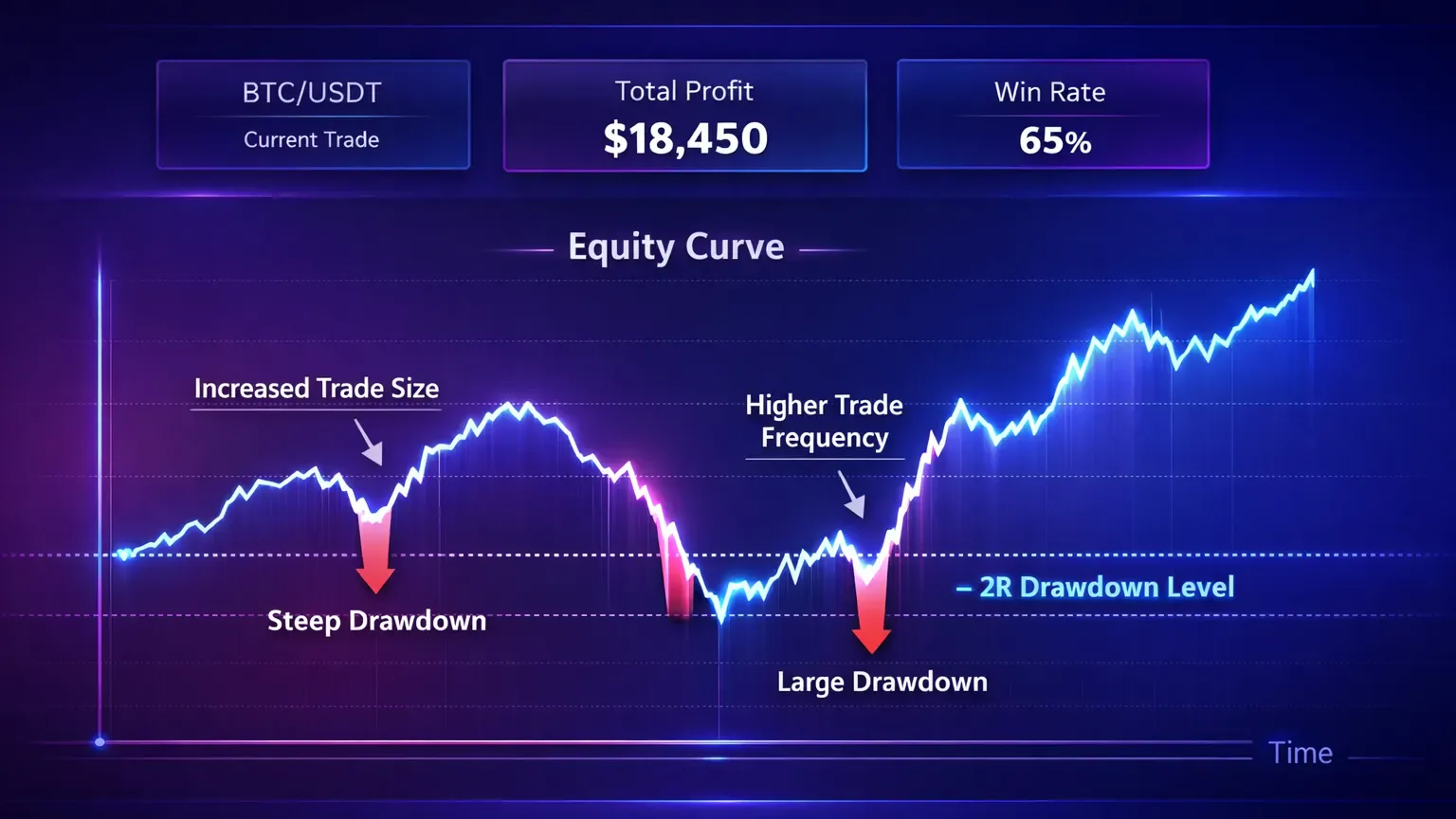
The data shows that whenever he drops more than 2R on the day, his trade quality collapses. Position size increases. Trade frequency rises sharply. Win rate drops. Almost every large drawdown starts the same way: a couple of normal losses followed by emotional trading.
This insight doesn’t magically fix the issue. But it gives him something objective to work with.
He creates two new rules.
Rule one: stop trading for the day if he hits -2R.
Rule two: review the journal before the next session anytime he hits max loss.
Over the next month, the number of emotional spike losses falls sharply. His average losing day shrinks. His monthly equity curve smooths out. The strategy did not change. His mindset didn’t transform overnight. What changed was awareness, process, and accountability to data.
This is how journaling improves discipline in real life. Not by theory, but by exposing the exact places where behavior drifts away from the plan, then putting structure around those moments.
How Can You Build the Three Types of Discipline?
Discipline is often treated like one big concept, but in practice it shows up in three different areas of your trading. A good crypto trading journal helps you separate these so you can see exactly where things break down.
First is pre-trade discipline.
This is the discipline to only take trades that match your plan. It is about patience, selectivity, and waiting for confirmation instead of predicting moves because price “feels like” it might go there. In crypto scalping, this usually means sticking to defined setups, respecting session behavior, and not trading when conditions don’t fit your system. Your journal reveals how consistent you really are. If half your trades do not match your documented setup types, you do not have a strategy problem. You have a pre-trade discipline problem.
Second is trade management discipline.
This is where most traders come undone. It includes position sizing, stop placement, partials, scale-outs, and following exit criteria. Your journal shows whether you stick to risk limits or creep size higher when you feel confident. It shows whether you widen stops when price moves against you. It shows whether your average loss is close to your intended 1R or whether emotional trades create occasional huge downside spikes. This is the category that separates controlled drawdowns from destructive ones.
Third is post-trade discipline.
This is the habit of actually reviewing what happened. Most traders skip this step when they feel good and only review after bad streaks. A journal creates structure around regular reflection. You tag mistakes. You tag emotions. You write notes about context. Over time, you build self-awareness instead of hoping things “just improve.”
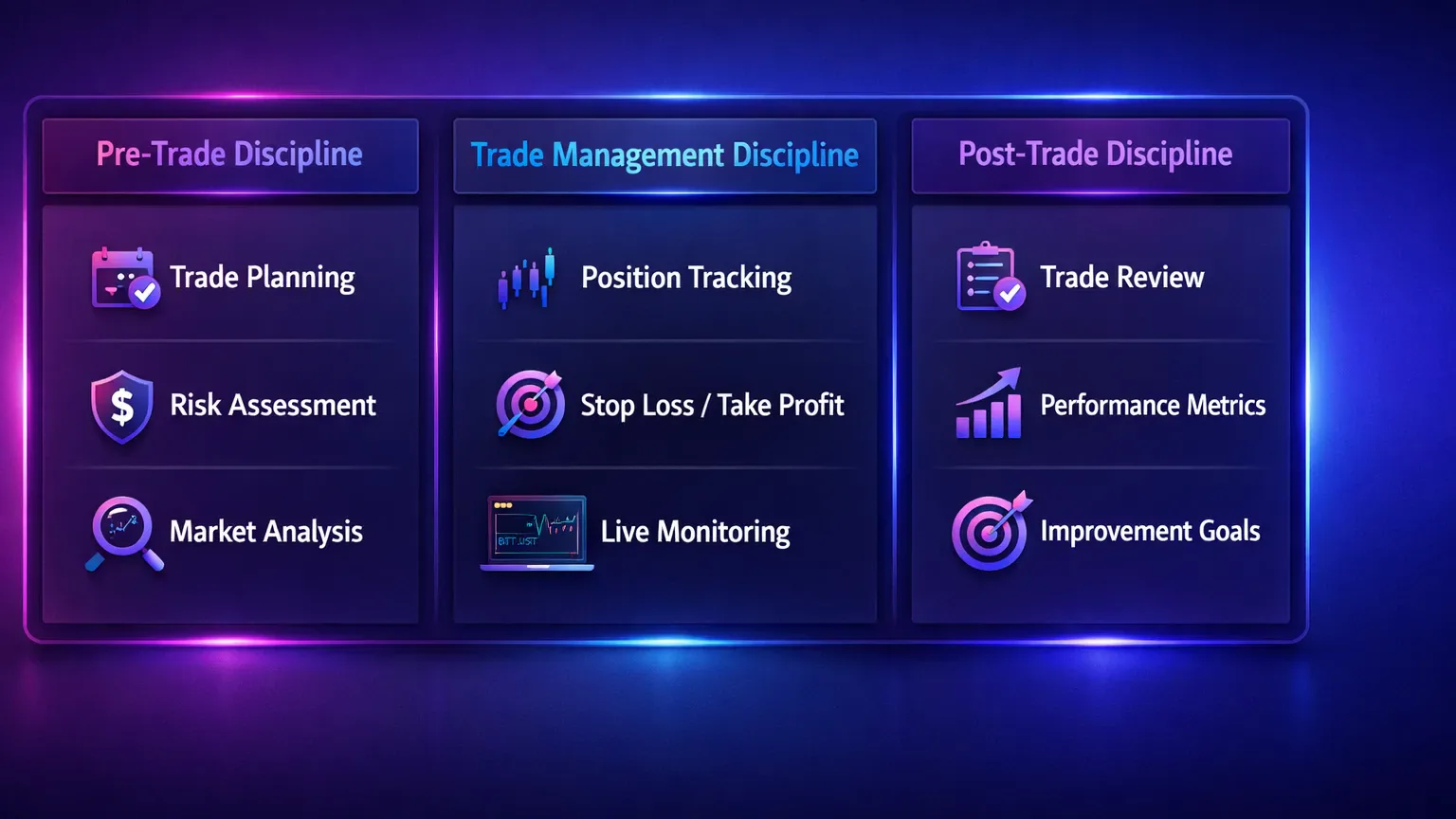
When traders complain that discipline is inconsistent, one of these three areas is usually breaking down. The journal simply makes it visible. Once you know where the leak is, you can fix it with intention instead of guessing.
How Do You Make Journaling Sustainable with Automation?
One more reality matters. Manual journaling sounds great in theory, but most crypto traders do not keep up with it. After a long session trading BTC, ETH, SOL, or alt perp pairs, the last thing you want to do is spend an hour copying trades into a spreadsheet. Eventually the habit breaks, and with it goes most of the structure that keeps discipline improving.
Automation changes that.
When your trades are imported automatically from exchanges like Binance, Bybit, OKX, or Coinbase, the review process becomes much lighter. You open your journal and the trades are already there. All you need to do is tag them, add context, and review performance. The friction disappears, which means the habit survives even when you are tired or busy.
This matters more in crypto than traditional markets. The pace is fast. Opportunities come constantly. Without automation, journaling often gets skipped in “busy” periods, which also happen to be the most emotional ones. That is when discipline tends to fall apart. A platform like TradeChainly is built around that idea. It keeps the data flowing in the background so you can focus on the review itself.
How Do You Turn Journal Insights Into Rules You Follow?
A trading journal only improves discipline if the insights turn into behavior change. This is where many traders stop too early. They review trades, notice patterns, but never translate those observations into clear rules they can actually measure.
The process is straightforward.
First, identify a repeated mistake in your data. Maybe you notice that most of your large losing days come from trading during low-liquidity weekend chop. Or you realize that you often enter too early on breakouts, then get wicked out before the real move. Or your journal shows that your worst trades come right after news volatility.
Second, define a rule that directly targets that mistake. For example:
- No trading within five minutes of a major wick.
- No adding size after two losing trades.
- Stop trading after hitting -2R for the day.
- Avoid trading low-volume weekend sessions completely.
Third, track compliance. This is the step that separates disciplined traders from hopeful ones. Your journal should show whether you actually followed the rule. If you broke it, you tag the reason. Over time, you can measure rule adherence in the same way you measure win rate or expectancy.
Fourth, review and refine. Maybe a rule is too strict or not strict enough. The point is not perfection. The point is conscious iteration.
This is how discipline becomes systematic instead of emotional. You are not trying to “be better.” You are testing and refining behaviors with data, the same way you test a trading strategy. That shift gives you control over your development instead of leaving it to chance.
What Changes Once Discipline Becomes Measurable?
A lot of traders think discipline is something you either have or you don’t. In reality, discipline is just the byproduct of structure. When you trade crypto every day in a market that never sleeps, that structure matters even more. Without it, emotion eventually takes over, no matter how experienced you are.
A trading journal gives you that structure. It turns behavior into data. It exposes patterns you would never see in real time. It helps you separate clean execution from emotional trading. And it gives you a framework for building rules you can actually follow, instead of relying on willpower in the heat of the moment.
You still have to do the work. You still have to review honestly and make adjustments. But once discipline becomes measurable, improvement becomes inevitable. A platform like TradeChainly simply makes that process more automatic and sustainable, so the habit sticks.
Over time, that combination of awareness, process, and consistency becomes a real edge. Not because you outsmart the market, but because you stop sabotaging yourself.