
Why Multi-Account Journaling Breaks Most Systems
If you trade crypto seriously, there is a high chance you do not operate from just one account. You might have a futures account on Binance, a spot account on Coinbase, and a second futures account on Bybit for a different strategy or risk profile. Some traders separate capital by strategy. Others split accounts to manage risk, comply with exchange limits, or test new approaches without contaminating their main performance data. On paper, this makes sense. In practice, it creates one of the biggest problems in trading journaling: fragmentation.
Most journaling systems are built with a single account in mind. They assume one stream of trades, one set of metrics, and one clean performance curve. As soon as you introduce multiple exchanges or accounts, everything starts to break. Your real profitability becomes harder to see. Your drawdowns look smaller or larger than they actually are. You stop trusting your own data because no single place reflects your full trading activity.
That is usually when spreadsheets appear. You export CSV files from Binance, Bybit, OKX, and Coinbase. You try to normalize columns. You manually adjust timestamps. You hope you did not miss a trade or double count something. It works for a week. Then it becomes another system you no longer fully maintain.

Multi-account journaling is not just a bigger version of single-account journaling. It is a different problem. It requires consistency, structure, and automation. Without those, your journal becomes a collection of partial truths instead of a reliable decision-making tool.
A proper multi account trading journal is not about convenience. It is about preserving data integrity across complexity. When your trading activity is spread across platforms and strategies, automation is what keeps your performance analysis grounded in reality instead of guesswork.
The Real Complexity of Trading Across Multiple Accounts
Most traders do not open multiple accounts because they want to make journaling harder. They do it because it solves real trading problems. One account might be dedicated to high leverage scalping. Another is for slower swing trades. A third might hold spot positions that are meant to be held for weeks. Some traders separate personal capital from funded accounts. Others spread capital across exchanges to reduce platform risk or to access different markets and liquidity.
Each of those decisions makes sense in isolation. The complexity appears when you try to analyze performance across all of them.
When your data is split, your perception of risk becomes distorted. One account might show strong profitability while another quietly bleeds. You feel confident because one curve looks good, even though your combined equity is flat or negative. Drawdowns that would be obvious in a unified view stay hidden when they are scattered across different platforms.
It also becomes harder to evaluate strategies objectively. If your breakout strategy runs on Bybit and your mean reversion strategy runs on Binance, you cannot compare them honestly unless their results live in the same analytical space. Without that, you are comparing feelings instead of numbers.
Another issue is behavioral. Traders naturally focus on the account they trade the most. Smaller accounts get ignored. Journaling becomes selective. Reviews become inconsistent. Over time, this creates blind spots that affect decision-making. You end up optimizing part of your trading while neglecting the rest.
There is also a technical layer to the complexity. Different exchanges report data differently. Timestamps vary. Fee structures differ. Funding payments appear in different formats. Position sizing logic changes between spot and futures. When this information stays fragmented, even simple metrics like win rate or average R multiple become unreliable.
A multi account trading journal is not just about collecting trades from different places. It is about merging different trading realities into one coherent system. Until that happens, you are not looking at your performance. You are looking at fragments of it.
This is why many traders feel their journal is “mostly accurate” but never fully trustworthy. The missing piece is not discipline. It is infrastructure.
What a Multi Account Trading Journal Must Handle
Once you accept that multi-account trading is structurally different from single-account trading, the requirements for your journal change. A simple log of entries and exits is no longer enough. The system has to understand that different accounts are parts of one trading operation, not isolated projects.
The first requirement is multi-exchange syncing. Your journal must be able to pull data from Binance, Bybit, OKX, Coinbase, Kraken, KuCoin, or any exchange you actively use, and do it continuously. If you rely on manual imports, you are building delays and errors into your workflow. Missed trades, duplicate entries, and incomplete fills become normal instead of exceptional. Over time, this erodes trust in your own numbers.
The second requirement is consistent normalization. Different exchanges label fields differently. Fees may be separated or combined. Funding payments may appear as trades, transactions, or balance changes. A proper multi account trading journal has to standardize this data so that a trade on Bybit is analyzed the same way as a trade on Binance. Without normalization, you are comparing apples to oranges while thinking you are analyzing performance.
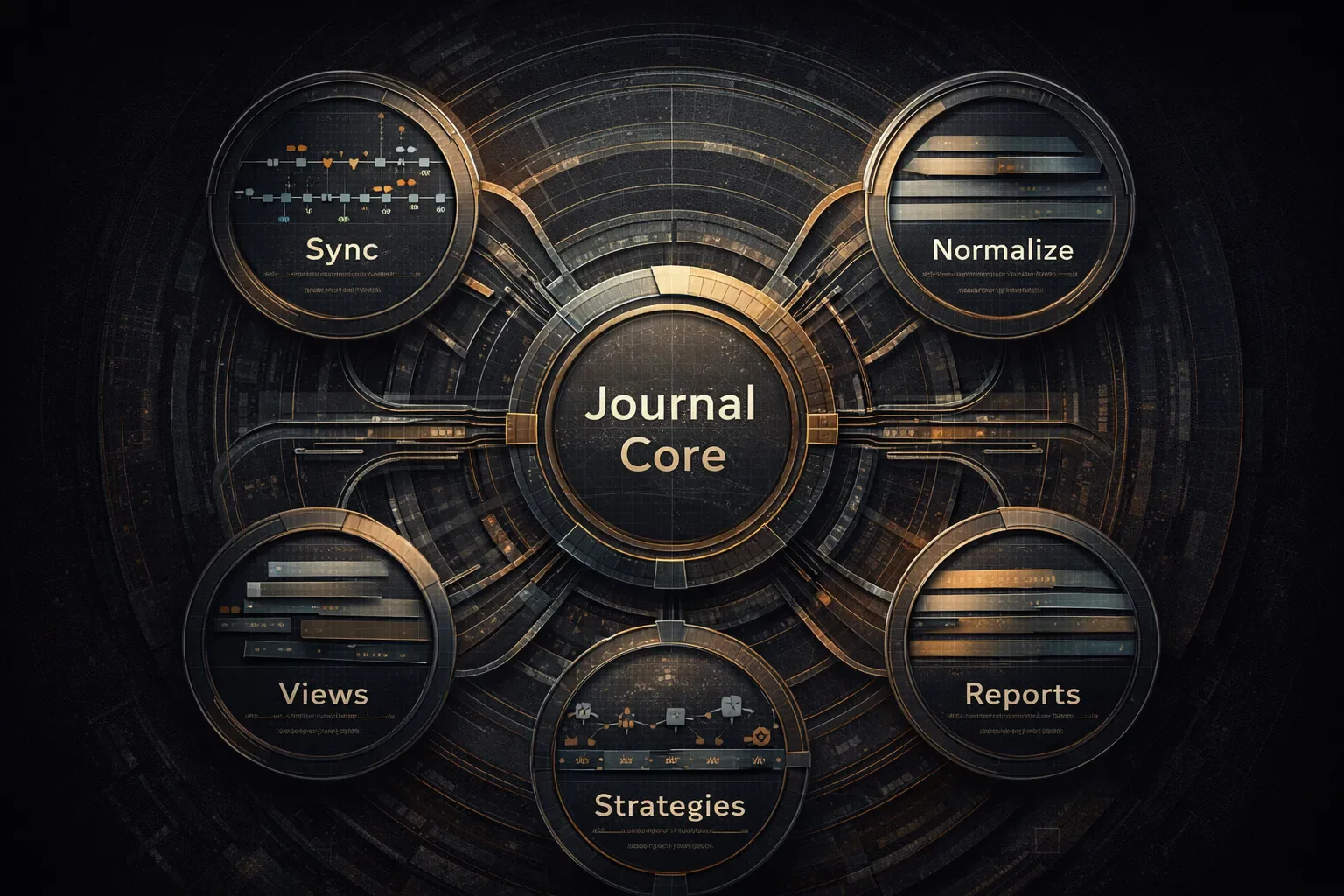
The third requirement is account-level and global visibility at the same time. You need to be able to look at one account in isolation when diagnosing a specific strategy. You also need to see all accounts combined when evaluating your real performance. If your journal forces you to choose one or the other, it is incomplete. Both perspectives matter, and switching between them should feel natural.
The fourth requirement is strategy segmentation that survives across accounts. If you trade the same setup on multiple platforms, your journal should treat those trades as one dataset. That is the only way to know whether a strategy works regardless of execution venue. If strategy performance is trapped inside individual accounts, you never see its true edge or lack of one.
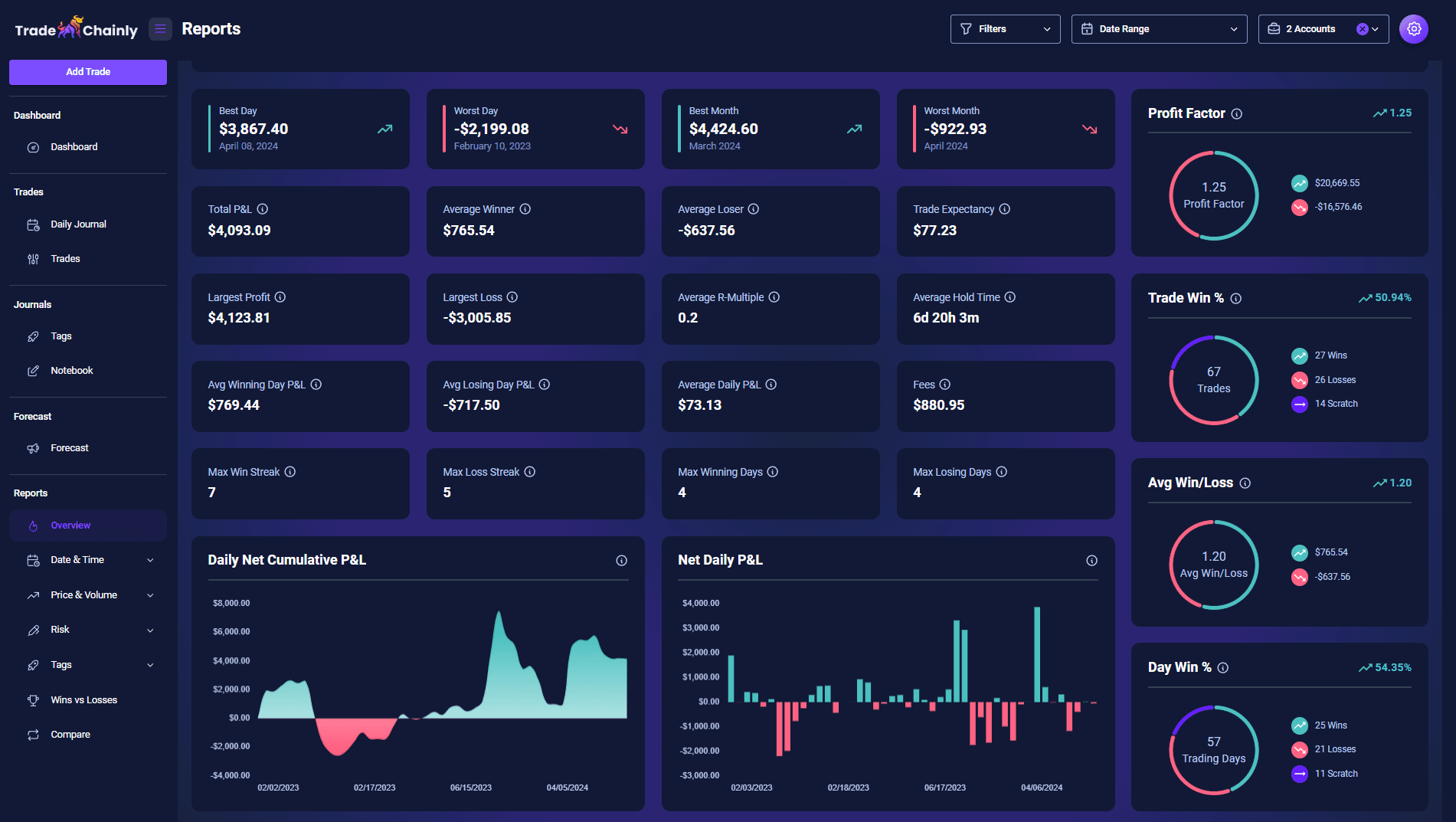
The fifth requirement is reliable reporting. Metrics like expectancy, drawdown, profit factor, and average R only make sense when the underlying data is complete. Partial data creates false confidence or unnecessary fear. A multi-account system must protect the integrity of these numbers.
| Requirement | What It Enables | What Happens Without It |
|---|---|---|
| Multi-exchange auto-sync | Complete trade history across all platforms | Missing trades, outdated data, broken performance metrics |
| Data normalization | Fair comparison between exchanges and accounts | Inconsistent stats, misleading win rates and expectancy |
| Account and global views | Precise diagnosis and accurate total performance | Tunnel vision on single accounts or loss of clarity |
| Strategy segmentation | Honest evaluation of setups across environments | Strategies appear profitable or unprofitable by accident |
| Unified reporting | Trustworthy analytics and decision making | Emotional trading based on distorted numbers |
These requirements are not “nice to have” features. They are structural. Without them, a multi account trading journal cannot be reliable. It becomes a storage system instead of a performance system.
This is where automation stops being about convenience and starts being about correctness. When your trading operation grows across accounts and exchanges, your journal has to grow into an analytical engine that can hold everything together.
Manual vs Automated Multi-Account Journaling
Most traders try to make manual journaling work before they ever consider automation. At first, it feels manageable. You export a CSV from Binance, another from Bybit, maybe one more from OKX. You paste everything into a spreadsheet. You clean up the columns. You adjust a few timestamps. You tell yourself it only takes fifteen minutes.
That is true when you have twenty trades. It stops being true when you have two hundred. And it completely collapses when you are trading every day across multiple platforms.
Manual systems fail for three reasons: time, error accumulation, and inconsistency.
Time is the obvious one. Every additional account multiplies the work. Each exchange has its own export format, its own quirks, and its own missing fields. What started as a quick task becomes a recurring maintenance job. Eventually, you fall behind. Then you stop trusting the journal because you know it is incomplete.
Error accumulation is more dangerous because it is silent. A missed import here. A duplicated trade there. A funding payment counted as a loss. A partial fill treated as a full position. Each mistake is small. Together, they bend your statistics. Your expectancy shifts. Your drawdowns look smoother than they really are. You start optimizing based on distorted information.

Inconsistency is what kills long-term value. Some weeks your journal is perfect. Other weeks it is three days behind. Sometimes you log spot trades. Sometimes you forget. The result is a dataset that cannot be trusted as a historical record. And if your history is unreliable, your analysis becomes opinion instead of evidence.
Automation solves these problems by removing the human bottleneck. When trades sync automatically from Binance, Bybit, Coinbase, or OKX, your journal becomes a living system instead of a periodic snapshot. Your data stays current. Errors drop dramatically. Your review process becomes about interpretation, not data cleanup.
There is also a psychological shift. When your journal updates on its own, you stop seeing journaling as a chore. It becomes part of your trading environment. Just like your charting platform, it is always there, always accurate, and always ready for review.
For multi-account traders, this shift is critical. Automation is not a luxury feature. It is what makes scale possible. Without it, the complexity of your operation eventually overwhelms your ability to analyze it.
Structuring Your Accounts for Meaningful Analysis
Once automation is in place, the next problem is structure. How your accounts are organized determines what kind of insights your journal can actually produce. Poor structure creates noise. Good structure turns raw trade data into something you can reason about.
The first decision is whether accounts should represent capital separation or strategy separation. These are not the same thing. If you split accounts only because exchanges require it, then strategies should live across accounts. If you split accounts to isolate strategies, then each account should have a clearly defined trading purpose. Mixing both ideas without clarity leads to confusion. You end up with accounts that do not mean anything analytically.
For example, if you trade a breakout strategy on both Binance and Bybit, those trades should be analyzed together. The exchange is just an execution venue. It should not define the strategy’s identity. On the other hand, if one account is dedicated to high leverage scalping and another is for lower risk swing trades, keeping them separate makes sense because they represent different risk systems.
This is where many traders overcomplicate things. They create too many categories, too many accounts, and too many labels. The journal becomes a maze instead of a map. The goal is not perfect segmentation. The goal is useful segmentation.
A simple rule helps. Accounts should answer structural questions. Tags and notes should answer behavioral and strategic questions. If you use accounts to describe emotions, mistakes, or setups, you are misusing them. Those belong in your tagging system.
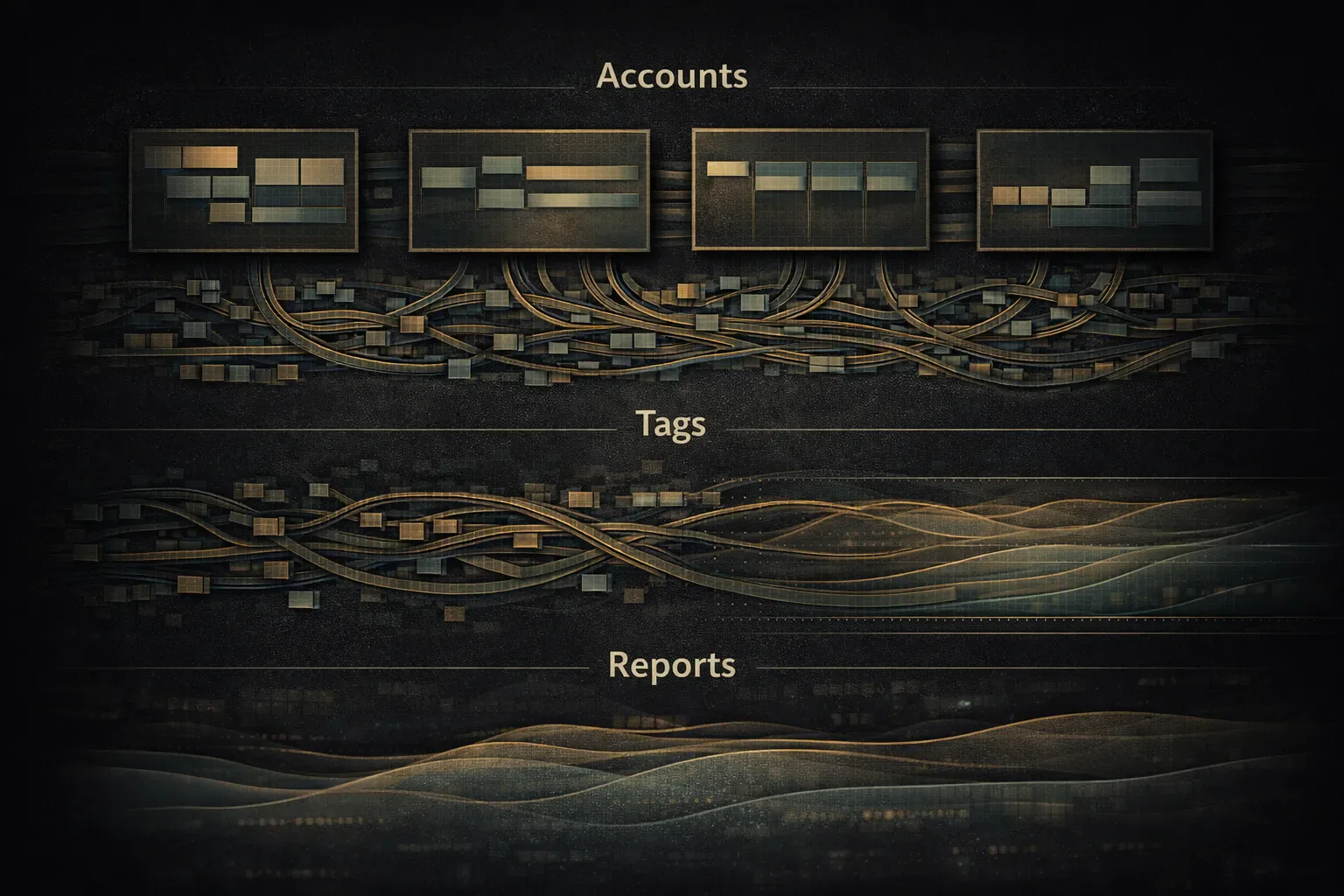
A clean structure often looks like this:
- Accounts separate capital, risk profiles, or execution environments.
- Tags define strategies, setups, mistakes, and market conditions.
- Reports combine everything into one performance view.
With this approach, you can ask meaningful questions. How does my breakout strategy perform across all exchanges? Which risk profile produces the smoothest equity curve? Does my scalping account distort my overall drawdown? These questions only make sense when structure is intentional.
A multi account trading journal should feel like a lens, not a filing cabinet. The structure exists to sharpen analysis, not to create more complexity. When accounts are designed with purpose, the data starts telling a coherent story instead of a scattered one.
Using Tags, Notes, and Metadata Across Accounts
When you trade across multiple accounts, tags become the glue that holds everything together. Accounts define structure, but tags define meaning. Without a consistent tagging system, a multi account trading journal is just a collection of disconnected trades that happen to sit in the same place.
The biggest mistake traders make is changing their tagging logic from one account to another. A breakout trade on Binance gets tagged one way. The same setup on Bybit gets tagged differently. Over time, this destroys your ability to analyze patterns because the same behavior is labeled as multiple things. Your journal shows diversity, but it is artificial.
Tags should be universal across all accounts. A setup is a setup regardless of where it is executed. A mistake is a mistake whether it happens on spot or futures. This consistency is what allows your journal to answer real questions. Which setups actually work? Which mistakes cost the most? Which market conditions produce the best outcomes?
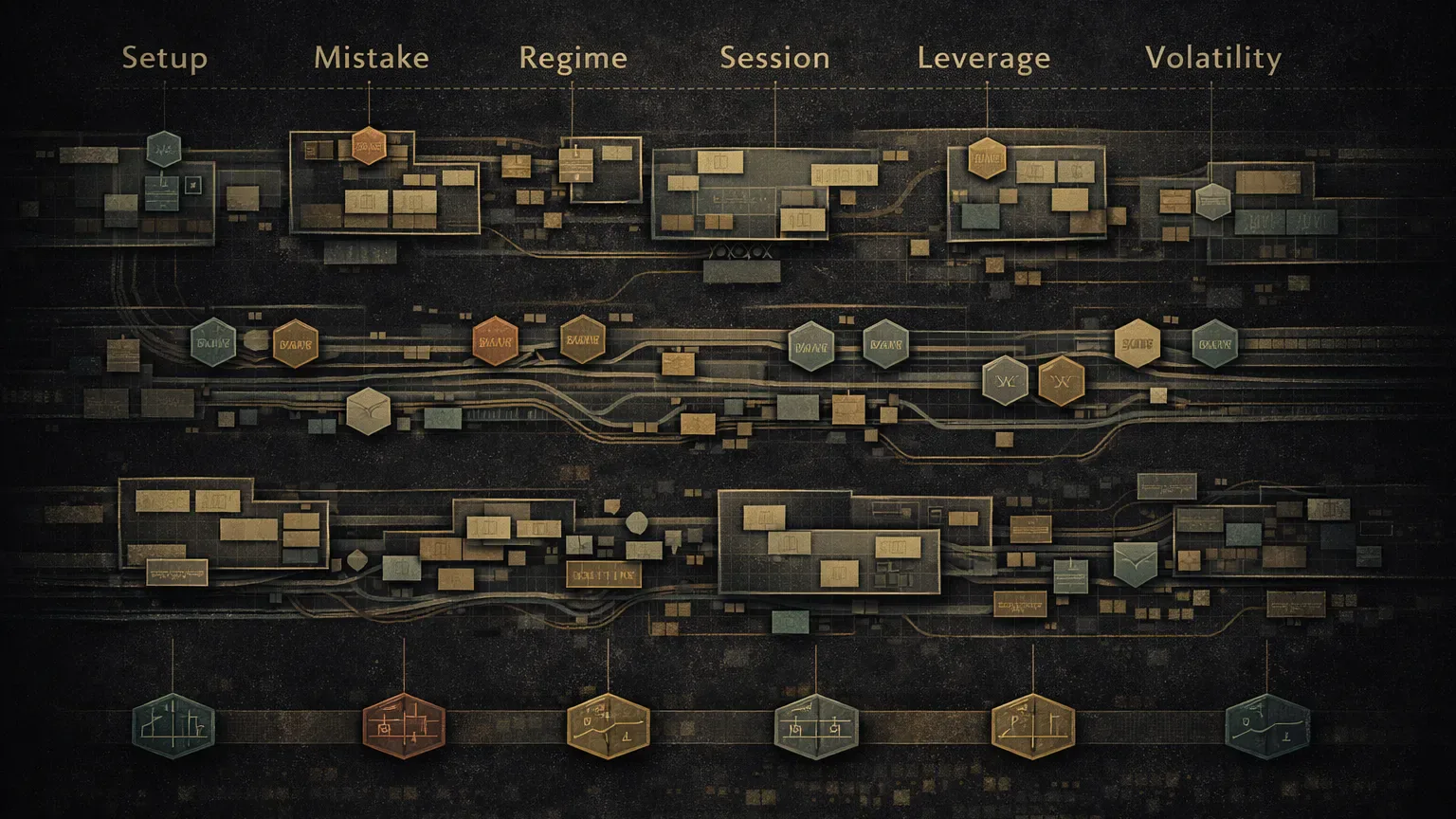
Notes add the layer that tags cannot capture. A tag can say “early entry.” A note can explain why it happened. A tag can say “trend continuation.” A note can record whether you felt confident or rushed. When this context is spread across accounts, notes become critical for understanding behavior patterns that do not show up in statistics alone.
Metadata matters too. Time of day, session, market regime, leverage level, or volatility environment can all be tracked consistently. When these fields are standardized across accounts, your journal becomes a research tool instead of just a history log.
In a well-built multi account trading journal, tags and notes do three things at once. They unify strategies across exchanges. They reveal behavior patterns that numbers cannot show. And they create a shared language for your trading decisions.
This is where platforms like TradeChainly quietly become powerful. When trades from Binance, Bybit, or Coinbase flow into one place and share the same tagging system, you stop thinking in terms of platforms and start thinking in terms of performance drivers. That shift is subtle, but it changes how you review, adapt, and improve.
Building Reports That Actually Reflect Reality
The biggest danger in multi-account trading is thinking you understand your performance when you only understand parts of it. Reports are where that illusion either gets reinforced or destroyed. If your reporting is fragmented, your decisions will be too.
When accounts are analyzed in isolation, it is easy to draw the wrong conclusions. One account might show a smooth equity curve and strong expectancy. Another might show heavy drawdowns and inconsistent execution. If you only look at them separately, you never see how they interact. You might believe you have one strong system and one weak system, when in reality the weak system is canceling out the gains of the strong one.
Unified reporting changes that. When all accounts feed into the same performance view, your true risk profile becomes visible. You see your real drawdown. You see whether your overall expectancy is positive. You see whether your capital allocation actually makes sense.
This also affects how you judge strategies. A setup that looks profitable on one exchange may become mediocre when all trades are combined. Another setup that seems average in isolation may become your strongest performer when you see it across every account. Without unified reports, you are making strategic decisions based on partial evidence.
| View Type | Net PnL | Max Drawdown | Expectancy (R) | Interpretation |
|---|---|---|---|---|
| Account A only | +3,200 | -900 | 0.45 | Looks like a solid, profitable system |
| Account B only | -2,600 | -1,400 | -0.30 | Appears as a weak or failing strategy |
| Unified (A + B) | +600 | -1,900 | 0.05 | Shows low edge and high risk exposure |
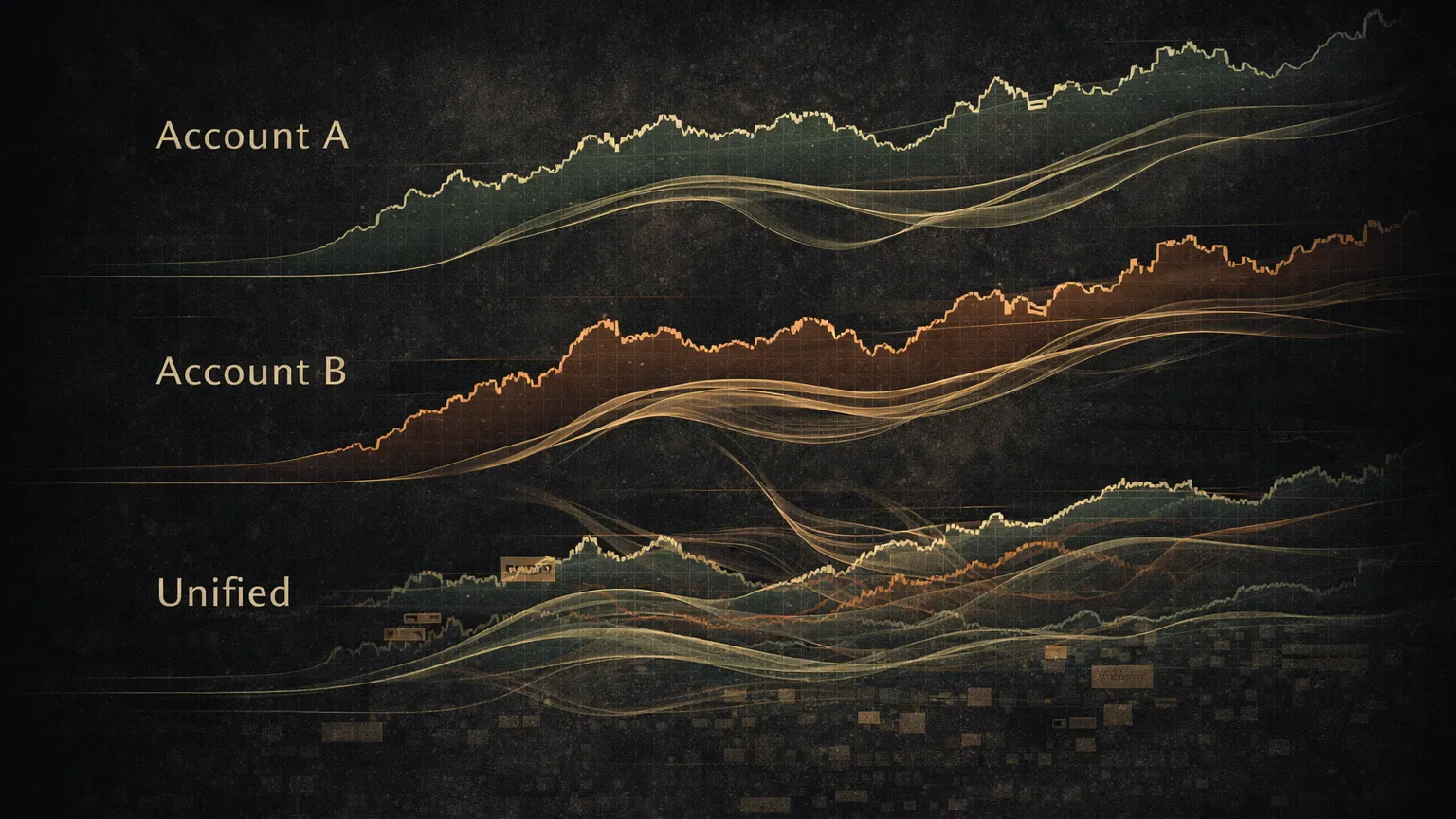
In isolation, Account A encourages confidence and scaling. Account B encourages abandonment. In reality, the combined view shows that the overall operation is fragile. That insight only appears when the journal is allowed to tell the full story.
Good multi-account reporting should also let you filter by strategy, tag, or risk profile while still preserving the unified context. You want to zoom in without losing the big picture. That balance is what makes a journal useful for both tactical reviews and strategic decisions.
When reports reflect reality, they stop being motivational tools and become management tools. They help you allocate capital, kill weak strategies, protect strong ones, and understand how your trading actually behaves as a system.
Common Pitfalls in Multi-Account Crypto Journaling
Even with automation and a solid structure, multi-account journaling has failure points that quietly corrupt your data if you are not paying attention. These problems rarely appear all at once. They creep in slowly and make your journal less reliable over time.
One of the most common issues is duplicated trades. This usually happens when accounts are reconnected, API keys are refreshed, or historical imports overlap with live syncing. If your system does not detect duplicates properly, your win rate and expectancy inflate artificially. Everything looks better than it really is, which is the most dangerous type of error.
Missing trades are just as harmful. An API connection can fail. An exchange can limit historical depth. A sub-account can be forgotten. When trades disappear, your statistics shift in the opposite direction. Your journal becomes overly pessimistic and you start questioning strategies that are actually working.
Timezone mismatches are another silent problem. Different exchanges log trades in different time standards. If your journal does not normalize time correctly, daily performance, session analysis, and market condition tagging all become unreliable. You think you traded during one session when you actually traded during another.

Strategy contamination happens when trades are misclassified or tagging rules are unclear. A breakout trade gets labeled as a scalp. A hedge gets treated as a primary position. Over time, strategy performance data becomes blurred and unusable.
Over-segmentation is more subtle. Some traders create too many accounts, too many tags, and too many categories. Instead of clarity, they create fragmentation inside their own journal. If a dataset is too small, no pattern will ever become statistically meaningful.
These pitfalls are not reasons to avoid multi-account journaling. They are reasons to build it deliberately. A strong system does not eliminate errors entirely, but it makes them visible and correctable before they distort decision-making.
Turning Complexity Into an Advantage
Trading across multiple accounts is not a flaw in your process. It is usually a sign that your operation has matured. You are separating risk, testing strategies, adapting to different exchanges, and building a structure that fits how you actually trade. The problem only appears when your journal cannot keep up with that complexity.
A multi account trading journal should not make your work harder. It should remove friction, protect your data, and give you a view of your performance that is honest and complete. When everything flows into one system automatically, the confusion fades. You stop wondering whether your stats are accurate. You stop guessing which strategy really works. You stop managing spreadsheets and start managing decisions.
The shift is subtle but powerful. Instead of thinking in terms of platforms, you start thinking in terms of edge. Instead of comparing accounts, you compare behaviors. Instead of reacting emotionally to individual results, you manage your trading as one unified operation.
This is where automation becomes more than convenience. It becomes the foundation that allows your trading to scale without losing clarity. The more accounts and strategies you run, the more valuable that foundation becomes.
Platforms like TradeChainly are built around this exact reality. When trades from Binance, Bybit, Coinbase, or OKX sync continuously into a single journal, you gain the ability to see your trading as a system instead of a collection of disconnected actions. Tagging, reporting, and review stop being fragmented tasks and become part of a consistent workflow.

If you trade across multiple accounts, your journal should be strong enough to hold that complexity without distorting it. When it does, complexity stops being a burden and starts becoming an advantage. It gives you more data, more perspective, and more control over how your trading evolves.