Why Most Trading Mistakes Keep Repeating
Every trader has been there. You look back at a trading week and realize most of the damage came from the same few mistakes. Maybe you overleveraged on a fast Bitcoin move. Maybe you chased a breakout on Solana that had already run. Or maybe you refused to accept a loss and turned a small red trade into a serious hit to your account.
When these mistakes repeat, they are rarely random. They come from habits, impulses, and blind spots that show up again and again in your trading. The problem is that most traders never measure them. They journal loosely, rely on memory, or simply tell themselves they will “do better next time.” Without data, those mistakes eventually return.
TradeChainly is built to fix that problem. The platform gives crypto day traders and scalpers a structured way to tag mistakes, track them across all trades, and turn them into measurable performance data. Instead of guessing what went wrong, you can open your Tag Reports and see exactly which mistakes cost you the most money, which ones show up most often, and which ones destroy your expectancy.
This blog is not about theory or generic psychology tips. It is about a clear, repeatable workflow you can use inside TradeChainly to analyze your trading mistakes using Tag Reports. You will see how to set up mistake tags, apply them consistently to your trades, and review the metrics that matter so you can remove the behaviors that hold you back.
If you want to become more consistent, this is one of the highest leverage habits you can build into your trading routine.
What Trading Mistake Analysis Really Means
When most traders think about reviewing their performance, they usually think about P&L. If the week finished green, they assume they traded well. If it finished red, they assume they traded badly. The problem is that P&L alone almost never tells the full story. You can make money while trading poorly, and you can lose money while following your plan perfectly. That is the nature of probabilistic outcomes in crypto trading.
Trading mistake analysis means something deeper. It means breaking down your results by behavior, not just by trade outcome. Instead of asking “Did I win or lose?”, you start asking questions like:
Did I size up emotionally after a losing streak? Did I chase price during high volatility? Did I ignore my stop loss? Did I exit too early because I was scared to give back profit?
These are not market problems. They are trader behaviors. If you want to improve as a trader, you need to measure those behaviors so you can see how they affect your performance over time.
This is where tagging becomes powerful. Inside TradeChainly, you can assign mistake tags to any trade. For example, you might use tags such as “FOMO entry,” “overleveraging,” “revenge trading,” or “did not cut losses.” Over time, these tags build a dataset around your decision-making. Instead of relying on memory, you have hard evidence.
Crypto trading makes this even more important. Leverage amplifies mistakes. The 24/7 market environment increases temptation. Sudden volatility creates emotional reactions. Small lapses in discipline can snowball quickly. If you do not track your mistakes in a structured way, they will quietly compound and erode your edge.
TradeChainly allows you to convert those subjective mistakes into objective metrics. Once your tags are in place, Tag Reports help you see the financial impact of each behavior across your entire trading history. That is what trading mistake analysis really means. You are no longer guessing where you go wrong. You are measuring it.
This shift alone can completely change how you review your trading. Instead of reacting emotionally to your P&L, you begin to focus on the root cause behaviors that drive your results.
Setting Up Mistake Tags Inside TradeChainly
Before you can analyze your mistakes, you first need a clean and consistent tagging system inside TradeChainly. The goal is simple. Any time you make a mistake, you should be able to label it in a structured way so that TradeChainly can group those trades together and calculate the impact automatically.
TradeChainly already helps you get started. On the Tags page, you will see that categories like Setups and Mistakes are already created for you. Setups are for tagging strategies that you intentionally trade. Mistakes are for tagging behaviors that should not have happened. You can also create new categories if you want to organize your tags even more specifically.
Inside the Mistakes category, you can begin adding mistake tags that match your trading reality. For example, a crypto scalper on Binance or Bybit might create tags such as:
FOMO entry
Overleveraging
Chasing after breakout
Did not cut losses
Moved stop loss
Revenge trading
Closed too early
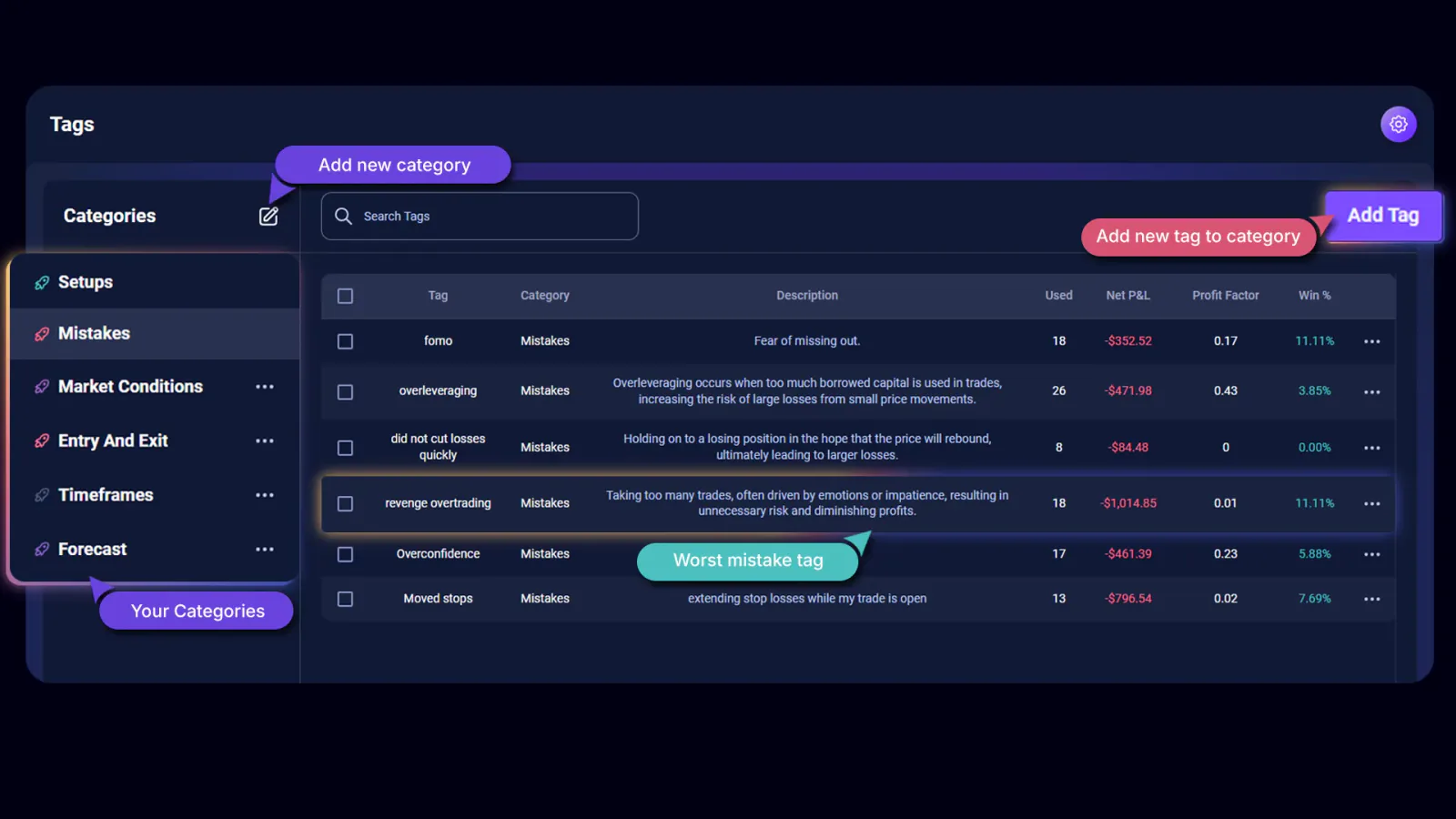
Each tag has a name and description so you always remember exactly what it means. TradeChainly also shows you how many times that tag has been used, along with performance stats like Net P&L, Profit Factor, and Win %. That means your mistake list is not just a label library. It is a live performance database.
Mistake tags work best when they are specific enough to be useful, but not so granular that you create confusion. “Fear” is too vague. “Closed early because I feared a reversal” is far more useful because it reflects a real behavior pattern you can measure.
You also want your mistake list to be honest. If you sometimes size up emotionally after winning trades, tag it. If you chase liquidation hunts on low liquidity coins, tag it. The goal is not to make yourself look disciplined. The goal is to capture reality.
Once your tags are set up, they become available anywhere inside TradeChainly where you interact with trades. This sets the foundation for Tag Reports, because TradeChainly now understands which trades were connected to which behaviors.
With your mistake tags prepared, the next step is applying them consistently across your trades so the dataset grows over time.
Assigning Mistake Tags to Your Trades
Now that your mistake tags are created, the real work is using them consistently. A tagging system only becomes powerful when every mistake is recorded. That way, TradeChainly can connect your behavior patterns with your results over time.
There are two main ways traders usually assign mistake tags inside TradeChainly.
The first is during your trading review, inside the Trade Details page. When you open any trade, you will see the Tags tab on the left. From there, you can quickly attach one or more mistake tags to that trade. This is especially useful when you are going through trade reviews at the end of the day or the end of the week. You can look at the TradingView chart, check your entries, analyze your execution, and then honestly ask yourself: “Did I follow my plan?” If the answer is no, you choose the mistake tag that matches what happened.
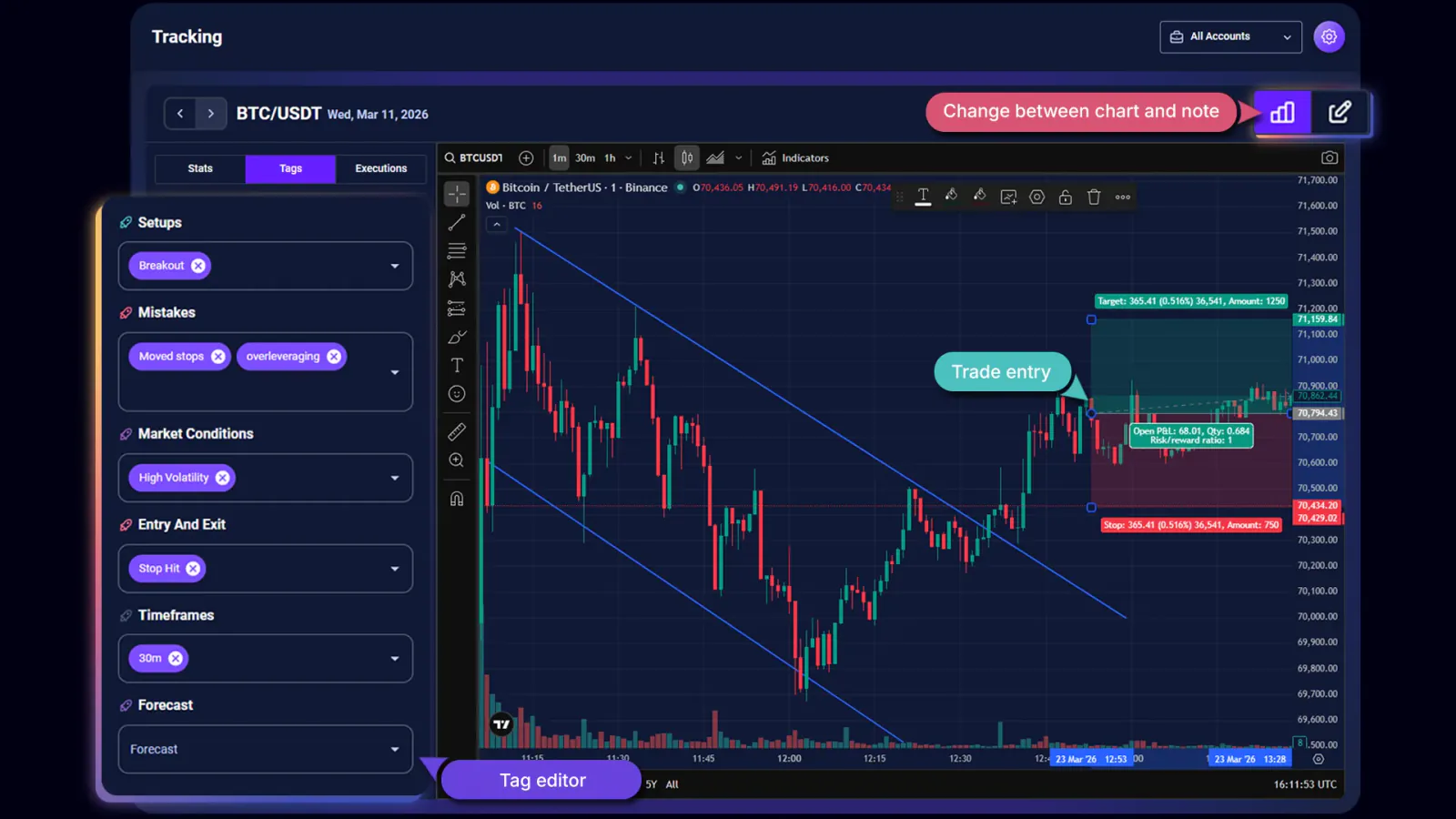
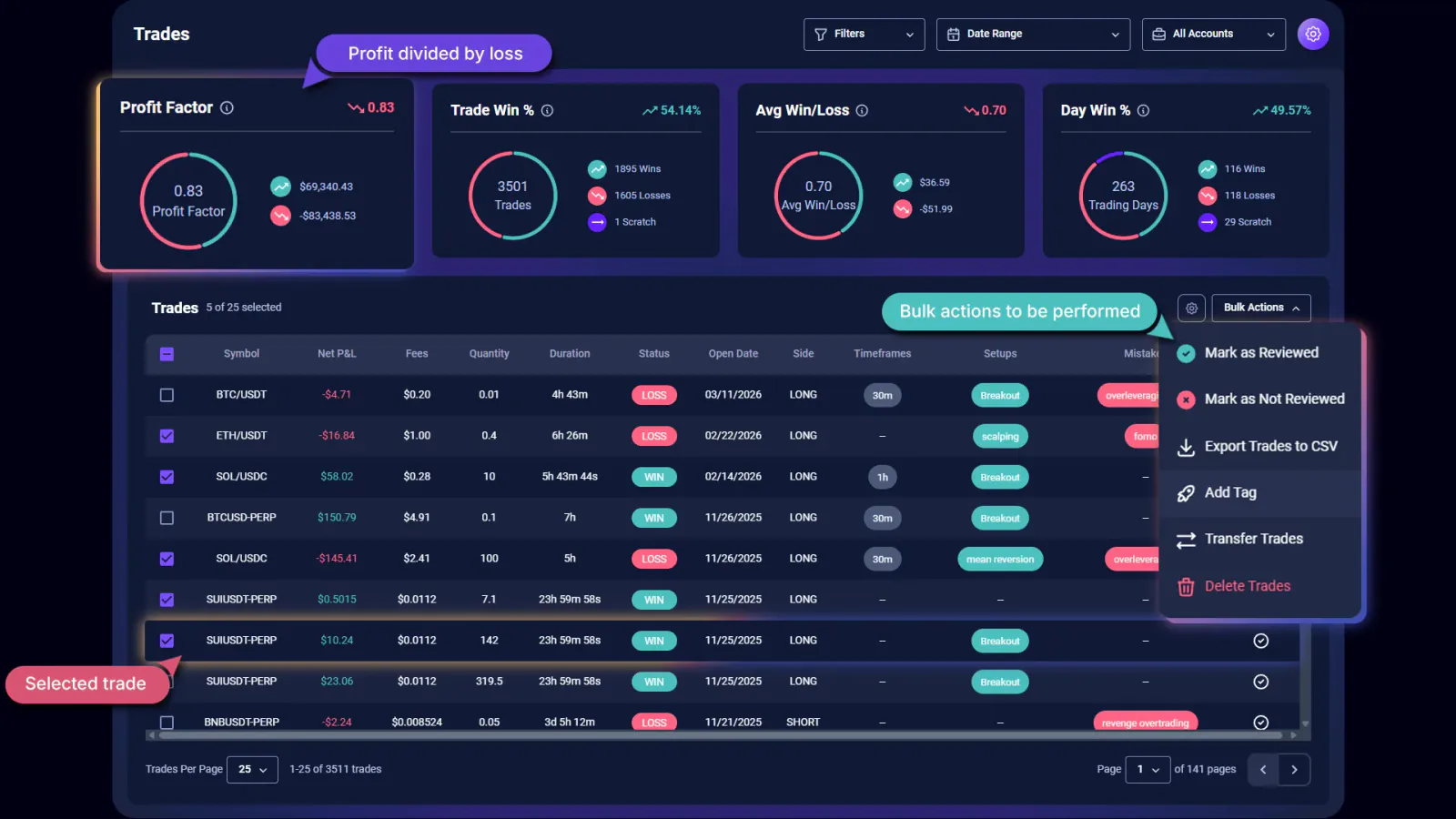
The second way is bulk tagging from the Trades page. This is helpful if you are catching up on older trades or cleaning up your journal. You can filter trades, select multiple entries, and apply the same mistake tag to all of them at once. For example, if you know that most of your liquidation-risk trades on Bybit came from overleveraging, you can bulk-assign the “Overleveraging” tag in one step.
There is no single rule for when you should tag mistakes. Some traders do it immediately after closing a trade. Others wait until the end of the session when emotions have cooled. What matters most is honesty and consistency. If you only tag obvious blow-ups and ignore the subtle mistakes, your Tag Reports will not reflect the full picture.
Think about situations like these:
You added size because the trade “felt good.”
You ignored your stop loss during a wick.
You chased a parabolic altcoin after seeing social media hype.
You exited too early because funding fees scared you.
All of those are valid mistake tags inside TradeChainly.
Over time, tagging becomes a habit. You stop seeing it as punishment and start seeing it as data collection. You are not judging yourself. You are labeling behavior so that the system can show you patterns later.
Once you have a growing set of trades with mistake tags attached, you are ready for the real value. This is where TradeChainly’s Tag Reports turn your behavior labels into measurable, actionable insights.
Using Tag Reports to Analyze Your Mistakes
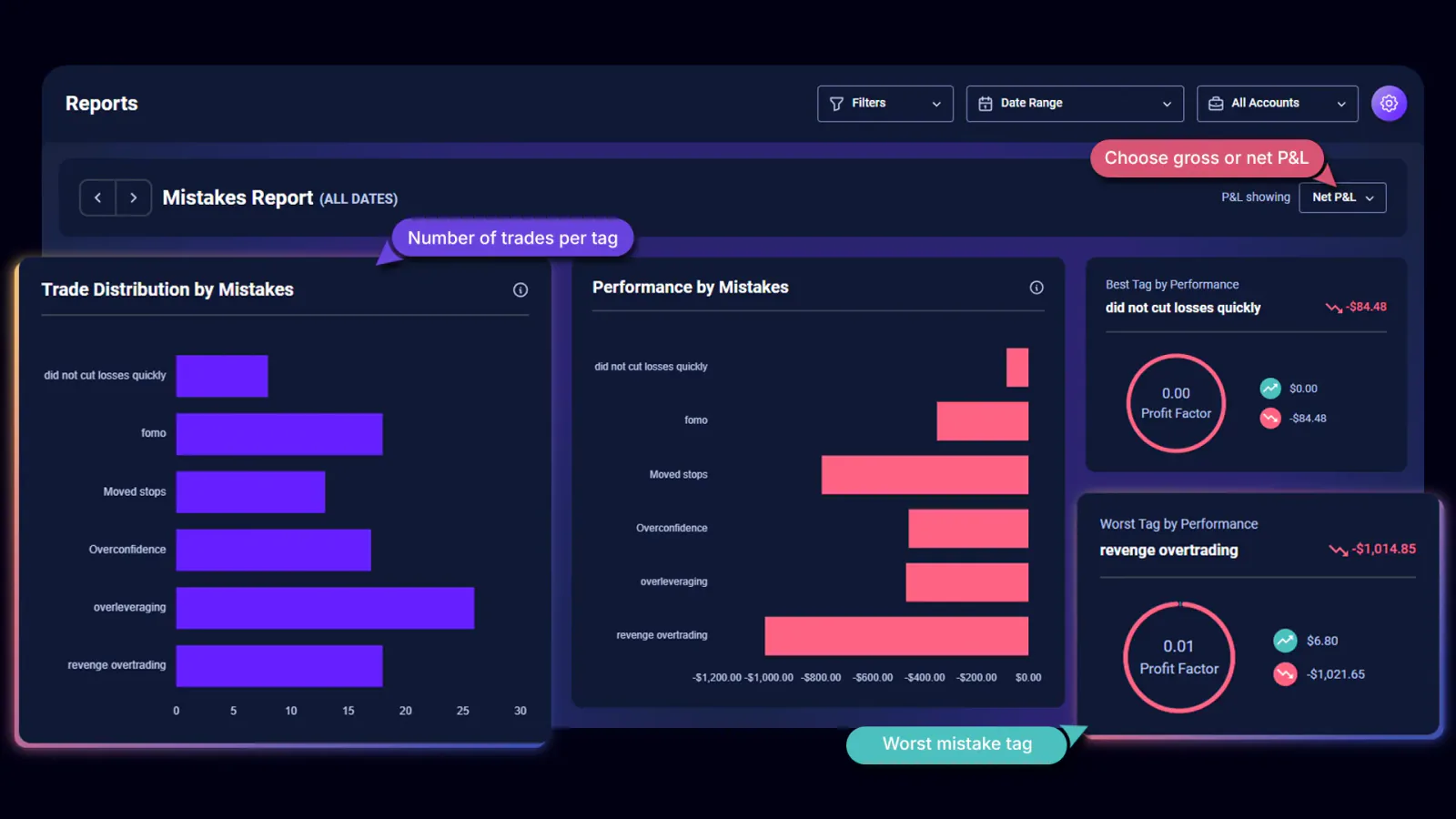
This is where everything comes together. Once you have been tagging your mistakes inside TradeChainly, Tag Reports give you a clear, data-driven picture of how each mistake impacts your performance. Instead of relying on memory or emotion, you are now looking at hard numbers.
When you open a specific mistake tag inside TradeChainly, you are taken to the Tag Details page. This is your command center for mistake analysis. Every trade that carries that tag is grouped together, and TradeChainly calculates a full set of performance metrics for that mistake alone.
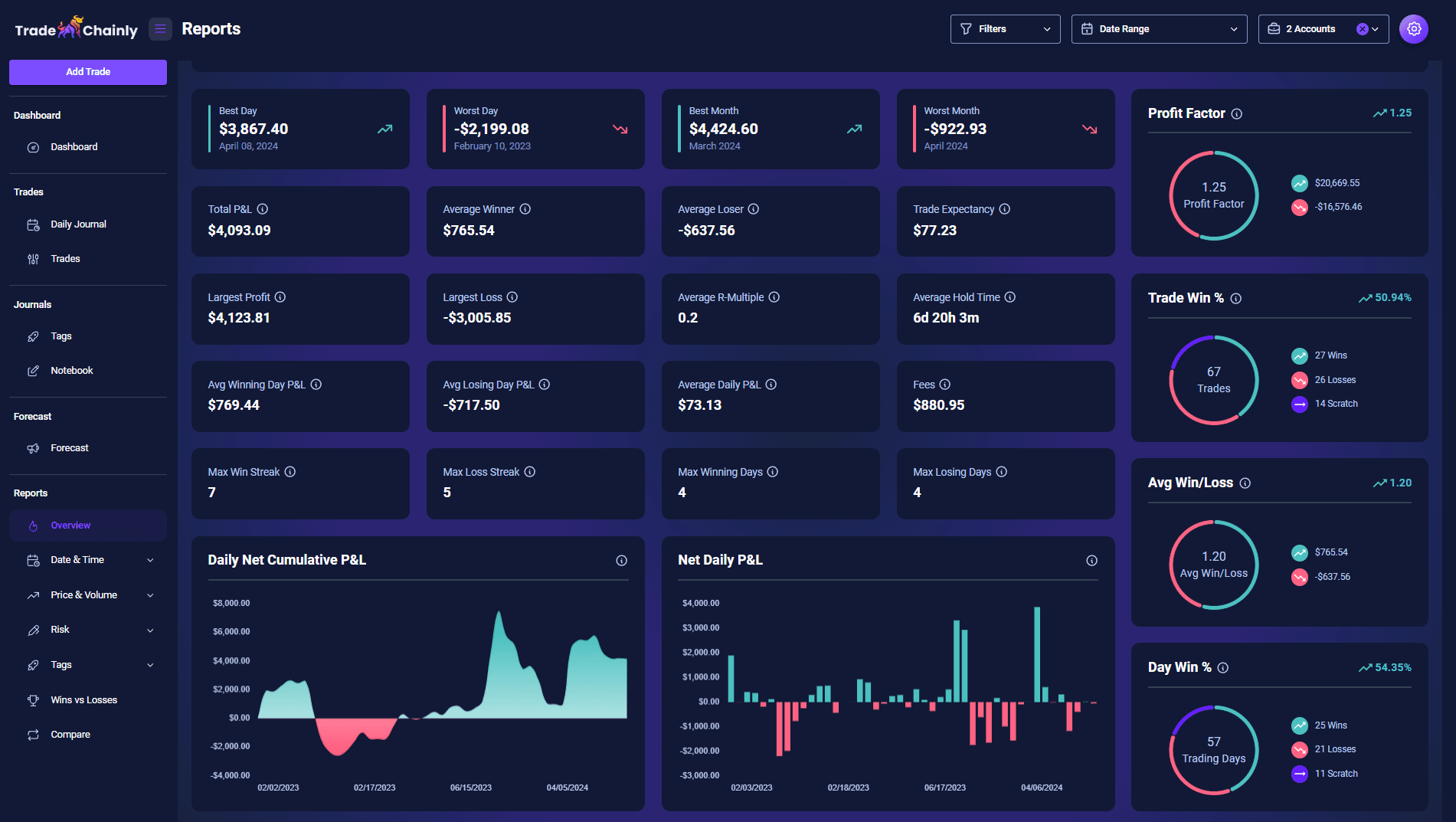
You will see metrics such as Net P&L, Average Winner, Average Loser, Trade Expectancy, Win %, Profit Factor, and more. These metrics tell a story. For example, if your “Overleveraging” tag shows a strongly negative expectancy, that means every time you overleverage, you are statistically likely to lose money over the long run. It might feel exciting in the moment, but the data exposes the truth.
Profit Factor is another powerful view. If your mistake tag shows a Profit Factor below 1.0, that mistake consistently loses more than it makes. You may also notice patterns in Average Hold Time. Maybe revenge trades last longer because you stubbornly refuse to close them. Or maybe panic exits show very short hold times and small losses that add up over time.
The charts provide even more context. The Daily Net Cumulative P&L chart shows how your account curve would look if you only traded when that mistake occurred. The Net Daily P&L chart shows the daily results tied to that behavior. These visuals help you see whether the mistake is an occasional issue or a persistent drag on your performance.
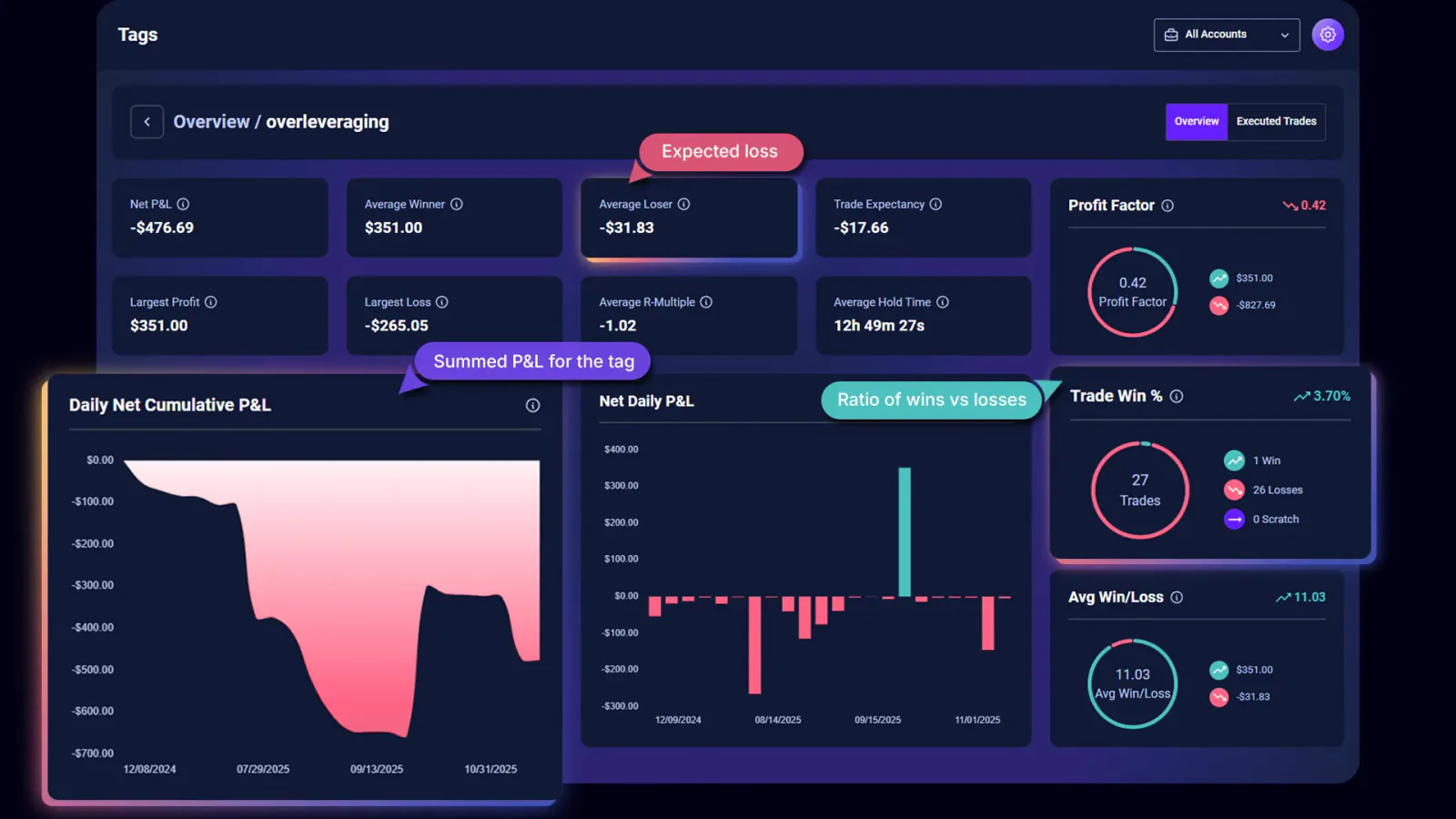
One of the most important mental shifts happens here. You stop arguing with yourself. You stop rationalizing. You stop saying things like, “Sometimes overleveraging works for me.” Instead, you look at the chart and see the consistent downward slope. The data becomes undeniable.
This level of mistake analysis is rare among traders. Most people only review winning and losing trades. With TradeChainly, you review behaviors. That is a completely different level of accountability and self-awareness.
When you can isolate a mistake and clearly see the financial damage it causes, improvement becomes far simpler. You are no longer trying to “trade better” in a vague sense. You are trying to remove one specific behavior that the data proves is hurting you.
And once you remove even one losing habit like that, your entire equity curve can change.
Turning Insights Into Actionable Improvements
Data only matters if it changes how you trade. Once you can clearly see which mistakes are costing you the most inside TradeChainly, the next step is turning those insights into real behavior change. This is where many traders go wrong. They identify the problem, feel motivated for a few days, then drift back into old habits. Your goal is to turn mistake awareness into structured improvement.
Start with the biggest damage source first. If your Tag Reports show that “Overleveraging” has the worst Net P&L and the lowest Profit Factor, that becomes priority number one. Do not try to fix everything at once. Focus on the single mistake that is dragging your results down the most. When you zoom in like this, improvement becomes manageable.
Then define a clear rule to counter the mistake. For example:
If the mistake is overleveraging, your new rule might be that you cap size at a fixed percentage of account equity for the next 30 days.
If the mistake is revenge trading, your rule might be to stop trading for the day after two consecutive losses.
If the mistake is cutting winners too early, your rule might be to scale out instead of exiting fully.
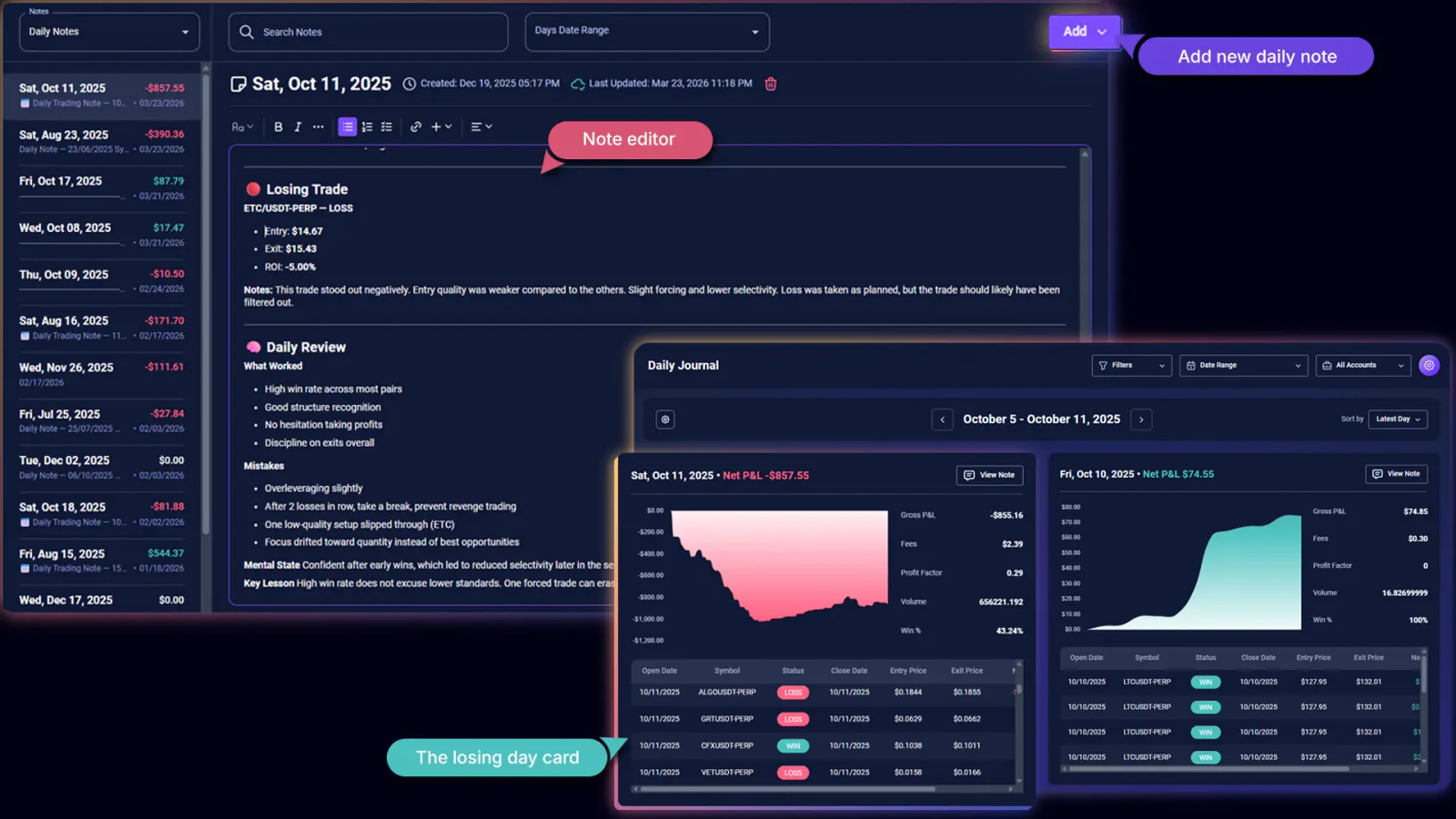
You can then reinforce these rules with daily journaling. Inside TradeChainly, the Notebook page or Daily Journal page gives you space to reflect on how well you followed your plan. This keeps the improvement loop alive. You trade, you review, you tag mistakes, and you write down what you learned.
Another powerful use of Tag Reports is spotting emotional cycles. If you notice mistake frequency spikes after a run of winning days, that tells you something about your mindset. If mistakes show up more often during high volatility sessions, that tells you where your discipline weakens. These patterns help you anticipate danger zones before they cost you money.
You can also combine mistake analysis with your setup performance. Maybe your best-performing setup turns negative only when paired with a specific mistake. For example, scalping breakout trades on Binance might work well for you, except when you size up beyond your normal risk. TradeChainly helps you spot that connection.
What this process really creates is self-awareness supported by data. You are no longer reacting to outcomes. You are studying behaviors, refining rules, and building discipline with structure instead of emotion.
Trading will always involve uncertainty. But your decision-making does not need to be random. When you consistently use mistake tags and Tag Reports inside TradeChainly, your trading starts to look more like a professional review process and less like guesswork.
Over time, the number of mistake-tagged trades should shrink. That is how you know the system is working.
What Happens When You Finally Track Your Mistakes Properly
If you trade crypto actively, mistakes will happen. You will misread moves. You will get emotional during volatility. You will occasionally push size too far or hesitate at the wrong moment. None of that makes you a bad trader. What separates improving traders from stagnant ones is the willingness to study those mistakes honestly and turn them into data.
TradeChainly is built to help you do exactly that. By tagging your mistakes and reviewing them through Tag Reports, you gain real visibility into the behaviors that damage your performance. You stop guessing. You stop blaming the market. You stop relying on vague intuition. Instead, you look directly at the numbers and understand how each mistake affects your P&L, your expectancy, and your consistency.
This is professional-level review. You are not just journaling. You are building a feedback loop that helps you remove losing habits one at a time. Over months of consistent review, those small corrections compound. You take fewer impulsive trades. You respect your stops more. You avoid overleveraging during emotional moments. The result is steadier execution and more predictable decision-making.
If you are ready to take trading mistake analysis seriously, start by setting up your mistake tags inside TradeChainly and apply them to your trades starting today. Then review your Tag Reports weekly and let the data guide your adjustments. The path to consistency is not magic. It is structured reflection, supported by the right tools.
TradeChainly gives you those tools. The rest is your discipline and commitment to using them.