Why Tagging Changes Everything
If you trade crypto actively, you already know how fast things move. Bitcoin breaks out while Solana pulls back. Funding flips. Liquidity shifts. One day you feel completely in sync with the market. The next day you give back three days of gains in a single session. It is not that you don’t know how to trade. The real challenge is knowing which trades are actually making you money, and which ones only feel like they are working in the moment.
Most traders rely on memory. You think “I do well with breakout scalps” or “I always lose when I fade trends” or “I need to stop revenge trading after losses.” But when you look at your account P&L, it rarely confirms the story you tell yourself. You may be profitable overall, yet most of your gains might come from just one or two specific setups. At the same time, a single recurring mistake may quietly drain your account over time.
This is where trading journal tags become powerful.
Inside TradeChainly, tags allow you to label every trade with the setup you executed, the mistakes involved, the emotions you felt, or any other meaningful category you want to track. Instead of guessing which trades work best, you can see the data clearly. You are no longer looking at one big P&L number. You are breaking that P&L down into what actually drives it.
For crypto traders, this matters even more. You may take dozens of trades per week across Binance, Bybit, Coinbase, Kraken, KuCoin, Crypto.com, or OKX. Markets run 24/7. Leverage magnifies both gains and losses. Without structure, patterns blur together. TradeChainly helps you turn that chaos into clarity.
Tagging trades is not busywork. It is the foundation of a repeatable edge. When you tag consistently, you can answer questions like:
Which setups actually generate profit?
Which mistakes cost the most money?
Do I trade better on certain symbols?
Does leverage change my performance?
Do I hold winners long enough?
Do I cut losers late?
You stop trading blindly. You start trading informed.
In this guide, you’ll learn exactly how you can use tags inside TradeChainly to identify your most profitable setups, eliminate losing behaviors, and speed up your path to consistency. We will keep things practical and workflow-focused, so you can start applying this immediately in your own trading.
What Are Trading Journal Tags?
Before we go deeper into workflows, let’s get clear on what trading journal tags actually are.
A tag is simply a label you attach to a trade. It tells you what type of trade it was, what happened during the trade, or what decisions influenced the result. Inside TradeChainly, tags help you organize your trades into meaningful groups so you can analyze performance at a much deeper level than just wins and losses.
Most traders use three main types of tags.
Setup tags describe the trading idea you executed. For example, breakout scalp, momentum continuation, range fade, VWAP reclaim, or liquidation sweep. When you apply setup tags consistently, you start to see which ideas actually put money in your account.
Mistake tags highlight what went wrong. Things like fomo entries, chasing green candles, oversizing, ignoring stop loss, moving stops, or revenge trading. These tags reveal the bad habits that silently drain your P&L.
Emotion tags help you track mindset. Fear. Overconfidence. Hesitation. Frustration. Emotional patterns often appear before performance problems. Seeing them in your data gives you early warning signals.
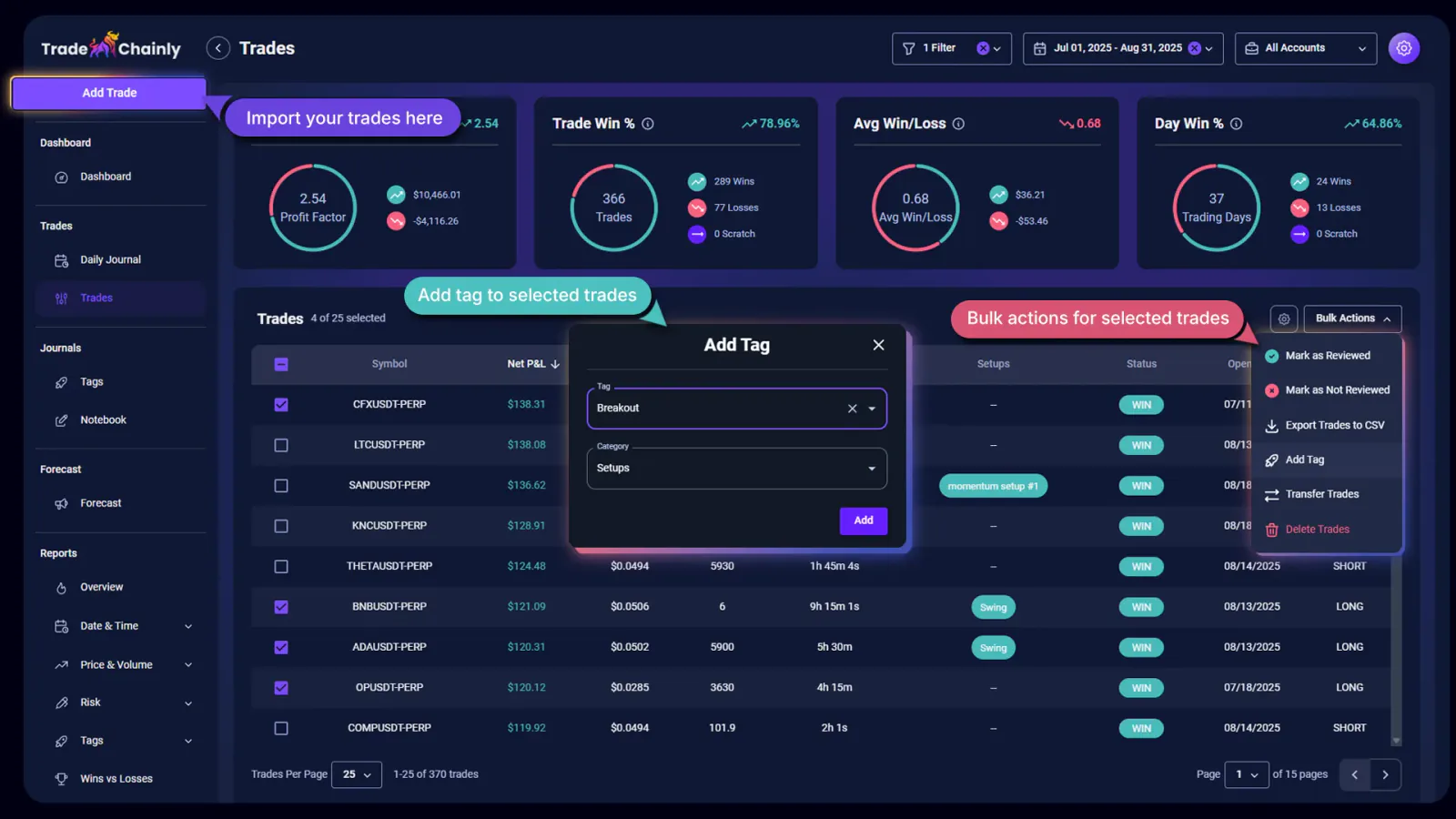
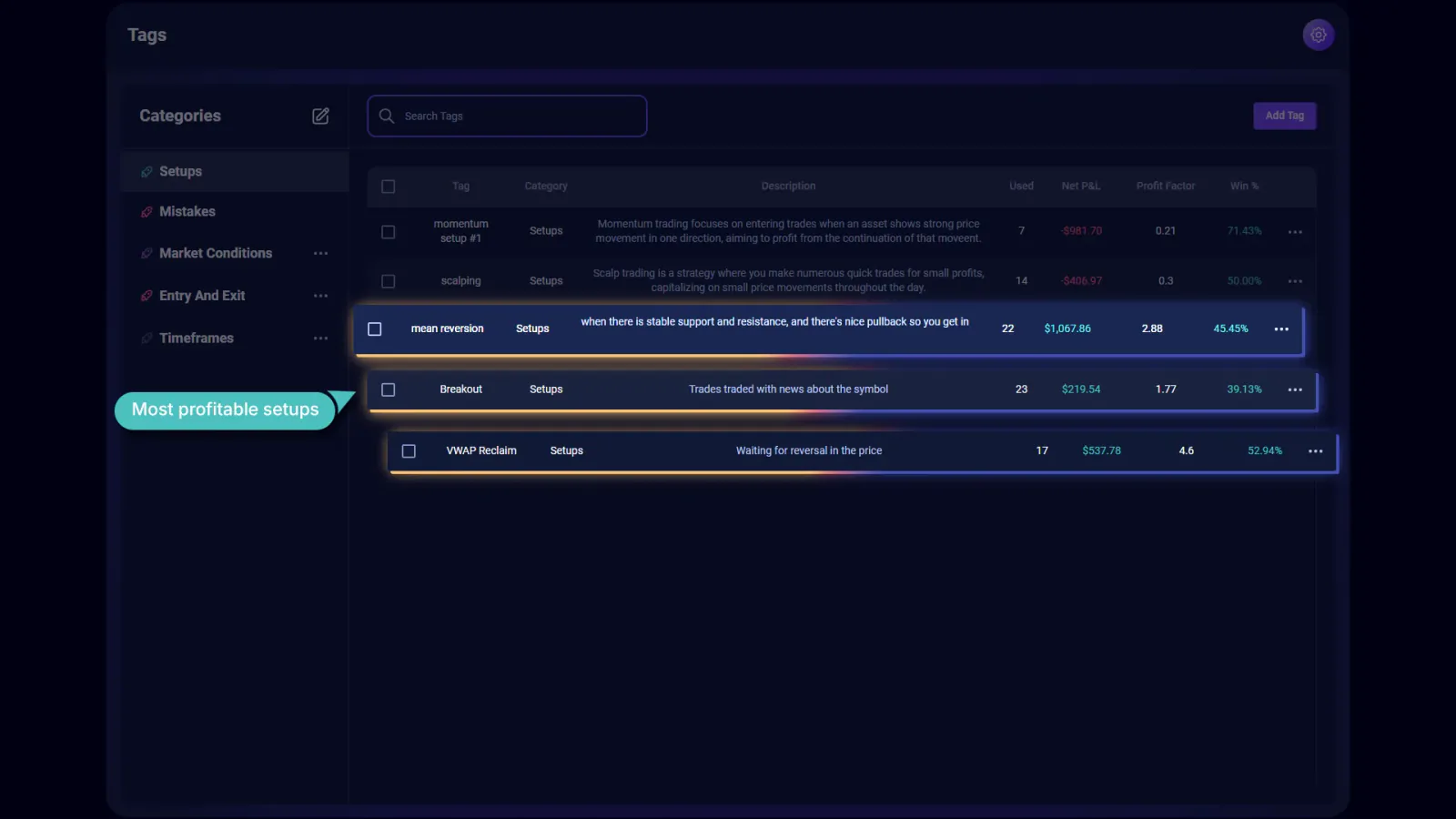
In TradeChainly, all of this lives inside the Tags page. You can create categories, organize your tags, view performance metrics for each tag, and see exactly how that pattern impacts your trading results.
Crypto traders benefit from tagging more than most markets. The speed, leverage, 24/7 movement, and constant volatility make it almost impossible to keep track of everything mentally. Without structure, trades blur together and bias takes over. Tags bring order to the chaos. Instead of guessing, you get clear data about which setups work, which mistakes cost money, and what behaviors you need to reinforce or remove.
The goal is simple. Turn random trading activity into measurable insights that you can use to improve performance. TradeChainly makes that possible by letting you tag trades quickly and review the results in a clean, organized way.
Setting Up a Tagging System in TradeChainly
Now that you understand what tags are, the next step is to set up a clean tagging system inside TradeChainly. This is where most traders either create a powerful structure they can use for years, or they overcomplicate things and eventually stop tagging altogether. The goal here is simplicity. You want a system that is easy to maintain, easy to understand, and useful when you sit down to review your performance.
TradeChainly gives you a clear starting point. When you open the Tags page, you will already see two default categories created for you: Setups and Mistakes. These cover the two biggest drivers of your results. Your profitable setups and your costly errors.
Inside the Setups category, you might create tags like breakout scalp, momentum continuation, VWAP reclaim, liquidity sweep, or range breakout. These describe the trading idea behind each execution. Try to keep your tags specific enough to be meaningful, but not so granular that you end up with dozens of rarely used tags. For example, “breakout scalp” is clear and reusable. “BTC breakout scalp during Asia session on 5x leverage” is too specific and will rarely repeat.
The Mistakes category is equally important. This is where you track behaviors that cost you money. Common mistake tags include fomo entries, overleveraging, chasing pumps, revenge trading, ignoring stop loss, moving stops, or trading chop. When you see the performance of these mistake tags inside TradeChainly, it often becomes painfully obvious which habits you must eliminate first.
You can also create additional categories if you want to go deeper. Many traders add Emotions, Risk Management, or Market Conditions. Emotion tags might include fear, greed, hesitation, or tilt. Risk tags could track things like full size entries, scaling, or premature exits. Market condition tags might describe trending conditions, ranging markets, or high volatility environments. TradeChainly allows you to build this structure in a way that matches your trading style.
For each tag, you can also add a short description. This is useful because it forces you to define exactly what the tag means. When you write “Breakout Scalp: entering immediately after a breakout candle with tight risk looking for a quick momentum continuation,” you remove ambiguity. Future you will thank you for that clarity.
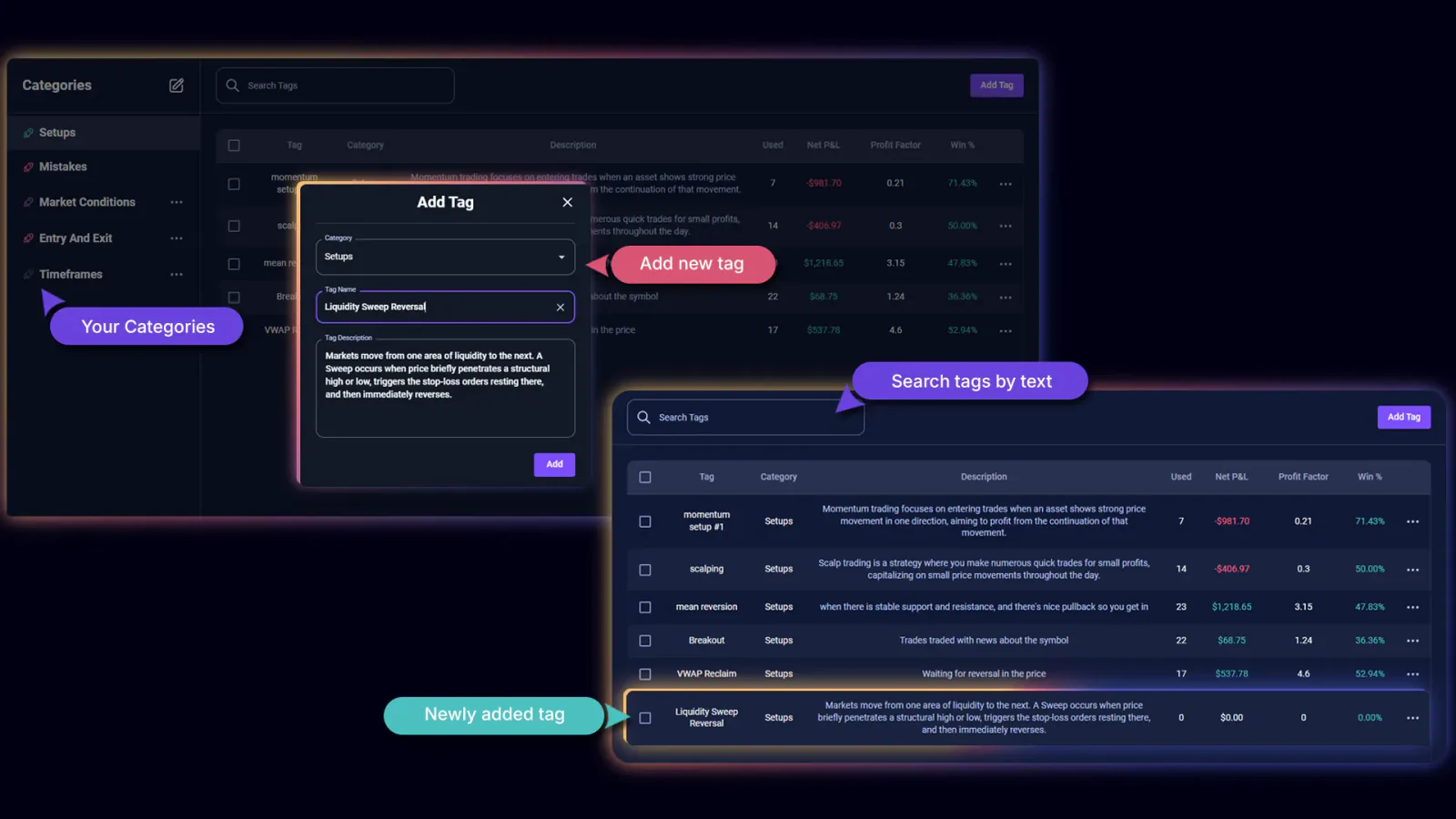
A good rule of thumb is to start with a small set of tags and expand only when necessary. If you begin with ten or twenty tags, you will likely feel overwhelmed. Start simple. Track your core setups. Track your main mistakes. Trade for a week or two. Then refine your system if needed.
Over time, the goal is consistency. The real power of tags inside TradeChainly comes from repetition. When the same setup is tagged across dozens of trades, the data becomes statistically meaningful. You can open a tag and instantly see if that setup deserves more focus or if it needs to be removed from your playbook entirely.
Think of this step as building the framework for your edge. A strong tagging system makes every future review session easier, clearer, and more actionable.
Tagging Trades in Real Time vs Review Sessions
Once your tagging system is set up inside TradeChainly, the next question is simple. When should you actually apply tags? There are two main workflows that traders use. Tagging trades as they are logged, or tagging trades later during review sessions. Both approaches work. The key is choosing the one that fits your trading style and making it consistent.
Some traders prefer to tag trades in real time, or at least shortly after closing them. This usually happens when trades are automatically synced from exchanges like Binance, Bybit, Coinbase, Kraken, KuCoin, Crypto.com, or OKX. As soon as the trade appears inside TradeChainly, you can quickly assign the correct setup and mistake tags. The benefit here is accuracy. The trade is still fresh in your mind. You remember exactly why you entered, what you were thinking, and what happened during execution.
Real-time tagging is especially useful for high frequency day traders and scalpers. If you are trading multiple times per session, your memory will fade fast. Tagging early prevents the “why did I even enter this again?” problem that shows up during weekly reviews.
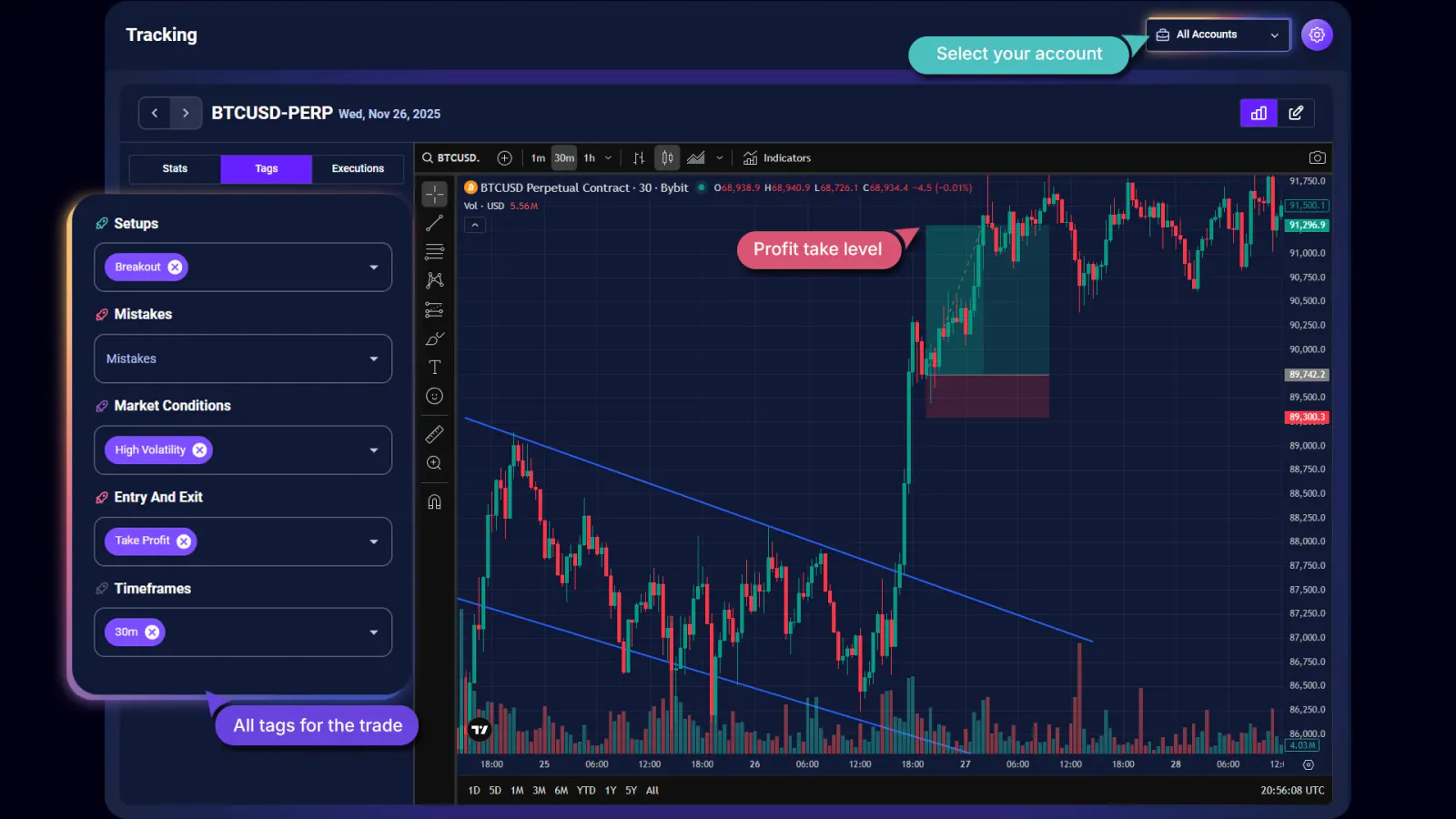
The second workflow is tagging during structured review sessions. Many traders prefer to review their trades at the end of the trading day, or once per week. They open their trades inside TradeChainly, sort through them, and carefully assign setups, mistakes, and other relevant tags. This approach gives you emotional distance. You are no longer reacting to the trade outcome. You can assess the trade more objectively.
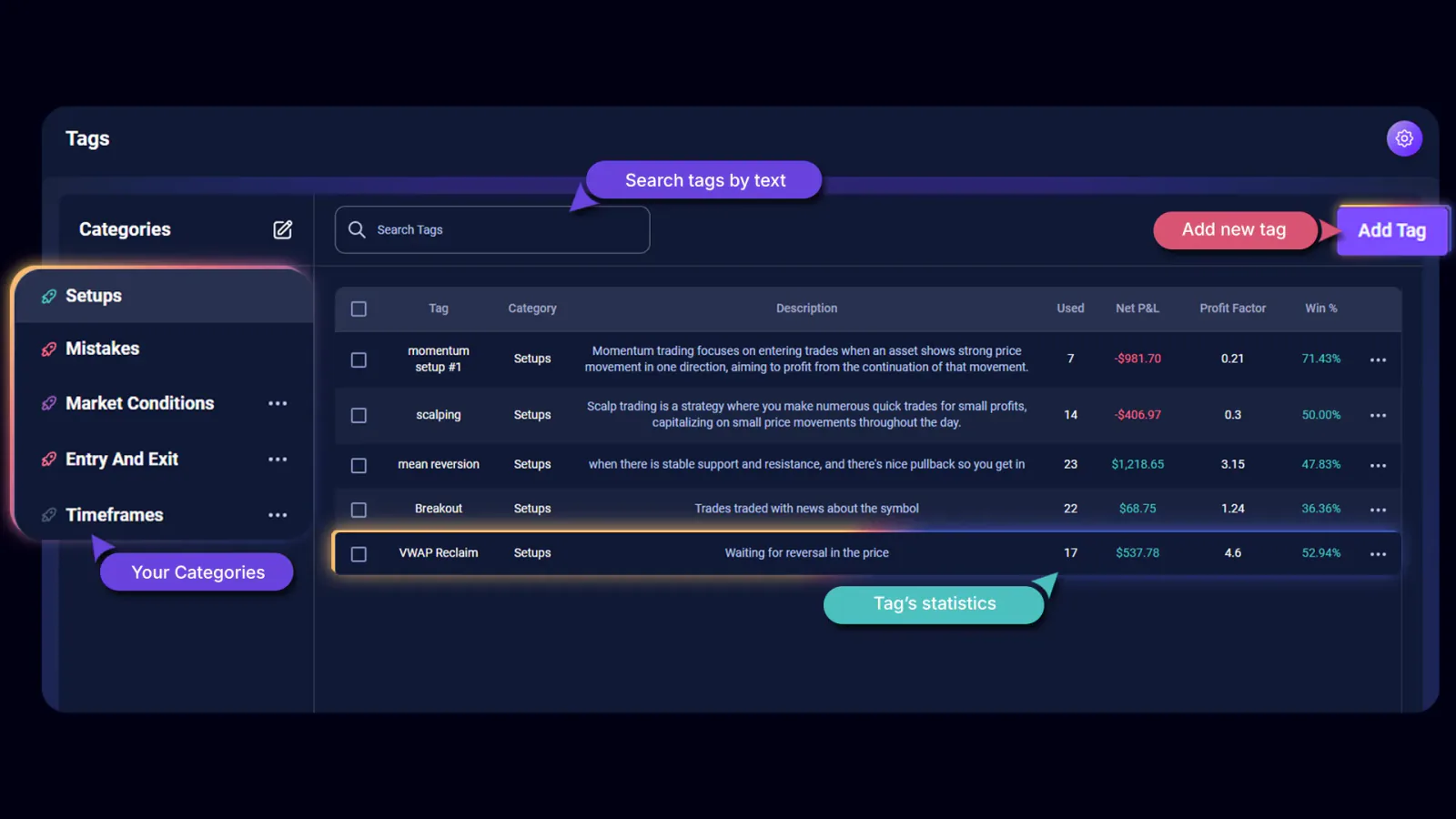
A powerful feature inside TradeChainly is the ability to mark trades as reviewed or not reviewed. This allows you to build a real review pipeline. Newly synced trades stay unreviewed. As you go through them and add tags, you mark them as reviewed. This creates accountability. No trade gets forgotten. Nothing slips through the cracks.
There is no single right answer here. Some traders tag immediately. Others tag during scheduled reviews. Many do a hybrid approach. Quick setup tagging during the day. Deeper mistake and emotion tagging during evening or weekend review.
What matters is consistency. If you only tag trades occasionally, the data becomes unreliable. When you tag every trade inside TradeChainly, the insights you unlock become incredibly powerful. Patterns emerge. Strengths become obvious. Weaknesses can no longer hide.
And the reality of crypto trading makes this even more important. With 24/7 markets, leveraged positions, and frequent volatility spikes, performance drift happens quickly. Tagging gives you structure in a market that rarely slows down.
Finding Profitable Setups with the Tag Details Page
This is where tagging inside TradeChainly really starts paying off. Once you have been tagging your trades for a while, you can open the Tag Details page for any setup, mistake, or behavior you want to study. Instead of looking at random trade outcomes, you are looking at clean performance data grouped by a single pattern. This is how you discover what is actually driving your results.
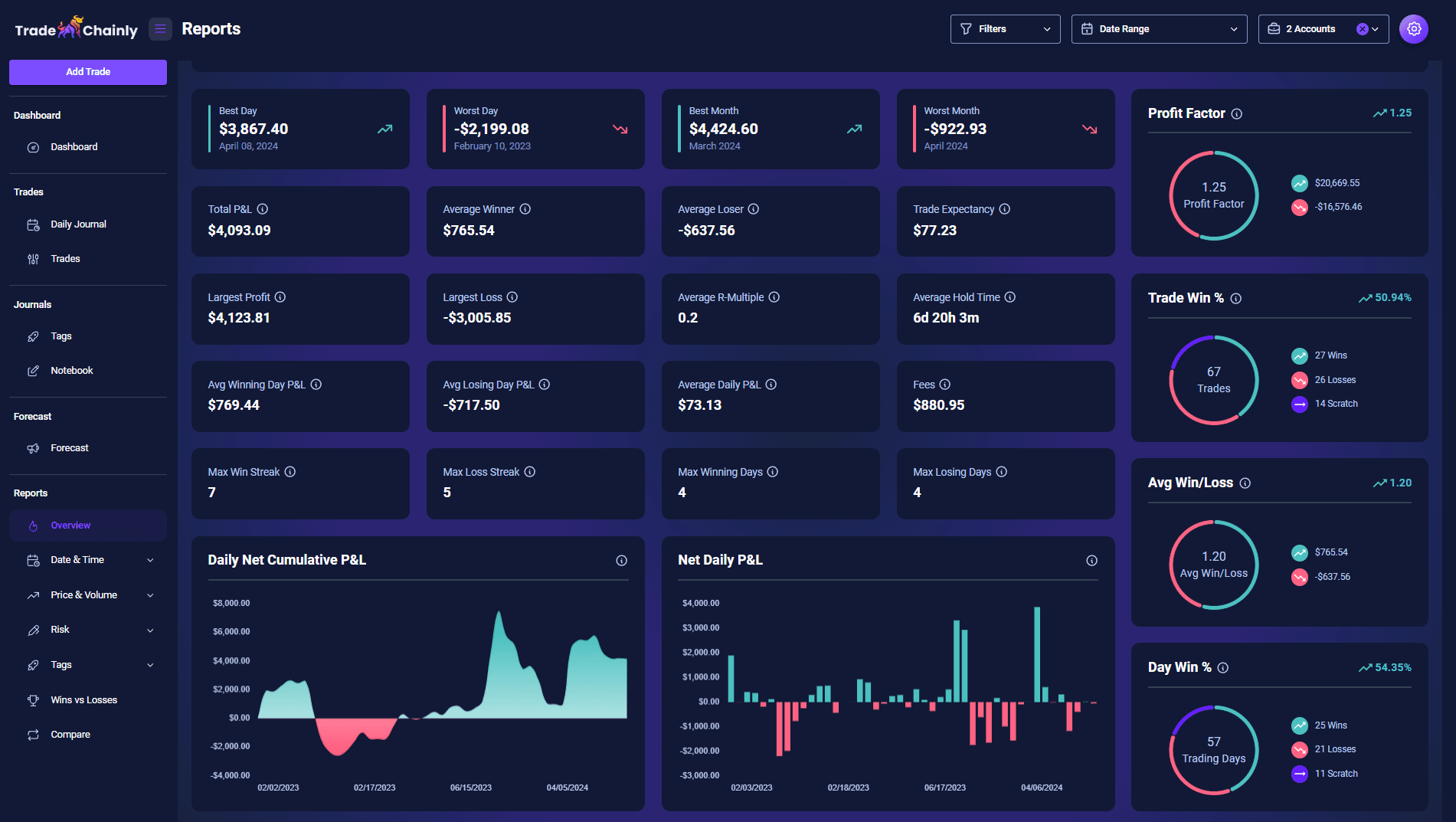
When you open a tag in TradeChainly, you don’t just see a list of trades. You see a full performance breakdown. Metrics like Net P&L, Average Winner, Average Loser, Trade Expectancy, Profit Factor, Win %, Largest Profit, Largest Loss, Average R-Multiple, and Average Hold Time are all visible. You also see charts like Daily Net Cumulative P&L and Net Daily P&L that show how this tag has performed over time.
This turns vague opinions into concrete evidence.
For example, maybe you believe breakout scalps are your bread and butter setup. You open the Breakout Scalp tag in TradeChainly. You see a strong Net P&L over time, a positive Profit Factor, solid Trade Expectancy, and an Average Win/Loss ratio that shows your winners are clearly larger than your losers. That is confirmation. This setup deserves more focus.
Now imagine the opposite. You open your Range Fade tag. The Win % looks decent, but the Average Loser is way larger than the Average Winner. The Net P&L trend is slowly bleeding lower. Your Profit Factor is hovering below 1.0. Suddenly it becomes obvious. This setup feels like it works, but the numbers tell a different story.
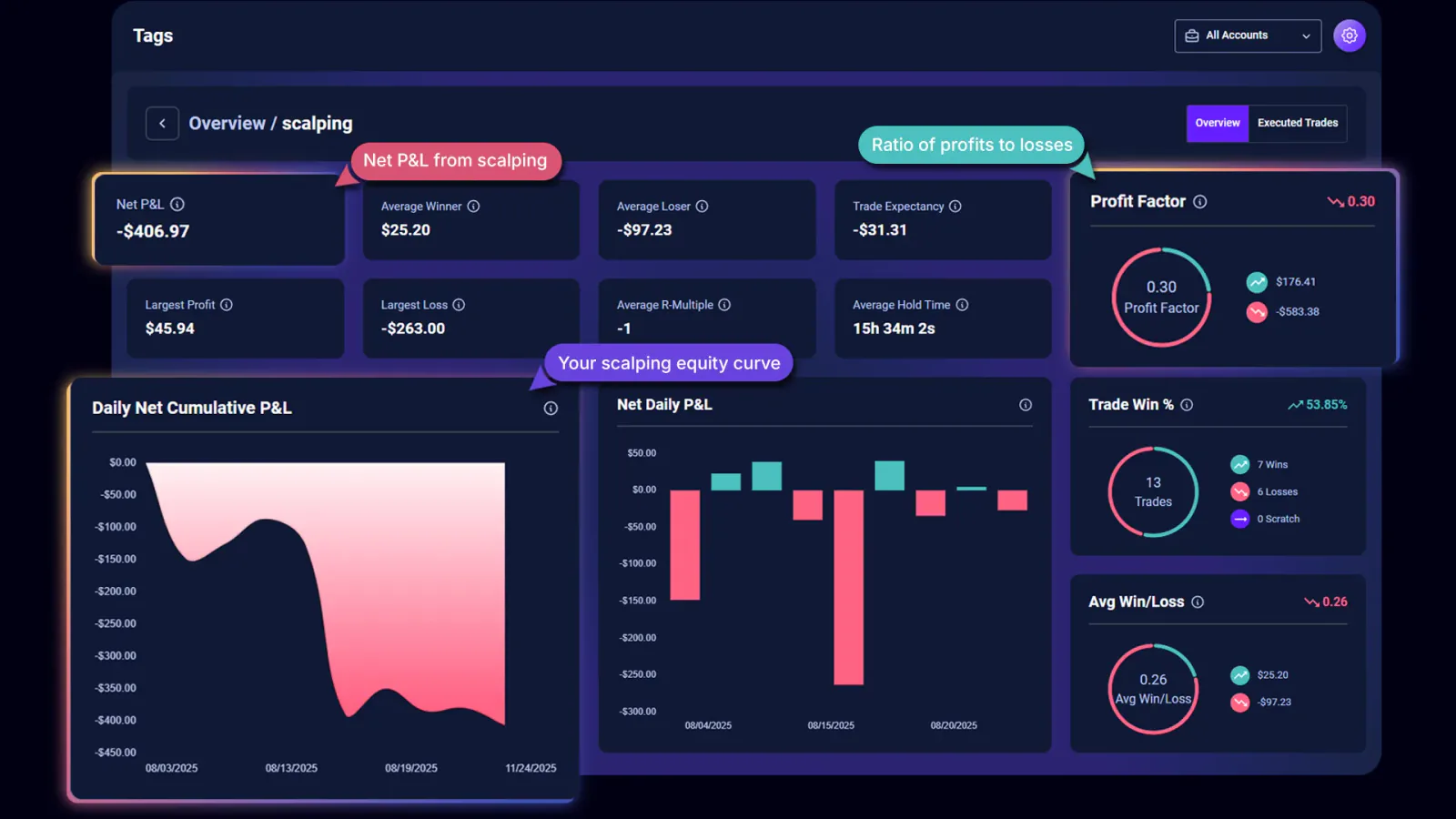
You can even apply filters while viewing tag performance. Maybe you want to see how a setup performs only on Binance, or only when trading SOL, or only during a certain date range. Maybe you want to compare performance between long and short trades, or between reviewed and unreviewed trades. TradeChainly makes that level of analysis simple.
Here is a realistic example.
Let’s say you scalp BTC and SOL on Bybit and Binance. You have two main setups tagged: Breakout Scalp and Liquidity Sweep Reversal.
You open Breakout Scalp:
Net P&L is positive
Profit Factor is 1.8
Win % is 42%
Average Win/Loss shows strong reward vs risk
Then you open Liquidity Sweep Reversal:
Net P&L is negative
Profit Factor is 0.7
Largest Loss stands out as painful
Average Hold Time is much longer than expected
This is insight you cannot get from raw P&L alone. You may be profitable overall only because one setup is carrying your results. Or your equity curve might be capped because you continue forcing a losing idea.
You can take this further with mistake tags too. Open a tag like Overleveraging. Look at the damage. Often you will discover that one or two bad habits account for the majority of your drawdowns. Seeing that number in TradeChainly changes your behavior fast.
The Tag Details page is, in many ways, the center of performance discovery inside TradeChainly. It gives you the truth. No stories. No selective memory. Just data tied directly to the decisions you make every day in fast-moving crypto markets.
Once you see the numbers, improvement stops feeling random. You know exactly what to double down on and what to cut out of your trading playbook.
Using Mistake Tags to Stop Leaking P&L
Most traders think the key to improving performance is finding better setups. That is only half the story. The other half is removing the behaviors that constantly leak P&L from your account. This is where mistake tags inside TradeChainly become incredibly valuable. They help you see, with painful clarity, which habits are costing you the most money.
Mistake tags are simple. You assign them when something in the trade execution goes against your plan or against good trading discipline. Maybe you sized too large. Maybe you chased an entry. Maybe you moved your stop. Maybe you jumped back into the market out of frustration after a loss. All of these can be tracked.
Common mistake tags inside TradeChainly include things like fomo entry, overleveraging, revenge trading, ignoring stop loss, moving stops, chasing pumps, trading chop, or entering without a setup. Each time one of these behaviors shows up, you tag it. Over time, a pattern forms.
Here’s what usually happens when traders start reviewing their mistake tags.
They discover that one or two mistakes account for a huge percentage of their losses. It is rarely ten different problems. It is often just one. Maybe overleveraging wipes out multiple good trading days. Maybe revenge trading turns small red days into large drawdowns. Maybe ignoring stops turns controlled risk into blown trades.
Inside TradeChainly, you can open a mistake tag just like a setup tag and see full performance metrics for trades where that mistake occurred. Net P&L. Profit Factor. Trade Expectancy. Average Loser. Largest Loss. All of it. You see the financial cost of your bad decisions in black and white.
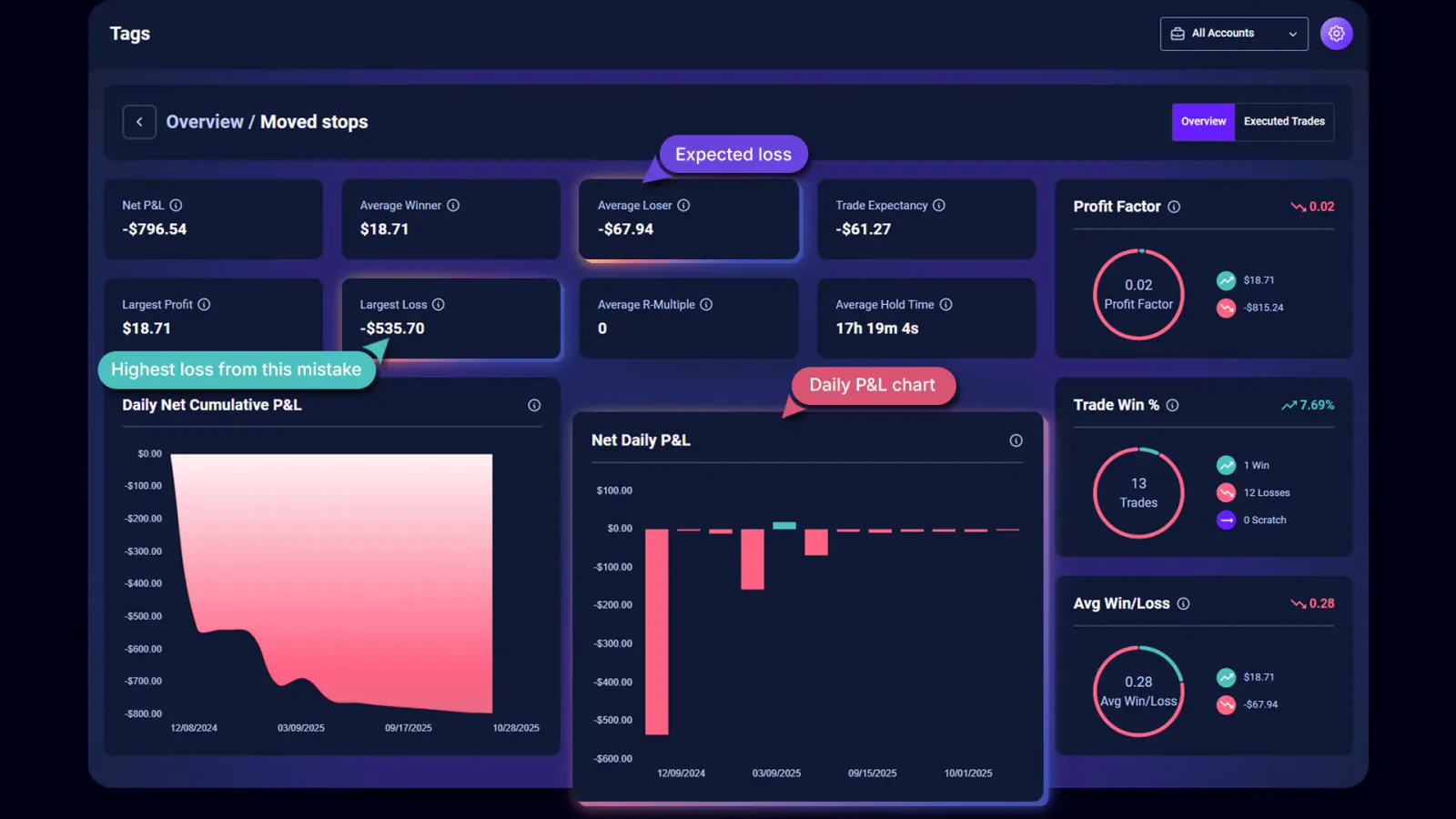
This changes the conversation you have with yourself.
You are no longer saying “I need to be more disciplined.” You are saying “Ignoring my stop loss has cost me $3,200 over the last two months. If I simply remove this behavior, my equity curve improves immediately.”
That level of clarity is rare in trading. Most traders guess at what is hurting them. TradeChainly gives you numbers so you cannot hide from the truth.
Mistake tagging also helps with emotional awareness. If you add tags like tilt, fear, boredom, or frustration, you can start connecting emotional states with performance outcomes. Maybe boredom trading always leads to losses. Maybe fear causes early exits and reduced profit. Maybe tilt creates oversized losing trades. When these patterns repeat, you gain control simply by being aware of them.
And remember, this matters even more in crypto. Leverage magnifies mistakes. Markets trade non-stop. Discipline fatigue is real. Without structure, small lapses become expensive fast. Mistake tags inside TradeChainly act like a mirror that shows you exactly where your discipline breaks down.
Once you see the cost of your mistakes, you naturally begin to respect your rules more. Improvement becomes less about motivation and more about protecting your capital from your own tendencies.
Building a Repeatable Edge Through Tags
At its core, trading is a probability game. You are not trying to win every trade. You are trying to consistently execute ideas that produce a positive long-term outcome. The problem is that most traders never truly verify which ideas have an edge. They rely on feel. They rely on memory. They rely on hope. Over time, that leads to inconsistency, second-guessing, and frustration.
Tags inside TradeChainly give you a way out of that cycle.
When you tag your setups, you are defining the specific trading ideas that you want to test. When you tag your mistakes, you are tracking the behaviors that hurt your results. Over weeks and months of trading, these tags turn into a data set that reflects exactly how you trade in real conditions. Not theoretical backtests. Not simulated outcomes. Real executions in fast-moving crypto markets.
This is what builds a repeatable edge.
A profitable setup tag shows you that, over many trades, this idea tends to make money. You learn the conditions where it works best. You see the average winner, the average loser, the hold time, and the drawdowns. You gain confidence because the data supports the idea.
A losing setup tag tells you the opposite. It shows you which ideas to scale back or eliminate. Instead of forcing trades because you “like the look,” you start filtering opportunities based on proven performance.
Mistake tags refine this further. You might discover that your core setup is profitable, but only when executed with proper risk and discipline. As soon as overleveraging or chasing gets involved, the edge disappears. That insight shapes your behavior. You commit to process, not impulse.
TradeChainly ties all of this together. Your trades sync automatically from exchanges like Binance, Bybit, Coinbase, Kraken, KuCoin, Crypto.com, and OKX. You tag them. You open Tag Details pages. You review the metrics. Slowly, your trading becomes less emotional and more systematic.
You are not trying to predict the future. You are simply stacking the odds in your favor, one decision at a time.
Over time, this creates a trading identity. You know your strengths. You know your weaknesses. You know when to press and when to protect capital. That clarity removes noise. It reduces hesitation. It keeps you grounded during both winning streaks and drawdowns.
And that is what a repeatable edge looks like in practice.
Daily & Weekly Review Workflow Recommendation
Tagging only becomes powerful when you use the data consistently. That means building a simple review routine that fits into your trading schedule. You do not need to turn this into a full-time research project. A focused daily review and a deeper weekly summary is more than enough to extract real value from your tags inside TradeChainly.
Here is a simple approach that works well for most active crypto traders.
Start with a short daily review. At the end of each trading day, open TradeChainly and look through the trades you placed. Make sure each trade has the correct setup and mistake tags assigned. Mark the trade as reviewed once you are done. This alone keeps you accountable. Nothing gets ignored. Every trade gets processed.
Then ask yourself a few direct questions. Did I follow my plan? Did I size correctly? Did I enter for the right reasons? If a mistake occurred, tag it honestly. The key here is truth, not ego protection. TradeChainly is only as powerful as the accuracy of your tagging.
Once a week, block out a slightly longer review session. Open the Tag Details pages for your main setups. Look at Net P&L, Profit Factor, and Average Winner vs Average Loser. Pay attention to the trend of performance over time, not just a single day. If a setup continues to perform well, that is confirmation that it belongs in your core playbook.
Do the same with mistake tags. Open the ones you triggered most frequently. Look at the cost in real numbers. If one mistake continues to show up and damage your results, move it to the top of your improvement list for the coming week.
You can also bring in other TradeChainly tools during this review. Look at your Daily Journal notes. Look at specific trades inside the Trades page. Reflect on emotions, conditions, and execution. Tag data gives you structure. Your review connects that structure to real-world trading behavior.
None of this needs to be complicated. Ten to fifteen minutes per day. Thirty to sixty minutes on weekends. That is enough to stay aligned with your edge.
Crypto trading moves fast. Without structure, you drift. With a consistent tagging review inside TradeChainly, you stay grounded. You know what is working. You know what is not. And you keep adjusting based on reality, not hope.
Where Real Trading Improvement Actually Comes From
Most traders want consistency, but very few build the structure required to achieve it. Tagging your trades inside TradeChainly gives you that structure. It turns every trade into data you can learn from. It shows you which setups deserve more focus. It exposes the mistakes that quietly destroy your P&L. And it helps you build a repeatable edge in a fast, volatile, 24/7 crypto market.
The best part is that this process is simple. You do not need to become a data analyst. You just need to tag your trades honestly, review your performance regularly, and make adjustments based on what the numbers tell you. Over time, clarity replaces confusion. Confidence replaces hesitation. Your trading becomes more intentional.
If you want a clearer picture of what actually works in your trading, start using trading journal tags inside TradeChainly. Build your tagging system. Review your Tag Details pages. Use the insights to shape your trading plan. This is how you move from random results to measurable improvement.
And if you are not already journaling your crypto trades with TradeChainly, this is the perfect time to start. Your future self will thank you for having real data behind every decision you make in the market.