
Why Consistency Is the Real Skill in Crypto Trading
Most crypto traders do not fail because they lack knowledge. They fail because they cannot apply what they know consistently. One day they follow their plan. The next day they chase price, increase size, or ignore rules they were confident in just hours earlier. The problem is rarely the strategy itself. It is the inability to execute that strategy the same way, day after day, under different emotional and market conditions.
Crypto makes this harder than most markets. Price moves fast. Volatility is constant. You can trade at any hour. Losses and wins come in clusters. That environment rewards impulsive behavior and punishes inconsistency brutally. Without structure, even good traders drift into random decision making without realizing it.
Consistency is often misunderstood as emotional strength or discipline. Traders tell themselves they need more willpower or better self control. That framing creates frustration because willpower is unreliable. It fluctuates with sleep, stress, confidence, and recent results. You cannot build a trading career on something that unstable.
Real consistency is built through process. It comes from having clear rules, measurable behavior, and a feedback system that shows you when you are drifting off track. It is less about forcing yourself to behave and more about designing an environment where the right behavior becomes the default.
This article shows how to build consistency as a skill, not a personality trait. You will learn how to define what consistency actually means in your trading, how to measure it, and how to use journaling and feedback loops to stabilize your performance over time.
Why Crypto Traders Struggle With Consistency
Most inconsistency in crypto trading does not come from a lack of intelligence or effort. It comes from operating without structure in an environment that constantly pushes emotional reactions. Crypto markets are fast, highly volatile, and available at all hours. That combination makes it easy to slip into reactive behavior without noticing when discipline starts to fade.
One common cause is overtrading. When the market is moving quickly, it feels wrong to sit still. Traders start taking setups that are “close enough,” increase frequency, and slowly abandon selectivity. What started as a solid strategy turns into random execution. The trader feels busy, but performance becomes unstable.
Another major issue is strategy hopping. After a losing streak, many traders assume the system is broken. They change indicators, timeframes, or entire strategies without collecting enough data to know whether the problem is execution or the strategy itself. This creates a cycle where no approach is ever given time to stabilize.
Emotional reactions to short-term outcomes also destroy consistency. A big win can lead to oversized confidence and higher risk. A loss can trigger revenge trading or hesitation. In both cases, the trader stops behaving like the same person who created their trading plan. Behavior changes based on recent results instead of rules.

Many traders also lack a real feedback system. They know whether they made or lost money, but they do not know why. Without structured journaling, tagging, or performance review, mistakes repeat silently. The trader feels inconsistent but cannot pinpoint where that inconsistency starts.
Finally, crypto’s 24/7 nature removes natural boundaries. There is no market close forcing a reset. Without defined sessions, rest periods, and review routines, trading becomes continuous stimulation. That erodes discipline over time, even for motivated traders.
Consistency breaks when behavior becomes reactive instead of procedural. The absence of structure makes every decision feel new, emotional, and subjective.
| Cause of Inconsistency | What It Looks Like in Practice | Long-Term Effect |
|---|---|---|
| Overtrading | Taking subpar setups, increasing trade frequency after wins or losses | Lower expectancy, higher emotional fatigue |
| Strategy hopping | Constantly changing systems after short losing streaks | No statistical edge ever develops |
| Emotional sizing | Increasing size after wins, reducing size after losses | Risk becomes unstable and unpredictable |
| No journaling | Forgetting why trades were taken or what went wrong | Same mistakes repeat unnoticed |
| No session structure | Trading randomly throughout the day or night | Burnout and impulsive execution |
| Outcome fixation | Judging trades only by profit or loss | Process quality is ignored |
Consistency Is a Process, Not a Personality Trait
A lot of traders believe consistency is something you either have or you do not. They look at disciplined traders and assume they were born with better emotional control. That belief is dangerous because it turns consistency into an identity problem instead of a process problem. When you think consistency is a trait, every mistake feels like proof that you are not cut out for trading.
In reality, consistency is built the same way any professional skill is built. Through structure, repetition, and feedback. A consistent trader is not someone who never feels fear or excitement. It is someone whose environment and rules make it harder to act on those emotions.
Think about pilots, surgeons, or professional athletes. They do not rely on motivation to perform well. They rely on checklists, routines, and standardized behavior. Trading is no different. The difference is that most traders never build those systems for themselves.

Another important distinction is between outcome consistency and behavior consistency. You cannot control your short-term results. You can control how you execute. When traders chase outcome consistency, they become emotionally unstable. When they focus on behavior consistency, performance stabilizes naturally over time.
Behavior consistency looks like this:
- Risk is always calculated the same way
- Setups are taken or skipped based on rules, not feelings
- Trade size is not adjusted based on recent wins or losses
- Reviews happen whether the week was good or bad
These are not personality traits. They are mechanical actions that can be designed into your workflow.
Most traders fail because they try to “be disciplined” without building discipline into their environment. They sit in front of the chart and hope they make the right choice in the moment. That is like trying to eat healthy while keeping junk food on your desk. The environment always wins.
Consistency improves when decision making becomes boring. When your trading day feels repetitive, predictable, and structured, you are doing it right. Chaos feels exciting, but structure is what produces stable results.
The goal is not emotional perfection. The goal is to make correct behavior easier than incorrect behavior. Once that happens, consistency stops being a struggle and becomes the default.
Define What “Consistent” Actually Means in Your Trading
Most traders say they want to be consistent, but very few can explain what that actually looks like in their own trading. “Be more disciplined” is not a usable instruction. If consistency cannot be measured or observed, it cannot be improved. This is where many traders get stuck. They chase a feeling of control instead of defining concrete standards for their behavior.
Consistency has multiple dimensions. It is not only about results. It is about how you manage risk, how you choose setups, how you behave during your session, and how you review your performance. If even one of these areas is unstable, your overall trading will feel inconsistent.
Start with risk. A consistent trader always knows how much they are risking before entering a trade. The percentage of the account at risk does not change because of mood, confidence, or recent performance. If one day you risk 0.5 percent and the next day you risk 2 percent for no structural reason, your trading is already inconsistent regardless of whether you win or lose.
Then look at setups. Are you taking the same type of trades each day, or are you reacting to whatever looks exciting on the chart? Consistency means your trades come from a narrow, well-defined set of patterns. If your trade history shows ten different types of entries with no repetition, there is no edge to stabilize.
Position sizing is another key area. Even if your risk per trade is defined, inconsistency appears when size fluctuates emotionally. Increasing size after wins and reducing it after losses is one of the fastest ways to destabilize your equity curve.
Session behavior matters just as much. Consistency includes when you trade, how long you trade, and when you stop. Random trading hours create random performance. A defined session creates predictable mental and physical conditions.
| Consistency Dimension | What Consistent Behavior Looks Like | How to Measure It |
|---|---|---|
| Risk per trade | Same percentage risk on every trade | Risk % variance over time |
| Setup selection | Trading only predefined setups | Number of setups used |
| Position sizing | Size derived from risk, not emotion | Position size vs account size |
| Session timing | Same trading window each day | Session start and end times |
| Trade frequency | Similar number of trades per session | Trades per day or session |
| Review behavior | Regular post-session or weekly review | Number of reviews completed |
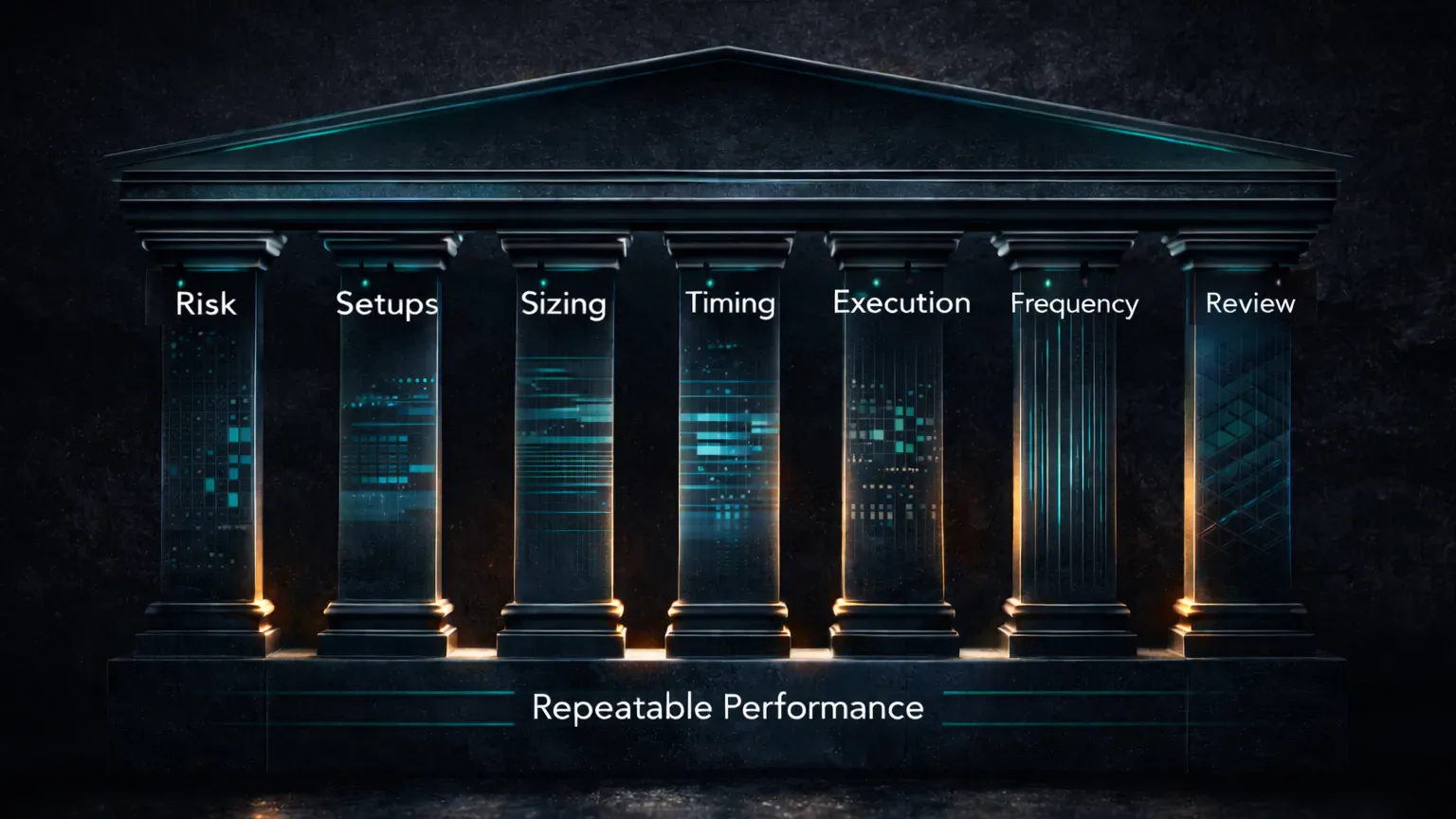
Journaling turns these ideas into something real. When you log your trades and tag your behavior, you stop guessing about your consistency. You can see it. You can see whether risk fluctuates, whether setups are respected, and whether your session structure holds.
This is where consistency becomes objective. Instead of asking “Do I feel disciplined?” you start asking “Did I follow my rules today?” That shift alone removes much of the emotional pressure traders put on themselves.
Consistency is not about perfection. It is about reducing randomness. The more predictable your behavior becomes, the more predictable your results become over time.
Build Consistency Through a Feedback Loop
Consistency does not improve just because you trade more. It improves when you shorten the distance between action and feedback. Most traders only get one form of feedback, profit or loss. That is not enough to build stable behavior. You need feedback on execution quality, rule adherence, and decision patterns.
This starts with how your trades are logged. Manual journaling works, but it is easy to skip when you are tired or emotional. Automatic trade importing removes friction. When every trade is captured without effort, you eliminate one of the biggest sources of inconsistency, missing data. Your journal becomes a complete record instead of a selective memory.
Once trades are logged, tagging becomes the core of the feedback loop. Tags turn vague experiences into measurable categories. You can tag:

- Setups that worked
- Mistakes that repeat
- Emotional states like fear or overconfidence
- Market conditions such as choppy or trending
- Rule violations like early exits or oversized risk
Without tags, all trades blur together. With tags, patterns become visible.
The next step is structured review. Consistent traders do not review randomly or only after bad days. They review on a schedule. Weekly reviews work well because they provide enough data to spot trends without becoming overwhelming. During review, the goal is not to judge yourself. It is to observe behavior.
You are looking for questions like:
- Did my risk stay stable?
- Did I take only my defined setups?
- Which mistakes appeared more than once?
- Did certain emotions show up before poor decisions?
This is where analytics matter. When performance is broken down by tag, setup, or mistake type, consistency stops being abstract. You can see which behaviors lead to stable results and which behaviors inject chaos into your trading.
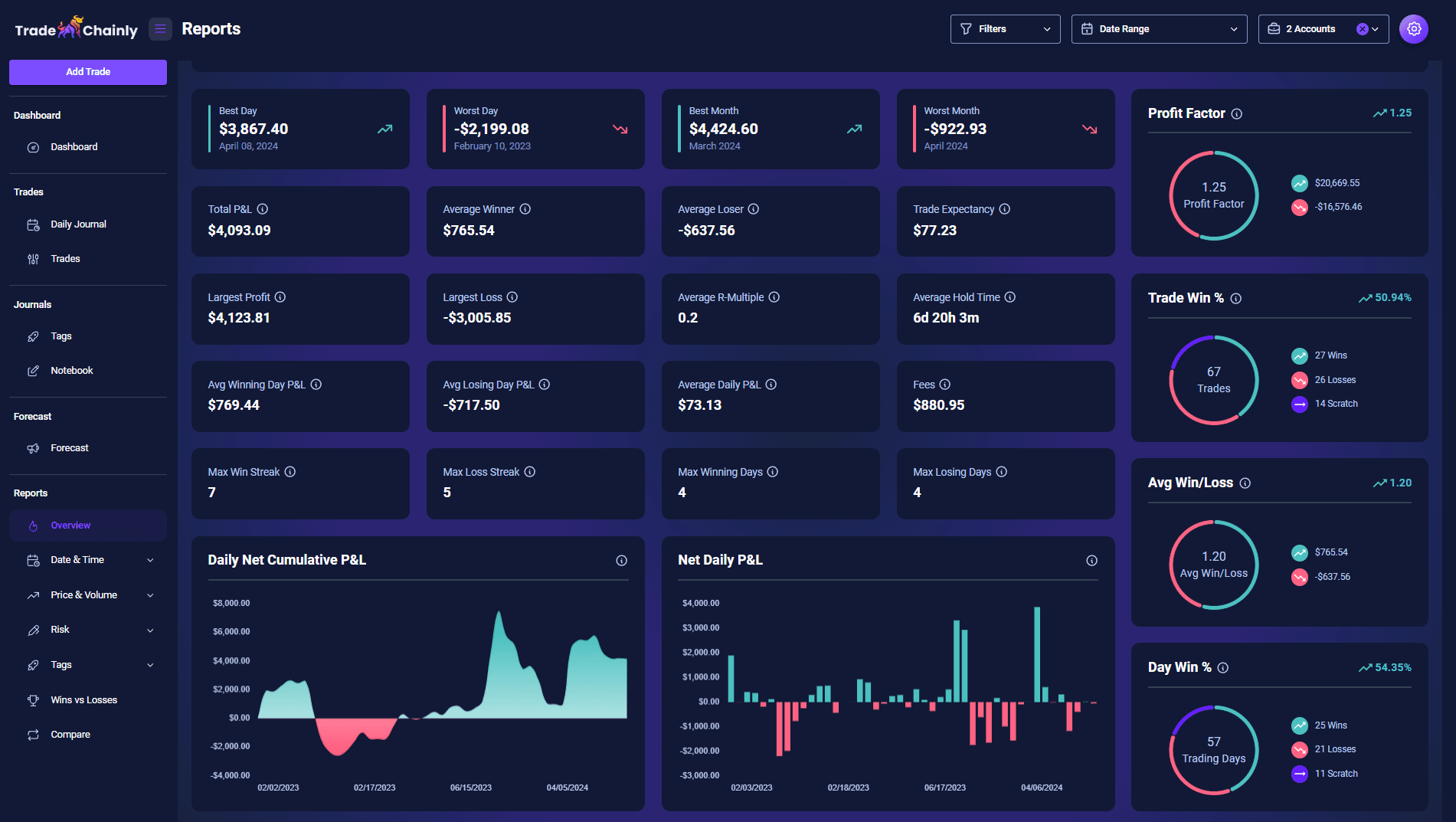
Platforms like TradeChainly make this process easier by combining automatic trade imports with tagging and performance reports. The value is not the tool itself, but the feedback speed it creates. The faster you see your behavior reflected back to you, the faster you correct it.
Over time, this creates a loop:

- Execute trades
- Log automatically
- Tag behavior and conditions
- Review patterns
- Adjust rules or focus
- Repeat
This loop is how consistency is trained. It removes guesswork. Instead of trying to feel more disciplined, you work with evidence. You see what is drifting and correct it before it compounds.
Most traders skip this step and wonder why their performance never stabilizes. Consistency is not built during the trade. It is built in the review process that follows it.
Use Journaling to Stabilize Your Psychology
Most traders think journaling is about recording what happened. In reality, its real value is showing you how you behave under pressure. Your psychology becomes much easier to manage once it is visible. When emotions stay vague, they control decisions. When they are written down and tracked, they become data.
A common pattern in inconsistent trading is emotional blindness. You feel frustrated, confident, impatient, or fearful, but you do not notice how those states change your behavior. Journaling creates awareness. You start seeing that certain emotions lead to predictable mistakes. For example, impatience may lead to early entries. Overconfidence may lead to larger size. Fear may lead to cutting winners too fast.
Once you recognize these patterns, your mindset shifts. Instead of thinking “I need to stop feeling this way,” you think “When this feeling appears, I need to tighten my rules.” The emotion no longer controls the trade. It becomes a signal that tells you to slow down or reduce exposure.

Trade notes play a big role here. Writing a few sentences after a trade about what you were thinking and feeling is often more valuable than writing about the chart. Over time, these notes create a psychological profile of your trading behavior. You can see when you are trading from clarity and when you are trading from reaction.
Journaling also reduces hindsight bias. After a trade closes, the outcome feels obvious. You convince yourself the decision was good or bad based on profit or loss. When you write your reasoning before or immediately after entry, you lock in your real thought process. That honesty is what allows improvement.
Another benefit is emotional release. Putting frustration or excitement into words lowers its intensity. You stop carrying emotions from one trade into the next. Each trade becomes more independent. That separation is a huge part of consistency.
Over time, journaling changes your relationship with mistakes. Instead of seeing them as failures, you see them as signals. A repeated mistake is not a personal flaw. It is information about what part of your system needs strengthening.
This is how psychology becomes manageable. You are no longer fighting your emotions. You are observing them, recording them, and building rules that account for them. Consistency grows naturally from that awareness.
Small Rules That Create Massive Stability
Consistency often comes from limits, not freedom. The more decisions you remove from the moment, the more stable your behavior becomes. Small rules act like guardrails. They reduce the number of ways you can sabotage yourself when emotions rise.
One powerful rule is a daily loss limit. When you know exactly when your session ends, you stop trying to “fix” a bad day. That alone removes a huge source of impulsive trading. Another is a maximum number of trades per session. Fewer trades force selectivity. You become more patient because every trade has a cost.
Time boundaries matter too. Define when your trading session starts and ends. Random trading hours create mental fatigue and blur the line between focus and impulse. A fixed session trains your brain to perform in a specific window.
Setup restriction is another stabilizer. Trade only one or two setups until consistency appears. Variety feels productive, but it hides whether anything is actually working. Narrow focus makes improvement measurable.
Risk caps protect your psychology. A fixed risk per trade and a fixed maximum daily risk remove emotional sizing. You do not need to decide how confident you feel. The system already decided for you.

These rules are not about being strict. They are about protecting your decision quality. Every rule removes a moment where emotion could override logic. Enough small rules stacked together create a stable trading environment where consistency becomes natural instead of forced.
Conclusion: Consistency Is Built, Not Found
Consistency is not something you discover one day. It is something you construct through repetition, structure, and honest feedback. The traders who become stable are not more motivated or more talented. They simply remove randomness from their process until correct behavior becomes automatic.
When your risk is fixed, your setups are defined, your sessions are structured, and your reviews are routine, trading stops feeling chaotic. You no longer rely on emotion to guide decisions. You rely on rules that were built when your mind was clear.
This is where journaling stops being optional and becomes foundational. A journal is not just a record of trades. It is the tool that turns experience into improvement. Without it, mistakes fade. With it, patterns become visible and correctable.
Platforms like TradeChainly exist to make that process easier by automating trade imports, organizing behavior through tags, and giving you reports that show where your consistency is holding and where it is breaking. The real power is not the software itself. It is the feedback speed it creates.
Consistency is not about perfection. It is about reducing noise. The more predictable your behavior becomes, the more predictable your results become. That is how stable performance is built.