Why Your Discipline Feels Random Without a Feedback System
Why do you feel sharp one day and completely undisciplined the next?
Crypto trading moves fast. One day you feel locked in, catching clean entries and managing risk well. The next day you are chasing price, second guessing yourself, and wondering how your discipline disappeared overnight. Traders often assume this is just part of the game. In reality, it is a sign that you are trading without a system to measure and correct your behavior.
A crypto trading journal is not a diary. It is a performance tool. It turns your trades into data that you can analyze, compare, and improve. Without it, your memory becomes your main source of feedback, and memory is unreliable. You remember the big winners and the painful losses, but you forget the small mistakes that quietly damage your results over time.

Crypto amplifies this problem. Markets run 24/7. Volatility is extreme. Leverage is common. One bad habit can cost weeks of progress. If you are not tracking what you do, how you do it, and why you do it, you are guessing. Guessing feels productive, but it keeps you stuck in the same performance loop.
A proper crypto trading journal gives you something most traders never build: a feedback system. It shows you which setups actually make money, which mistakes keep repeating, and which emotions show up before your worst decisions. It replaces opinions with evidence. Instead of saying “I think I trade better in the mornings,” you can prove it. Instead of assuming your strategy works, you can measure its expectancy.
This guide shows how to use a crypto trading journal as a practical tool for improvement. Not a motivational habit. Not a box to check. A system that helps you trade with clarity, consistency, and confidence.
Defining a Crypto Trading Journal for Real Crypto Conditions
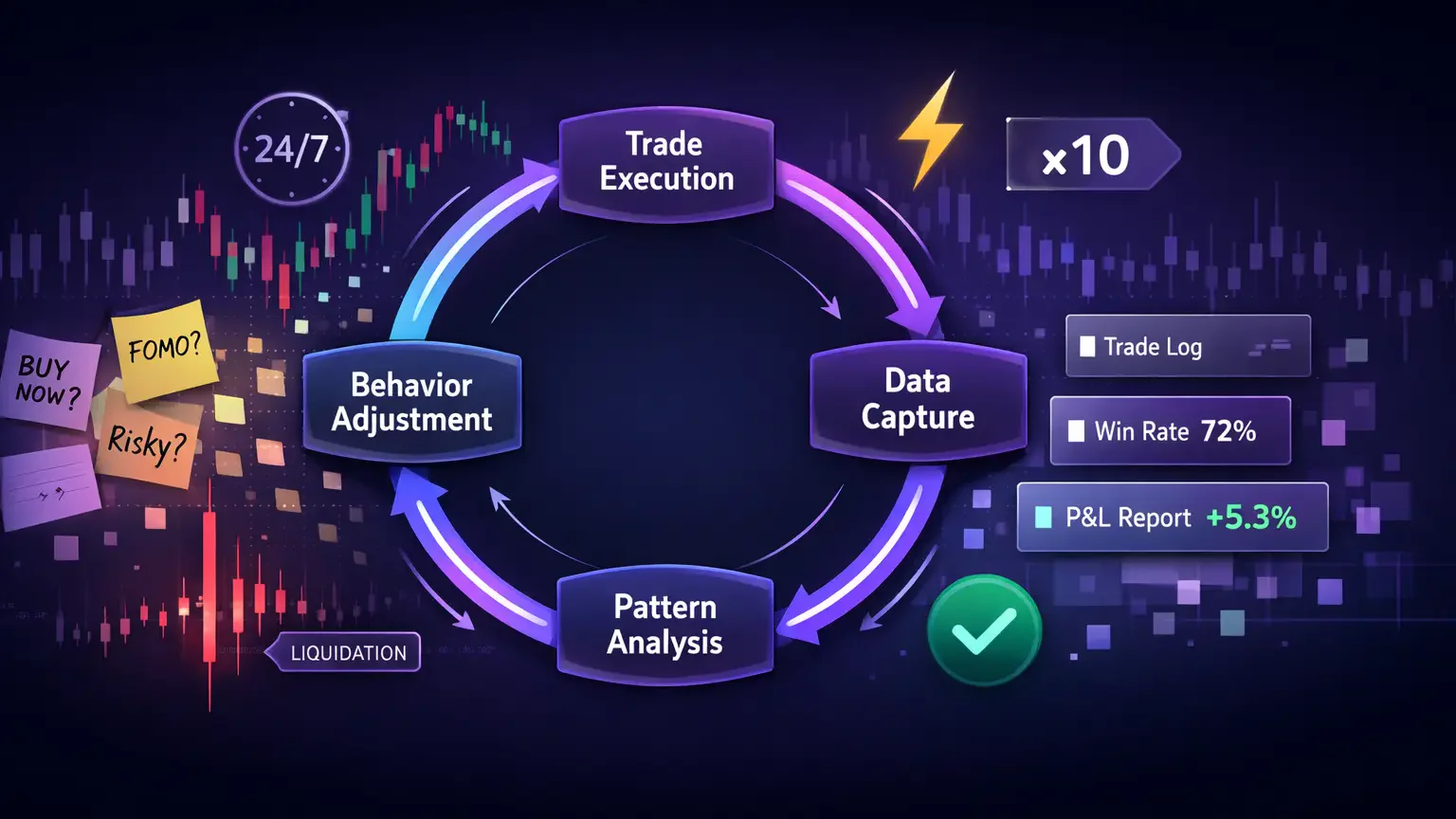
A crypto trading journal is a structured record of your trading activity that goes beyond logging entries and exits. It captures what you traded, how you traded it, why you took the trade, and what the result tells you about your decision-making. Its purpose is not to store history. Its purpose is to turn your trading into a feedback loop that constantly improves your execution.
Traditional trading journals were designed around slower markets. Stocks and forex traders often deal with limited trading hours, lower volatility, and fewer trades per session. Many of those journals focus heavily on price levels, technical setups, and basic notes. That approach works when your market gives you time to react and your risk is relatively contained.
Crypto trading does not operate in that environment. The market is open at all times. Price can move violently in minutes. Futures traders deal with leverage, funding rates, and liquidation risk. Spot traders face sudden volatility during news or liquidation cascades. A crypto trading journal must reflect that reality.
What makes a crypto trading journal different is not just the asset class. It is the amount of context that must be tracked for each trade. You are not only recording a position. You are capturing how volatility, timing, leverage, execution speed, and emotional state interact with your strategy.
In crypto, the journal needs to capture the exchange used because liquidity and execution quality vary between Binance, Bybit, OKX, Coinbase, and others. It needs the market type, such as spot or futures, since risk dynamics are completely different. Position size and leverage matter because small sizing errors can distort your entire performance. Entry and exit execution matters, including slippage and partial fills. The setup or idea behind the trade matters, not just the chart pattern. Emotional context matters, because many losing streaks are psychological, not technical.
This is where spreadsheets start to break down. They can hold numbers, but they struggle to connect behavior, emotion, and structure in a way that is easy to review. Most traders end up with messy sheets that they rarely open after a few weeks.
| Aspect | Traditional Trading Journal | Crypto Trading Journal |
|---|---|---|
| Market hours | Limited sessions | 24/7 market |
| Volatility | Moderate | Often extreme |
| Leverage use | Rare or limited | Common, especially in futures |
| Trade frequency | Lower | Often high |
| Emotional pressure | Moderate | High due to speed and risk |
| Data complexity | Simpler | Requires deeper context |
| Automation needs | Optional | Essential for accuracy |
| Review depth | Basic performance | Behavior and strategy driven |
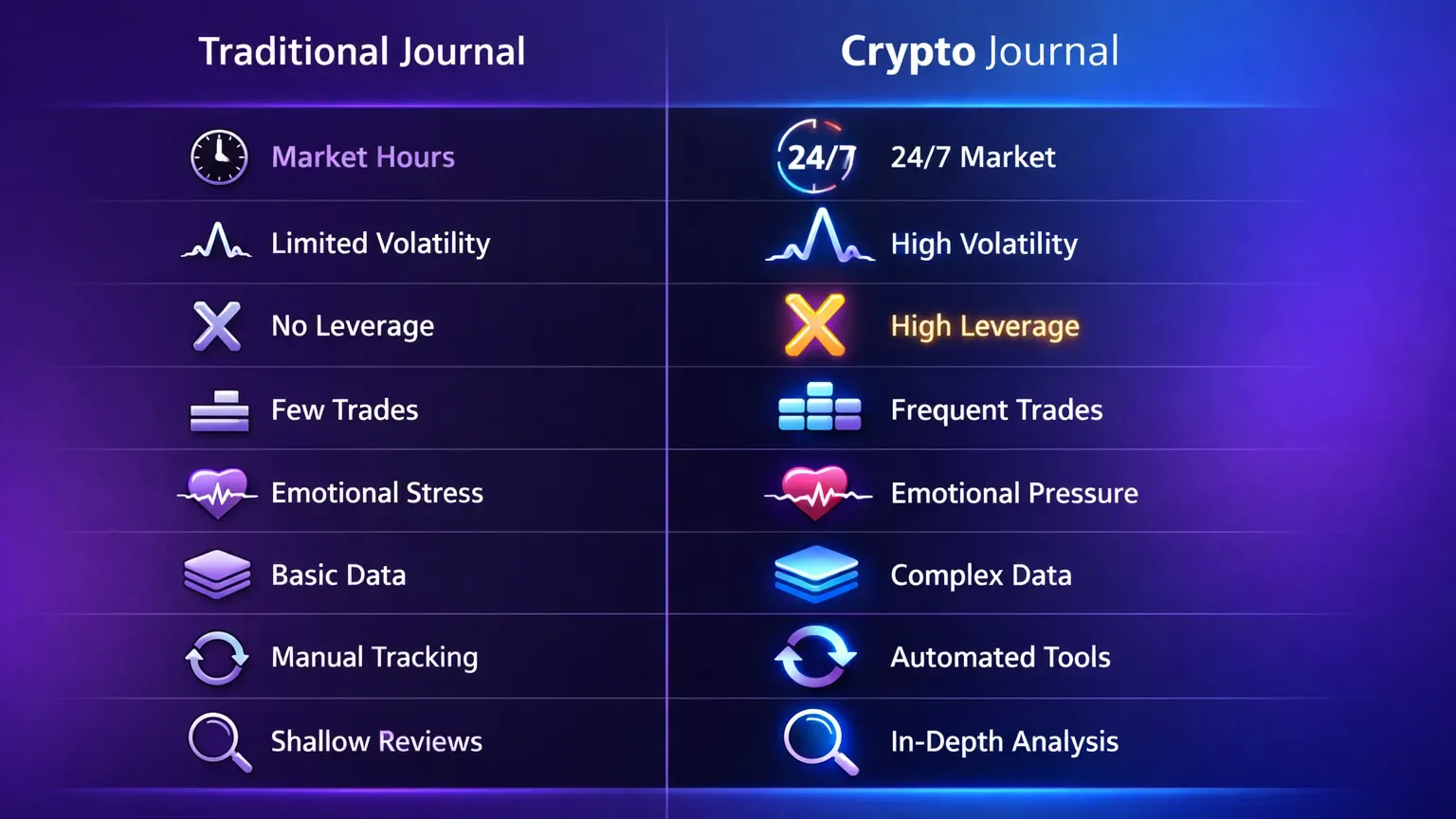
A crypto trading journal is not just about organizing trades. It is about creating clarity in an environment that is designed to overwhelm you. It helps you slow down after the fact so you can move faster and more confidently in the future.
Used correctly, it becomes a map of your decision-making. You stop guessing why your performance changes. You can see it directly in your data.
Choosing Your Approach: Manual Journaling Versus Automated Journaling
There are two main ways traders journal their crypto trades. They either do it manually using spreadsheets and notes, or they use a system that imports trades automatically from their exchange. Both approaches can work, but they do not produce the same level of accuracy, consistency, or long-term usefulness.
Manual journaling usually starts with good intentions. You open a spreadsheet, create columns for entries and exits, and promise yourself you will update it after every session. At first it feels organized. Over time, friction appears. You forget to log a trade. You approximate prices instead of copying exact fills. You skip emotional notes because you are tired. Small inaccuracies stack up, and the journal slowly loses its reliability.
Crypto makes this problem worse. Trades can happen at any hour. Partial fills are common. Funding fees, leverage, and rapid volatility add complexity. Manually capturing all of that without errors becomes difficult, especially if you are active or trading multiple markets.
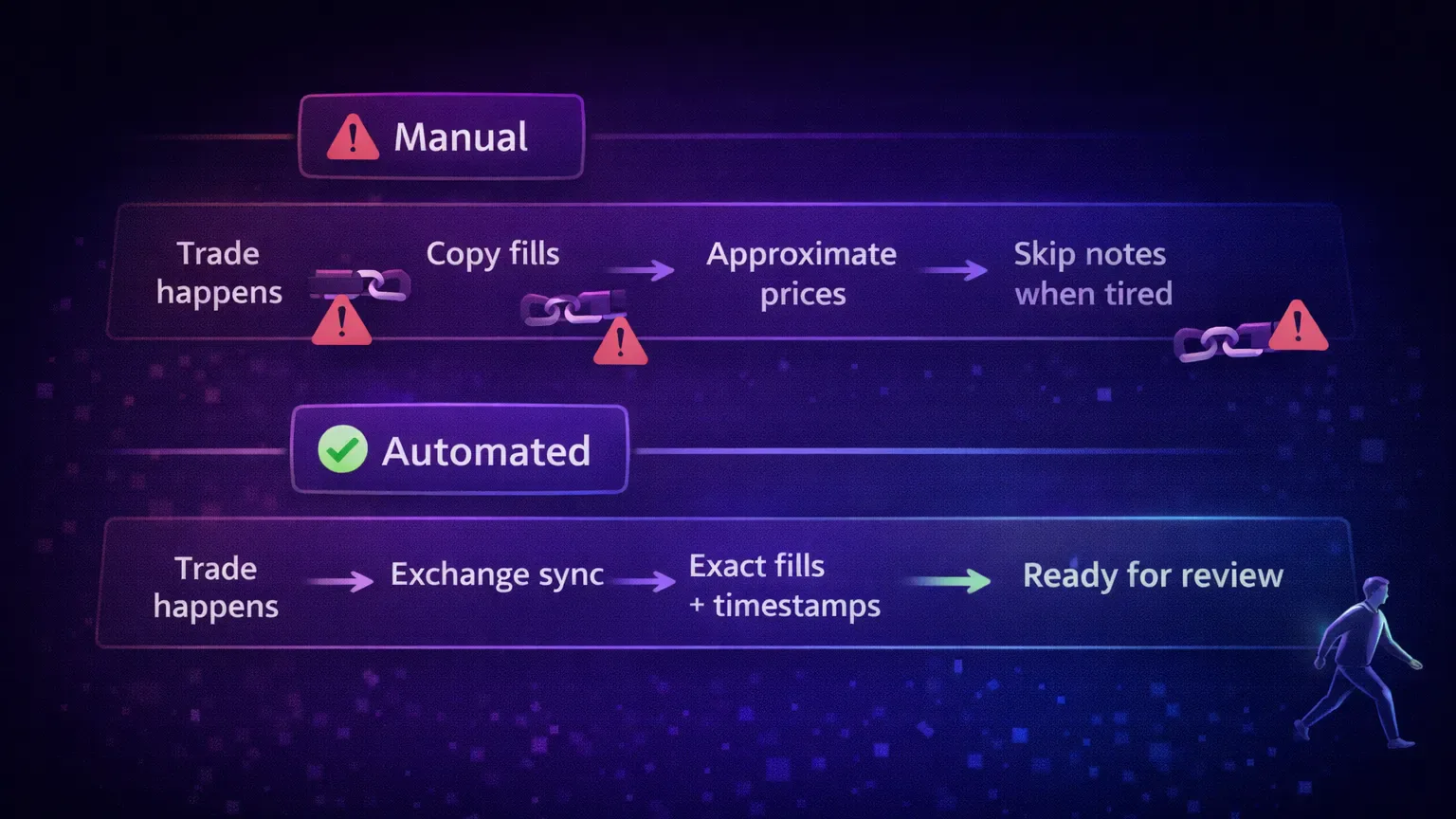
Automated journaling removes that burden. When trades sync directly from your exchange, accuracy becomes the default. Every fill is recorded. Every timestamp is precise. Every position size is exact. This changes how traders behave. Instead of spending energy on data entry, they spend it on analysis and review.
The difference shows up most clearly in consistency. Manual journals depend on motivation. Automated journals depend on systems. Motivation fades. Systems run quietly in the background. Over months of trading, that distinction matters more than most traders expect.
There is also a psychological benefit. When data collection is automatic, traders are less tempted to avoid logging bad days. The journal becomes honest. Losses are not hidden. Mistakes are visible. That honesty is uncomfortable, but it is essential for growth.
Manual journaling can still be useful for beginners who are placing very few trades and want to understand basic structure. It forces awareness. But as soon as trading volume increases, automation becomes a practical necessity. Without it, most journals collapse under their own maintenance cost.
The goal of journaling is not to build a beautiful spreadsheet. It is to create a reliable mirror of your behavior. Automation makes that mirror accurate even when your motivation is low.
Serious crypto traders eventually move away from fully manual systems. Not because spreadsheets are bad, but because consistency is more important than flexibility.
Tracking What Matters Inside a Crypto Trading Journal
Most traders think journaling means writing down entries, exits, and profit or loss. That is only the surface. A proper crypto trading journal tracks the full decision cycle of every trade. It captures what happened in the market, what you decided to do, how you executed, and what the result reveals about your process.
Without that full picture, you are only tracking outcomes. Outcomes alone do not tell you whether you traded well. A winning trade can be badly executed. A losing trade can be perfectly executed. Your journal should help you separate decision quality from randomness.
Start with clean, accurate trade data. That means the symbol, market type, position size, entry and exit prices, and timestamps. In crypto, it also means capturing leverage for futures trades and whether the position was long or short. These details form the backbone of any analysis. If the data is wrong, everything that follows is distorted.
Beyond raw trade data, context is where your journal becomes powerful. You want to record the conditions under which you took the trade. Was volatility expanding or contracting? Was the market trending or ranging? Were you trading during high liquidity hours or quiet periods? These factors heavily influence performance but are invisible if you only look at price.
Execution quality is another layer that most traders ignore. Did you enter where you planned, or did you chase price? Did you exit according to your rules, or did fear and greed interfere? Slippage, partial fills, and rushed decisions matter, especially in fast-moving crypto markets.
Then there is the human side. Emotions are not a weakness in trading. They are information. A proper journal notes what you felt before, during, and after a trade. Frustration after a loss. Overconfidence after a win. Hesitation after a losing streak. Patterns in emotion often appear before patterns in results.
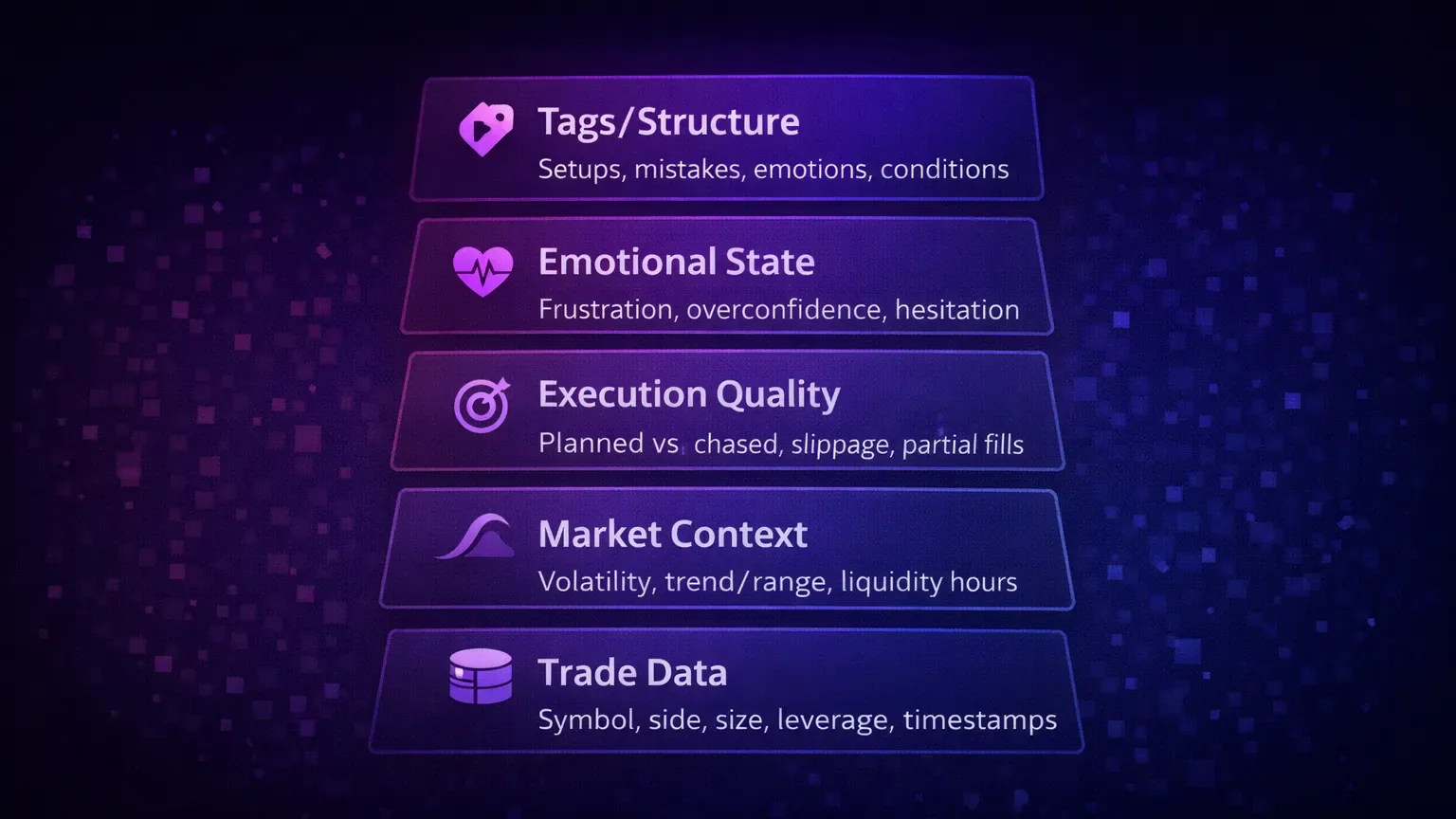
A strong crypto trading journal also connects trades to structure. That means using tags or categories to group similar ideas together. Setups, mistakes, emotions, and market conditions should all be taggable. This allows you to ask real questions of your data. Which setups are profitable? Which mistakes cost the most? Which emotions precede your worst sessions?
A proper journal captures accurate trade data for every position, market context that explains why conditions mattered, execution quality that shows discipline versus impulse, emotional state that reveals behavioral patterns, and structured tags that turn chaos into searchable insight.
When all of these layers exist together, your journal stops being a logbook. It becomes an analysis engine. You are no longer reviewing individual trades in isolation. You are studying your behavior across hundreds of decisions.
That is where real improvement starts.
What Changes When You Journal: Benefits That Actually Show Up in Results
Most traders hear that journaling builds discipline. That is true, but it is also incomplete. Discipline is a byproduct. The real value of a crypto trading journal is that it gives you clarity. Clarity about what actually works, what quietly hurts your performance, and where your effort should be focused.
Without a journal, improvement is random. You change things based on feelings, not evidence. After a losing streak, you tweak your strategy. After a winning streak, you assume you figured something out. A journal replaces that cycle with proof. It shows you patterns that are invisible in day-to-day trading.
A major benefit is finding your real edge. Many traders believe they have multiple profitable setups. In reality, most traders have one or two that carry their performance. A journal exposes this quickly. When you group trades by setup or tag, you can see which ideas generate consistent returns and which ones only create noise. This allows you to narrow your focus instead of spreading your attention across too many strategies.
A journal also reduces randomness in your results. Crypto markets are volatile, so randomness never disappears, but your behavior can become stable. When your entries, exits, and sizing follow the same structure, your performance becomes predictable. Predictable does not mean always profitable. It means measurable. And what is measurable can be improved.
Confidence is another hidden benefit. Real confidence does not come from winning streaks. It comes from knowing that you are executing a process that has positive expectancy. When a loss happens, it does not shake you. It becomes part of a larger sample. Your journal gives you that perspective.
Decision speed improves as well. When you know your best setups, your risk limits, and your performance tendencies, you hesitate less. You are not debating every trade internally. You are following a tested framework that your data supports.
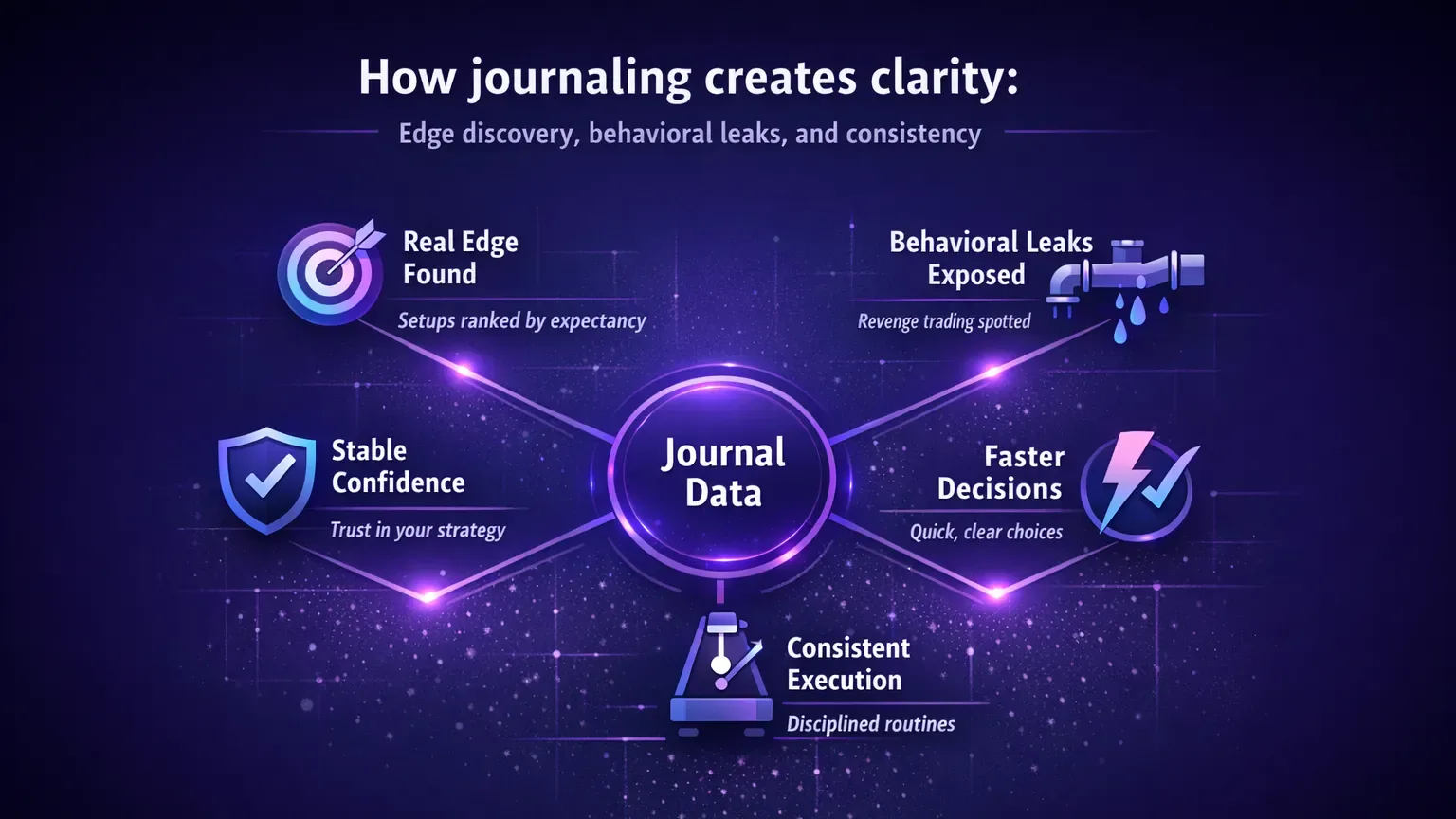
A strong journal also exposes behavioral leaks. Overtrading. Revenge trading. Increasing size after losses. Avoiding good setups after a drawdown. These patterns are emotional, not technical, and they repeat until you see them clearly. A journal makes them visible.
Consistency comes next. Most traders are inconsistent not because they lack knowledge, but because their execution varies with mood and market conditions. Journaling stabilizes your behavior. You start showing up to the market in a similar way every day, even when conditions are difficult.
Finally, a crypto trading journal gives you direction. Instead of trying to improve everything at once, you can focus on the highest impact areas. One setup. One mistake. One execution issue. Improvement becomes targeted and efficient.
Journaling is not about being disciplined for the sake of discipline. It is about building a system that quietly pushes your trading toward higher quality decisions.
Building a Journal System That Produces Actionable Insight
A crypto trading journal only works if it is built around structure. Random notes and disconnected spreadsheets do not create insight. You need a system that consistently captures the same types of information so your data can be compared, grouped, and analyzed over time.
Trade logging is the foundation. Every trade must be recorded automatically or with minimal friction. That includes the symbol, market type, side, position size, leverage if applicable, entry price, exit price, timestamps, and profit or loss. Without clean trade data, nothing else in your journal is reliable. Many traders fail here because manual input leads to missing trades, incorrect prices, or inconsistent sizing.
Tagging turns raw trades into structured data. A tag represents meaning. It could be a setup name, a mistake, an emotional state, or a market condition. Instead of looking at trades one by one, tags let you group similar decisions and study their performance as a category. This is how you discover which ideas deserve more focus and which habits are costing you money.
Notes and context connect the numbers to your decision-making. Numbers tell you what happened. Notes explain why it happened. A good journal allows you to add short, focused comments to a trade. Why you entered. What you saw on the chart. What you were feeling. What you did well. What you would change. These notes become extremely valuable during reviews because they connect outcomes to decisions.
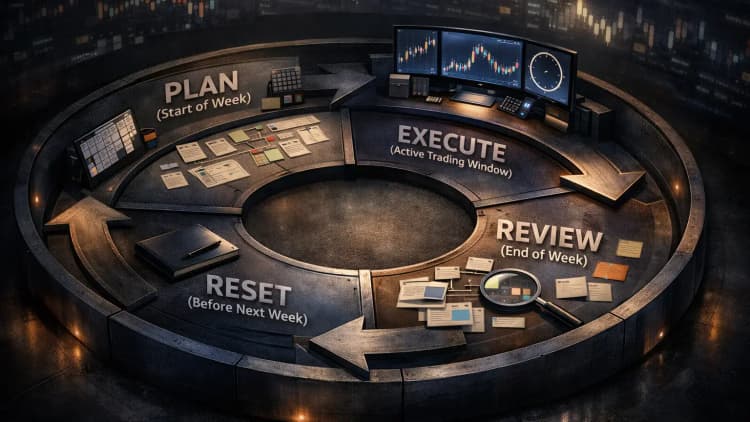
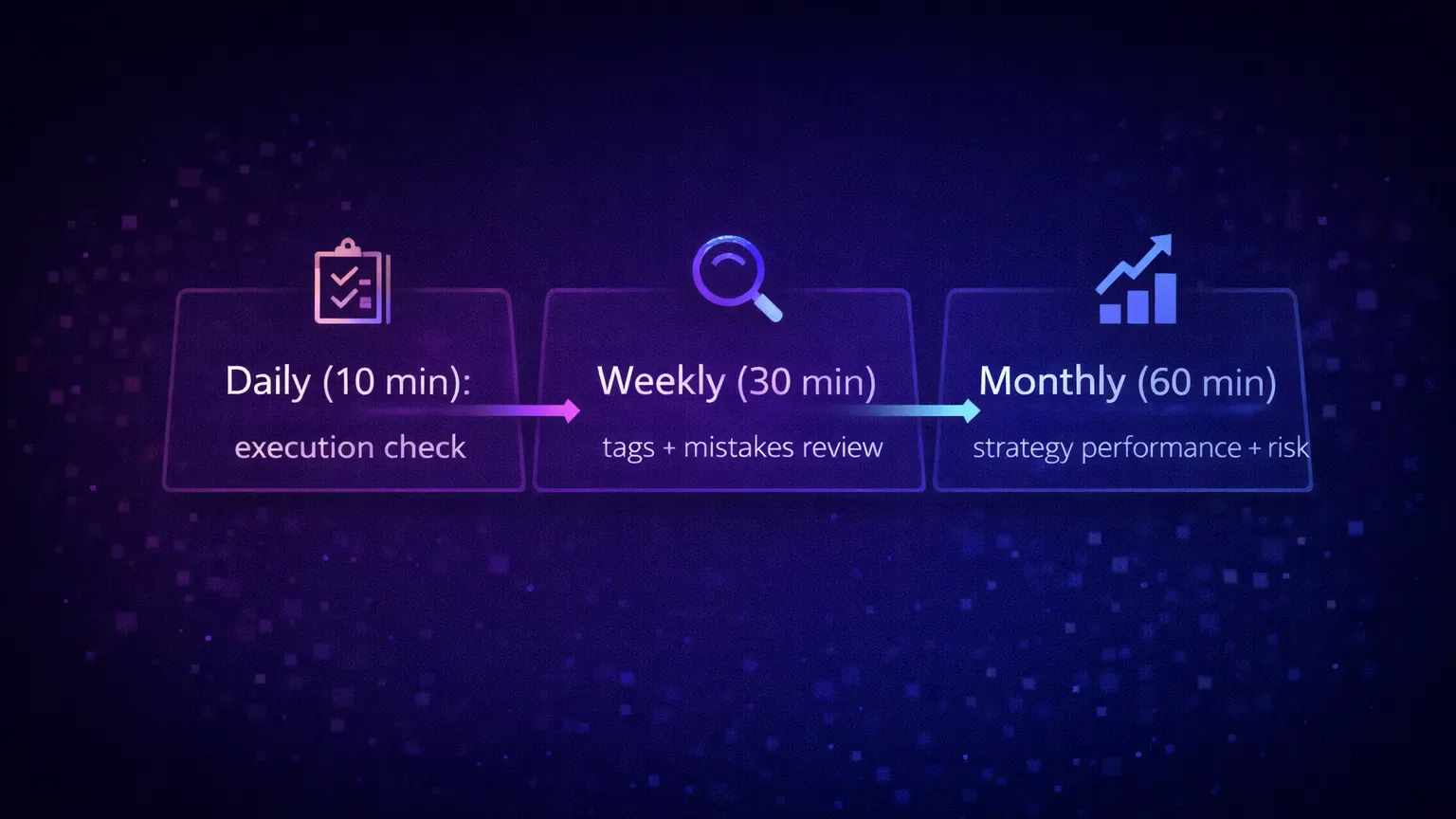
Review structure is where journaling becomes learning. A proper system supports daily, weekly, and monthly reviews. Daily reviews focus on execution quality. Weekly reviews focus on patterns and mistakes. Monthly reviews focus on strategy performance and risk management. Without review, a journal becomes a storage system instead of a learning system.
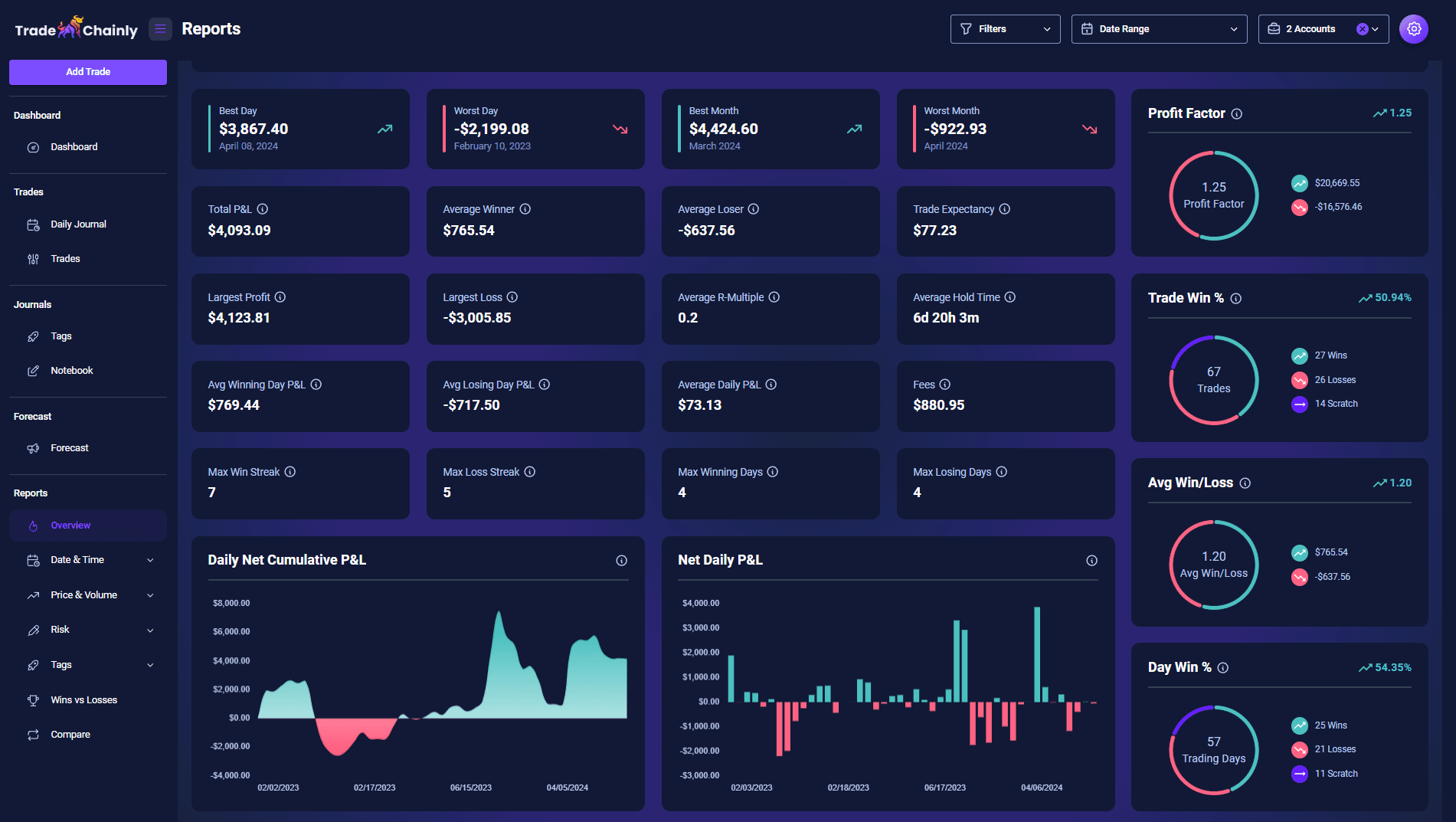
Analytics and reporting make the insight obvious. Metrics like win rate, average win, average loss, expectancy, and drawdown help you understand whether your strategy is mathematically sound. When combined with tags, analytics reveal which behaviors drive those numbers. You stop guessing and start measuring.
| Component | What It Captures | What It Reveals |
|---|---|---|
| Trade logging | Entry, exit, size, leverage, timestamps | Accuracy of execution and real performance |
| Tagging system | Setups, mistakes, emotions, conditions | Which behaviors and ideas are profitable |
| Notes and context | Thought process and decision reasoning | Why trades succeeded or failed |
| Review structure | Daily, weekly, monthly evaluation | Where improvement should be focused |
| Analytics and reports | Metrics and aggregated performance | Whether your strategy has positive expectancy |
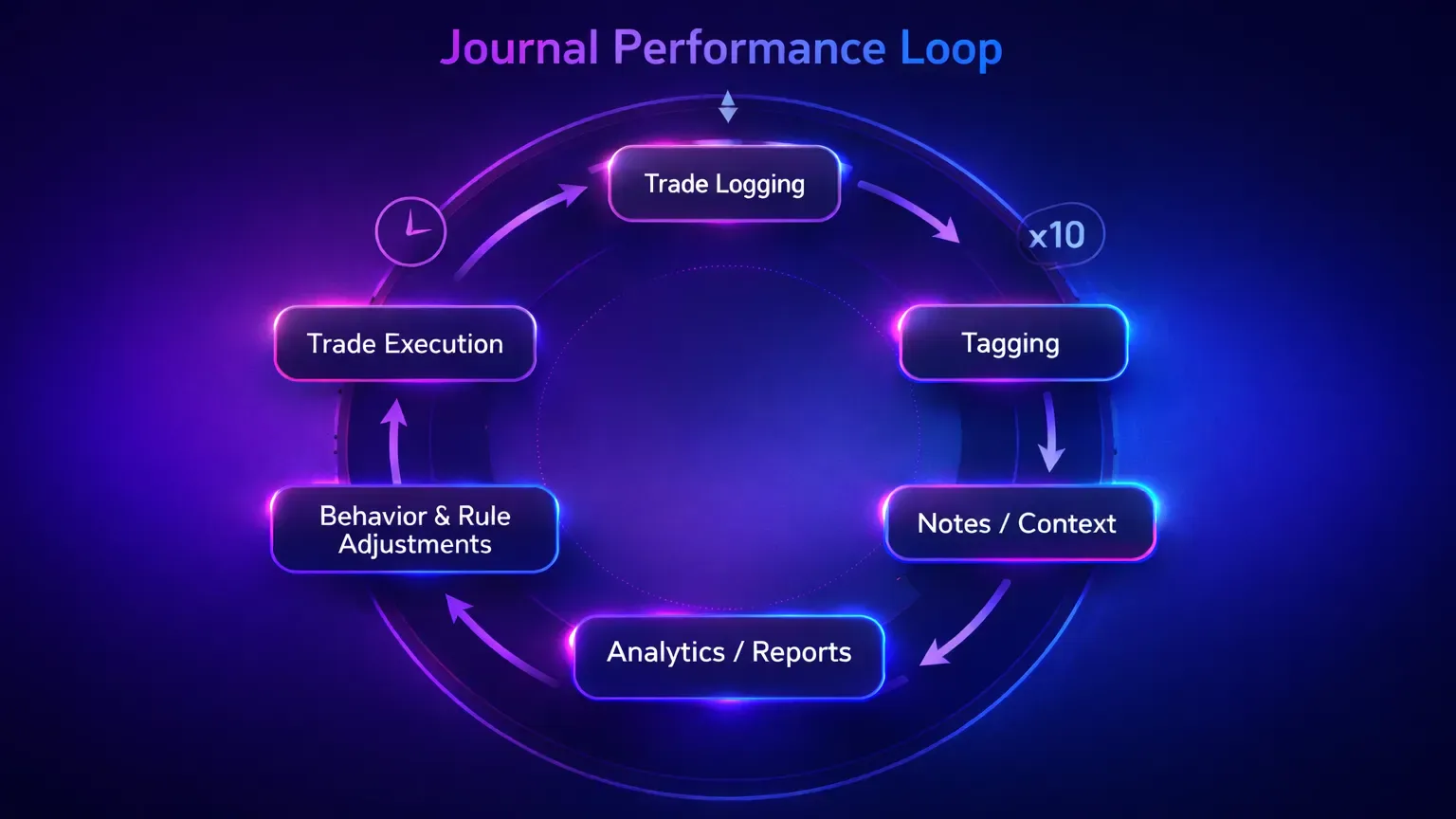
Automation ties it together. In crypto, automation is not a luxury. It is what makes consistency possible. Markets never close. Traders miss sessions. Manual tracking becomes exhausting. Automated imports remove friction and protect data accuracy. They also allow your journal to scale as your activity increases.
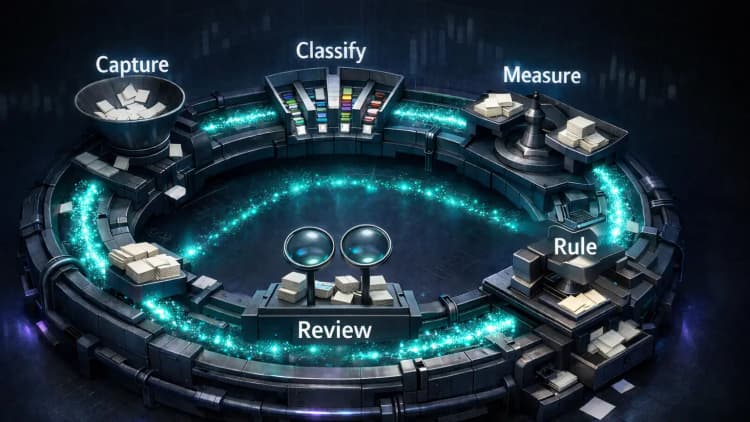
When these components work together, your journal becomes more than a log. It becomes a performance system. Each part reinforces the others. Trade data feeds tags. Tags feed reports. Reports guide reviews. Reviews guide changes in execution. Execution produces new data. The loop continues.
That loop is what separates traders who slowly improve from those who repeat the same mistakes for years.
Setting Up Your First Crypto Trading Journal Without Overcomplicating It
Setting up your first crypto trading journal does not require complexity. In fact, simplicity is what makes it sustainable. The goal is not to track everything. The goal is to track the right things consistently so patterns can emerge over time.
Start by deciding which markets you want to journal. If you trade both spot and futures, you should record them separately or clearly label them. The risk profiles are different. Mixing them without structure makes analysis confusing. A futures trade with leverage cannot be evaluated the same way as a spot position held without margin.
Next, define what success means for you. Some traders care primarily about profit and loss. Others focus on execution quality and risk control. Your journal should reflect your priorities. If your main problem is overtrading, you need data that shows frequency and impulsiveness. If your problem is poor risk management, you need clear sizing and stop behavior recorded.
A small, meaningful tag system is enough to start. Many traders make the mistake of creating too many tags and never using them properly. Begin with a few core categories: setups, meaning the patterns or strategies you trade; mistakes, like chasing, early exits, or oversizing; emotions, such as fear, overconfidence, frustration, hesitation; and market conditions, like trend, range, high volatility, low liquidity. You do not need dozens of tags. You need tags that reflect your real behavior.
After that, decide how you will review your trades. Journaling without review is just data storage. A simple structure works best. At the end of each trading day, look at execution quality. Once a week, look for repeating mistakes and strong setups. Once a month, evaluate whether your strategy is improving or stagnating.
Finally, define a small number of metrics to focus on. Win rate, average win, average loss, and expectancy are enough for most traders. Avoid drowning yourself in numbers. Your journal should clarify decisions, not complicate them.
The most important part is starting. A journal that is simple and consistent will always outperform a complex one that you abandon after two weeks. Let your system grow naturally as your understanding deepens.
Using Your Journal Like a Professional Trader
Most losing traders journal passively. They record trades, glance at profit or loss, and move on. Professional traders use their journal actively. It is not something they check after things go wrong. It is something that shapes how they trade before problems appear.
Professionals use a journal to filter their strategies. They do not treat all setups as equal. Over time, their data shows which ideas produce stable returns and which ones create volatility without payoff. When a setup underperforms, it is reduced or removed. When a setup shows consistency, it becomes a core focus. This keeps the strategy tight instead of bloated.
They also use their journal to control risk more precisely. Instead of using fixed position sizes for every trade, professionals adjust size based on performance data. If a setup has strong expectancy and low drawdown, it can handle slightly larger size. If a setup is volatile or experimental, risk stays small. The journal becomes a risk management guide, not just a report.
Behavioral correction is another major use. Professionals do not try to eliminate emotions. They track how emotions affect execution. If frustration leads to oversized positions, that pattern is written down. If hesitation leads to missed entries, that pattern is recorded. Over time, emotional triggers become predictable. Once something is predictable, it can be managed.
Professionals also rely on their journal to simplify decisions. They do not analyze every trade from scratch. Their journal already shows which conditions work best for them. Trend days versus range days. High volume sessions versus quiet hours. The journal becomes a filter that tells them when to trade and when to stay out.
Reviews are not random. They are structured. A professional trader might spend ten minutes daily checking execution, thirty minutes weekly reviewing tags and mistakes, and an hour monthly studying strategy performance. That rhythm keeps improvement steady without becoming overwhelming.
Finally, professionals use their journal to stay objective. When emotions rise, the data stays calm. It shows the truth of performance without drama. That objectivity is what allows them to improve steadily while others oscillate between confidence and doubt.
Their journal is not a record of trades. It is a decision-support system. It tells them where to focus, where to cut back, and where to trust themselves more.
Common Ways Crypto Traders Break Their Journaling Habit
Most trading journals fail not because the idea is bad, but because the execution is flawed. The mistakes traders make are rarely technical. They are behavioral and structural. Fixing them often creates immediate improvement without changing a single trading rule.
A common failure is overcomplicating the journal. Traders create dozens of tags, track too many metrics, and design elaborate spreadsheets that feel productive but become exhausting. Complexity creates friction. Friction leads to inconsistency. A journal that is not updated regularly becomes useless, no matter how well it is designed.
Some traders go in the other direction and track too little. They only log entry, exit, and profit or loss. That turns the journal into a scoreboard instead of a learning tool. Without context, you cannot see why results change. You only see that they change.
Avoiding review is another pattern. Traders log trades and never analyze them. This often comes from discomfort. Reviewing mistakes is emotionally hard. It is easier to place another trade than to study why the last one failed. Without review, journaling becomes passive record keeping.
Treating the journal as a diary is another trap. Writing long emotional paragraphs without structure feels therapeutic, but it does not create actionable insight. Emotions should be recorded, but they must be tied to decisions and outcomes.
Quitting too early is also common. Traders expect clarity after a few days or weeks. Journaling works through accumulation. Patterns appear after dozens of trades, not a handful. Stopping early guarantees you never see the value.
Many traders also try to journal perfectly instead of consistently. They wait until they have time to write detailed notes. They skip sessions when tired. Perfectionism kills momentum. A simple, incomplete entry is better than no entry at all.
The best journals are not impressive. They are boring, repeatable, and honest. That is what makes them powerful.
Turning Journal Data Into Better Trades
A journal only becomes valuable when its data changes how you trade. If your journal never affects position sizing, setup selection, or execution rules, it is just an archive. The purpose is not to admire statistics. The purpose is to make better decisions tomorrow than you made yesterday.
This starts with recognizing that your journal shows probabilities, not certainties. No setup is perfect. No metric guarantees success. What your data gives you is direction. It shows where your edge is stronger and where it is weaker. Trading then becomes a process of leaning into what works and slowly reducing what does not.
One practical way this shows up is in setup selection. If your journal shows that two setups produce most of your profits, those setups deserve more attention. They should be traded more often, with more focus and preparation. Setups that consistently underperform should be reduced or removed, even if they look good on the chart.
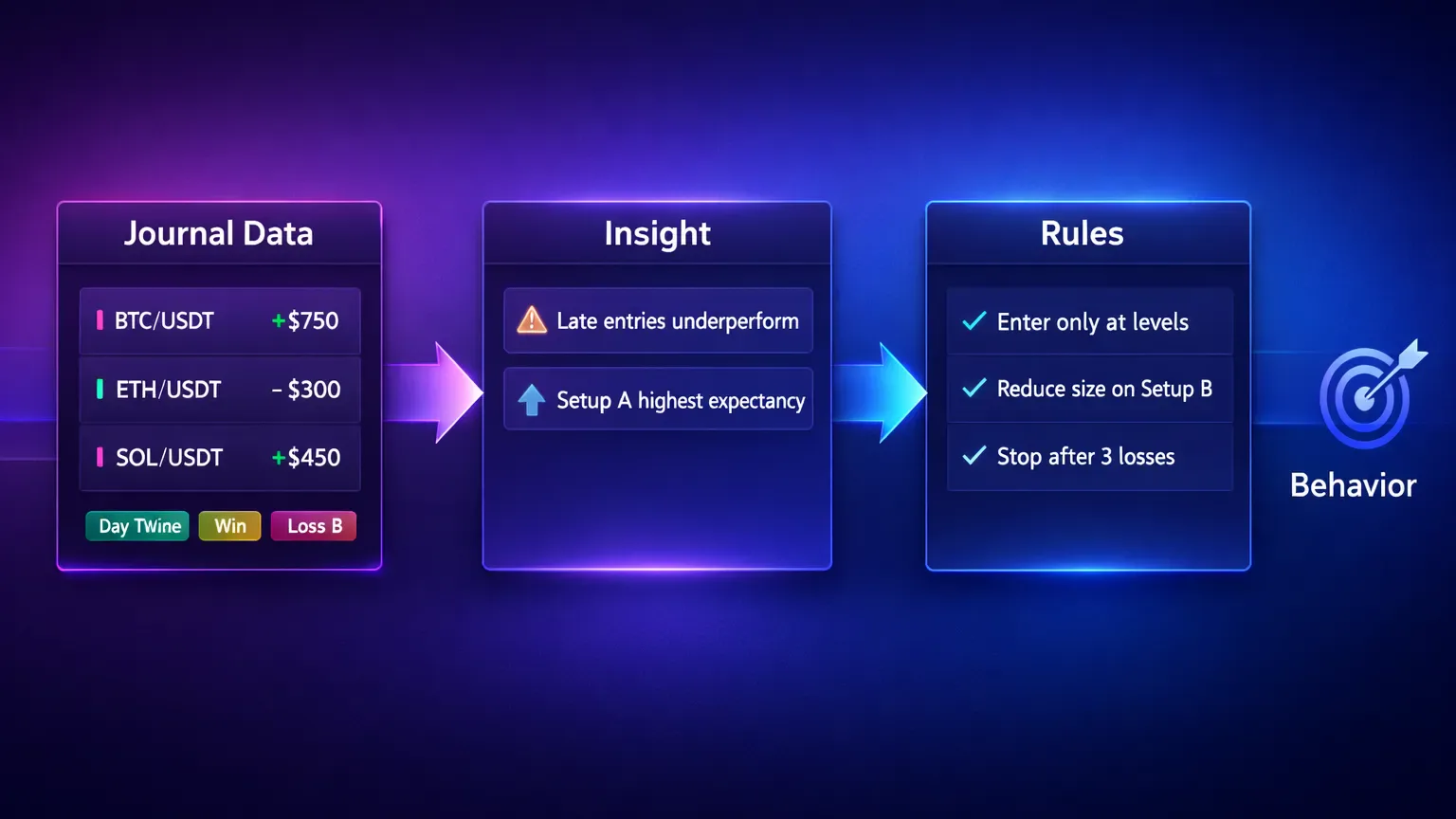
Another change comes in risk management. Data reveals how volatile your results are. If a setup has large swings, it should carry smaller size. If another setup shows stable returns and shallow drawdowns, it can tolerate slightly higher risk. Position sizing stops being emotional and becomes proportional to performance.
Execution rules also evolve. Your journal might show that late entries reduce profitability or that moving stops too quickly cuts winning trades. Once that pattern is visible, execution rules can be tightened. You are no longer guessing which behaviors matter. You are correcting proven leaks.
| Journal Insight | Trading Decision | Behavior Change |
|---|---|---|
| Setup A has the highest expectancy | Focus on trading Setup A more often | Allocate more preparation time to this setup |
| Setup B has frequent large drawdowns | Reduce risk on Setup B | Lower position size or stop trading it |
| Trades entered late perform worse | Tighten entry discipline | Only enter at predefined levels |
| Losses increase after three trades in a row | Add a daily stop rule | Stop trading after three consecutive losses |
| Overconfidence after wins increases risk | Cap size after big wins | Enforce maximum risk per trade |
The most important shift is psychological. When decisions come from data, confidence becomes stable. You are no longer reacting to your last trade. You are responding to your full history. That removes a large part of emotional pressure.
Your journal becomes a decision filter. It tells you what to trade, how much to risk, and which habits to protect. That is when journaling stops being educational and starts being operational.
The Non-Negotiable Part: Making Improvement Inevitable
A crypto trading journal changes the way you relate to your performance. It shifts trading from something emotional and reactive into something structured and measurable. Instead of guessing why a week went well or badly, you can see it. Instead of changing strategies based on frustration, you refine them based on evidence.
The market will always be uncertain. Volatility, news, and randomness are part of crypto. What you control is how you respond to it. A journal gives you control over your process. It shows you where your edge lives, where your mistakes hide, and where your emotions quietly interfere with execution.
Most traders spend years trying to improve by changing indicators or switching strategies. The biggest breakthroughs usually come from understanding themselves. How they size positions. How they react after losses. Which setups they truly execute well. A journal exposes those patterns faster than any chart ever will.
This is also where tools matter. When your trades are automatically recorded, your data stays honest even on bad days. When tags and reports organize that data, insights become easier to see. A platform like TradeChainly simply removes friction from a process that serious traders already need. It lets you focus on review and improvement instead of data entry.
A crypto trading journal is not an optional habit. It is infrastructure. It is the difference between hoping your trading improves and building a system that makes improvement inevitable.