Why P&L Alone Is Misleading in Crypto Trading
Most crypto traders think in terms of wins and losses. If a trade closes in profit, it feels like a success. If it closes in the red, it feels like a mistake. The problem is that the market does not reward good behavior every time, and it does not punish bad behavior every time either. You can trade terribly and still make money on Binance or Bybit when volatility pushes price in your direction. You can also trade perfectly and still get stopped out on a quick wick.
That is why a simple P&L snapshot never tells the full story.
Serious traders eventually realize that what really matters is execution quality. Did you follow your plan? Did you size correctly? Did you enter where your system told you to? Did you manage risk? These are the real drivers of long term consistency, especially in crypto where leverage, funding rates, and sudden liquidations can punish emotional decisions.
This is where a trade rating system becomes incredibly powerful.
A trade rating system gives you a structured way to grade each trade based on performance, discipline, and alignment with your plan. Instead of looking only at profit or loss, you review how well you executed. The goal is not perfection. The goal is building awareness of habits, patterns, and behaviors that either support or destroy your edge.
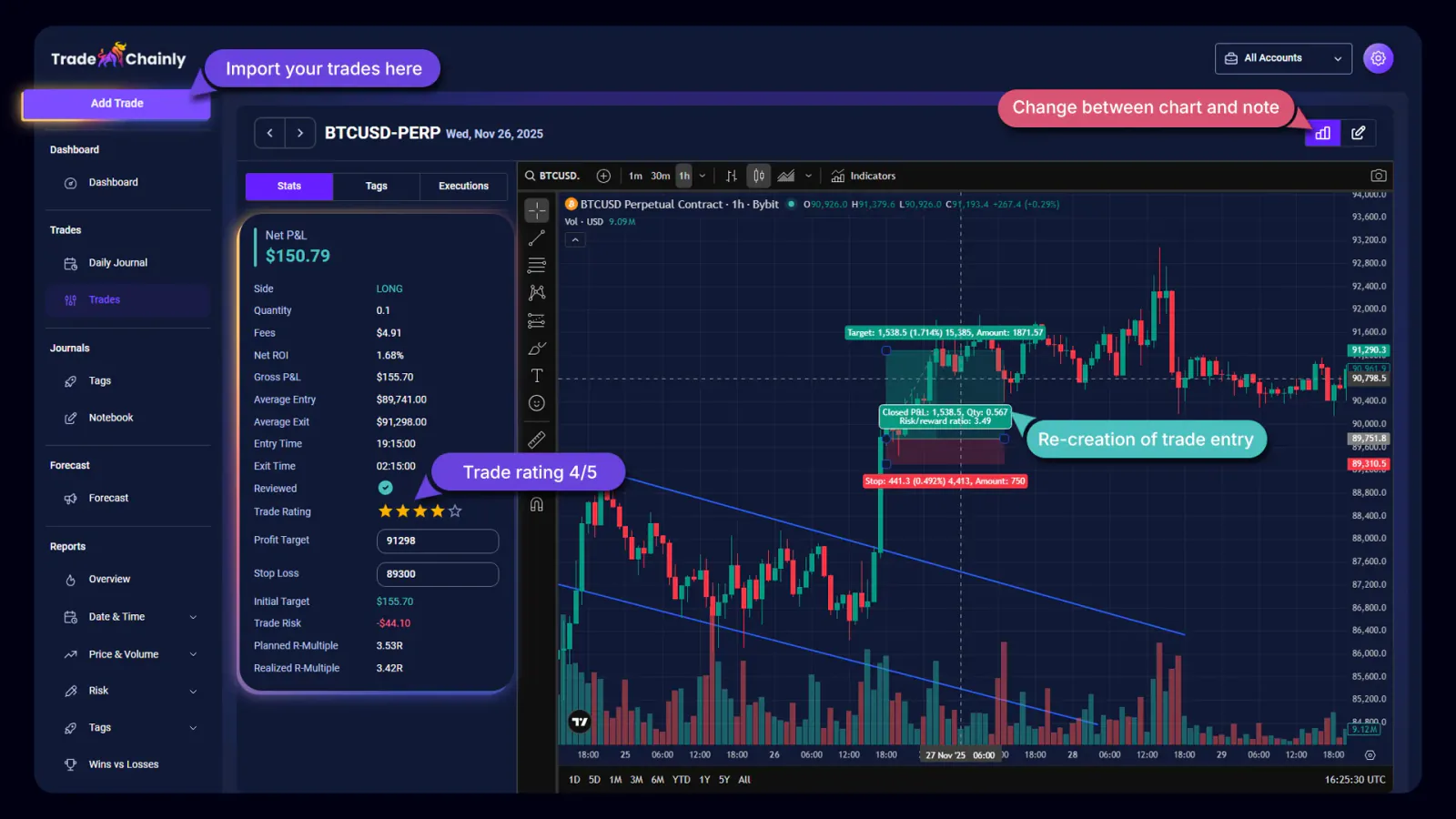
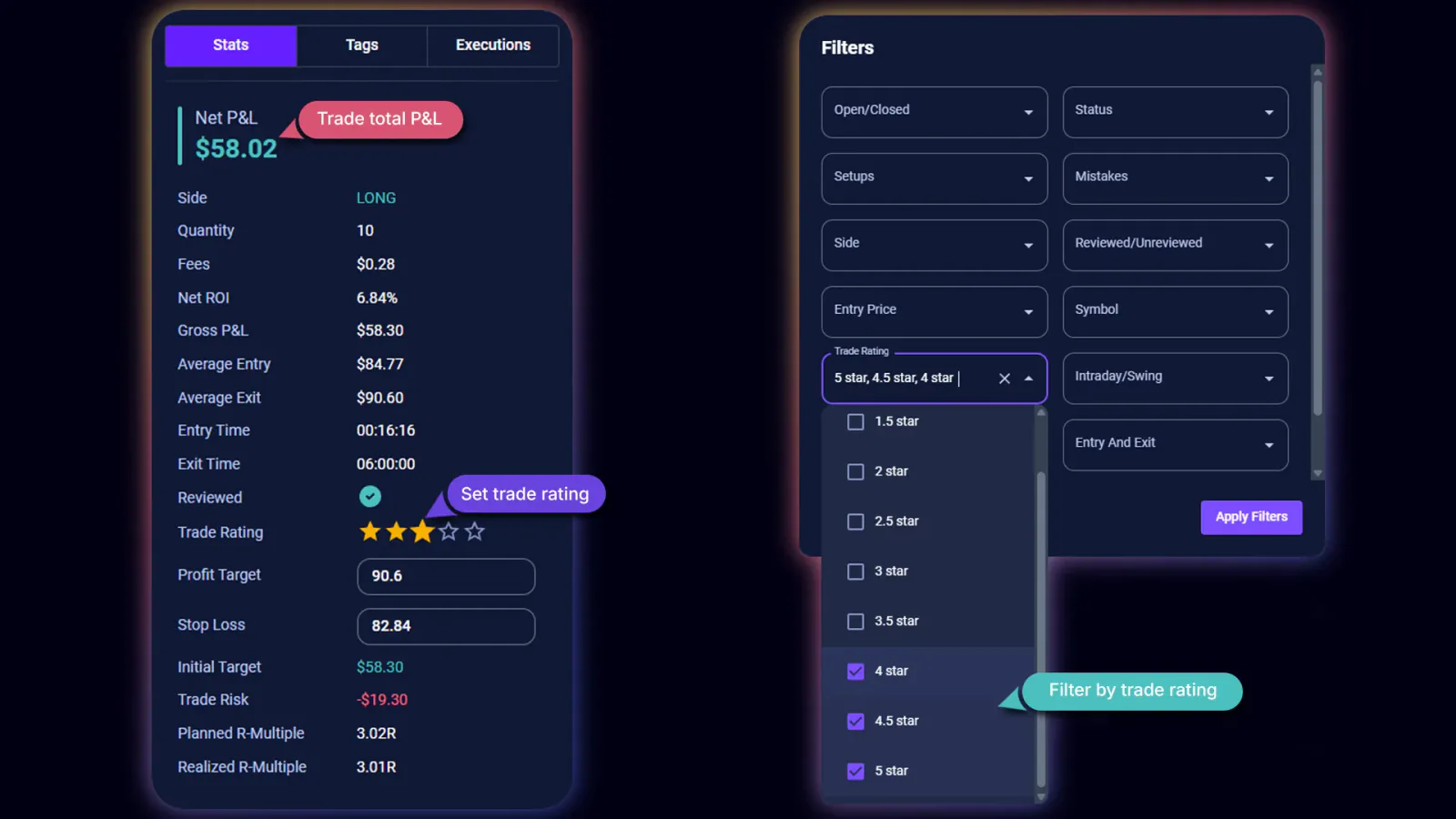
Inside TradeChainly, you can rate every trade directly from the Trade Details page. You review the trade, assign a rating from 0 to 5, and mark it as reviewed. Over time, your trading journal becomes more than just a log of transactions. It becomes a feedback system that shows whether you are improving as a trader.
This matters even more for day traders and scalpers. You may execute dozens or even hundreds of trades in a month. Without structure, your reviews become random. With TradeChainly, your ratings give context, help you identify repeat mistakes, and highlight the setups and behaviors that actually work for you.
By the end of this guide, you will know exactly how to grade your trades, how to use ratings inside TradeChainly, and how this simple habit can change the way you trade.
What Is a Trade Rating System?
A trade rating system is a structured way to grade each trade based on how well you executed your plan. It is not focused only on profit or loss. Instead, it measures the quality of the decision making behind the trade.
Think of it like a school grading system for your trading performance. Every trade receives a score. That score reflects discipline, planning, risk management, and emotional control. The goal is to see whether you traded well, not just whether price moved in your favor.
This is especially important in crypto trading. Markets are open 24/7, volatility is constant, and leverage amplifies both gains and losses. You can stumble into profits by accident. You can also follow a high quality process and still experience a losing trade. If you only judge yourself by the P&L column, you will get inconsistent feedback and confused signals about what is actually working.
A trade rating system solves that problem. It allows you to separate outcome from execution.
When you use a rating system consistently, patterns become obvious. You start to see which trades follow your plan and which trades come from impulse. You notice whether your best performing trades also tend to be your highest rated trades. You also identify times when you abandoned your system, chased price, overleveraged, or reacted emotionally.
Inside TradeChainly, trade ratings become part of your overall analytics. Each trade you execute can be reviewed, rated, and filtered. You are no longer guessing about your behavior. You have real data about the quality of your trading decisions over time.
This creates clarity. Instead of asking, “Why am I losing lately?” you can ask much better questions like:
Did my execution quality drop?
Am I breaking my rules more often?
Are my losing trades still high quality trades?
That is the real power of a trade rating system. It keeps you grounded in process rather than outcome, which is essential for any trader who wants to build consistency in fast moving crypto markets.
The Role of Trade Ratings Inside TradeChainly
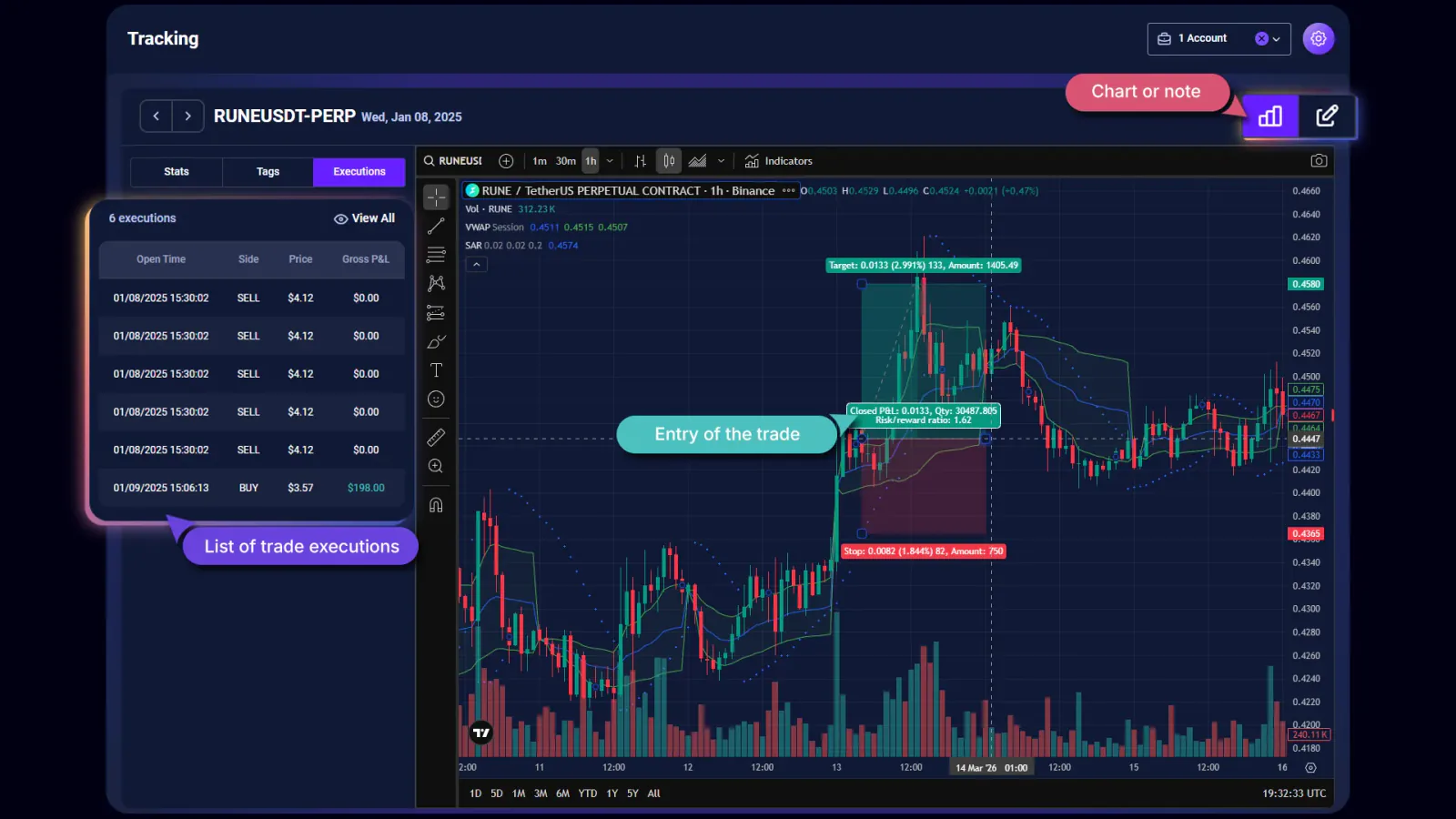
Trade ratings are built directly into TradeChainly so you can review trades without spreadsheets or separate notes. The feature lives inside the Trade Details page, which is where you already go to analyze each trade. You can see your executions, TradingView chart, tags, notes, and all trade stats in one place. The rating system fits naturally into that workflow, so reviewing trades becomes part of your normal routine instead of an extra chore.
When you open a trade in TradeChainly, you can mark it as reviewed and assign a rating from 0 to 5. This rating represents how well you executed your plan. It is completely independent from your P&L. You might rate a losing trade as a 5 if you followed your rules perfectly. You might give a profitable trade a 1 if you know you acted emotionally or ignored your risk plan.
This separation between outcome and execution is intentional. TradeChainly encourages you to build process discipline, not just chase green numbers.
The rating lives alongside your other important performance metrics such as Net P&L, Net ROI, R-Multiple, fees, and execution details. You can also see tags like setups, mistakes, and emotions. That means you are not rating trades in isolation. You are rating them in context with everything else that matters.
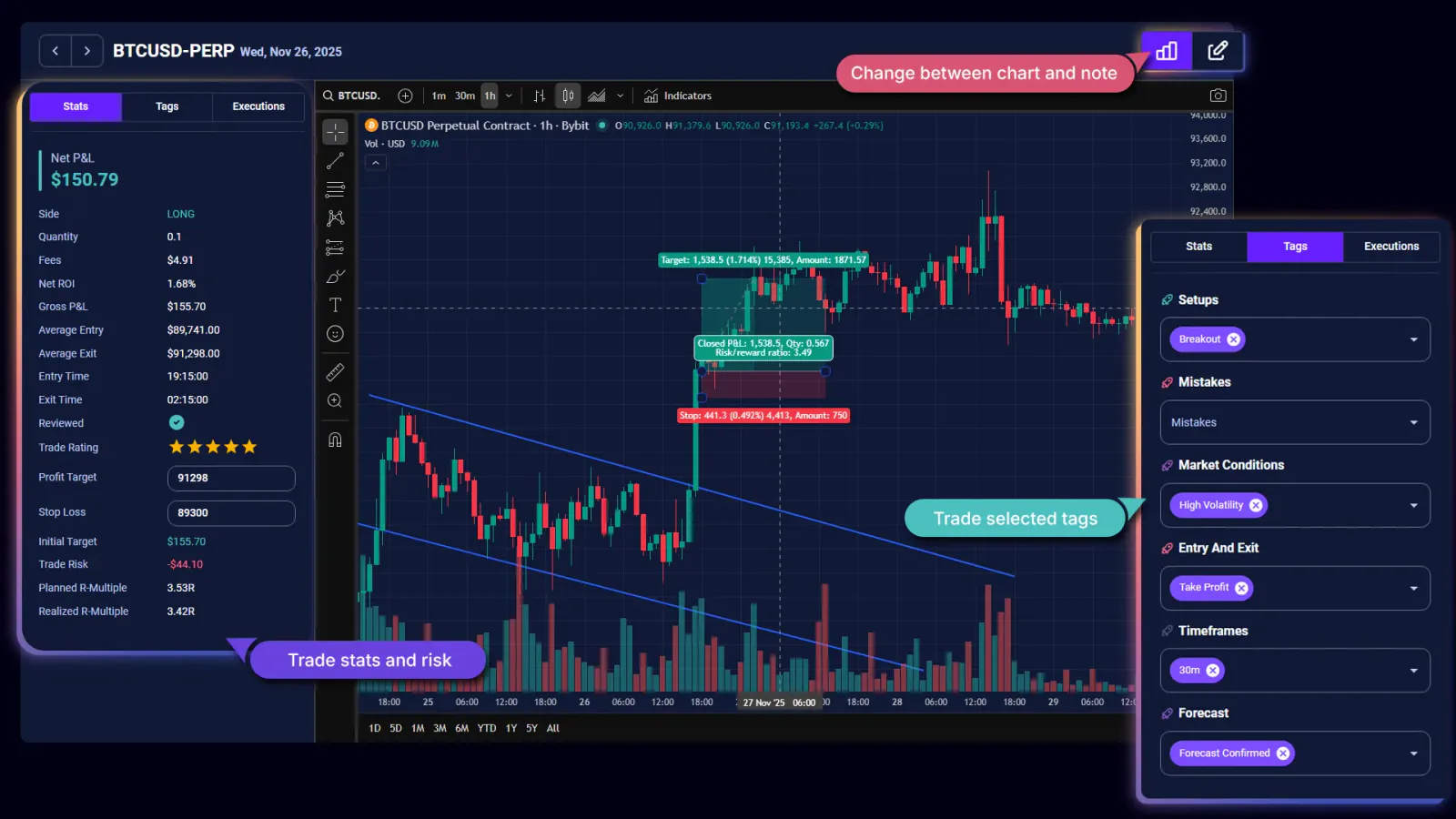
For example, you might notice that your lowest rated trades often share the same mistake tag, like FOMO or overleveraging. You might also see that your highest rated trades normally come from your best performing setup category. Over time, these connections become powerful insights because the rating helps you quantify the quality of your thinking.
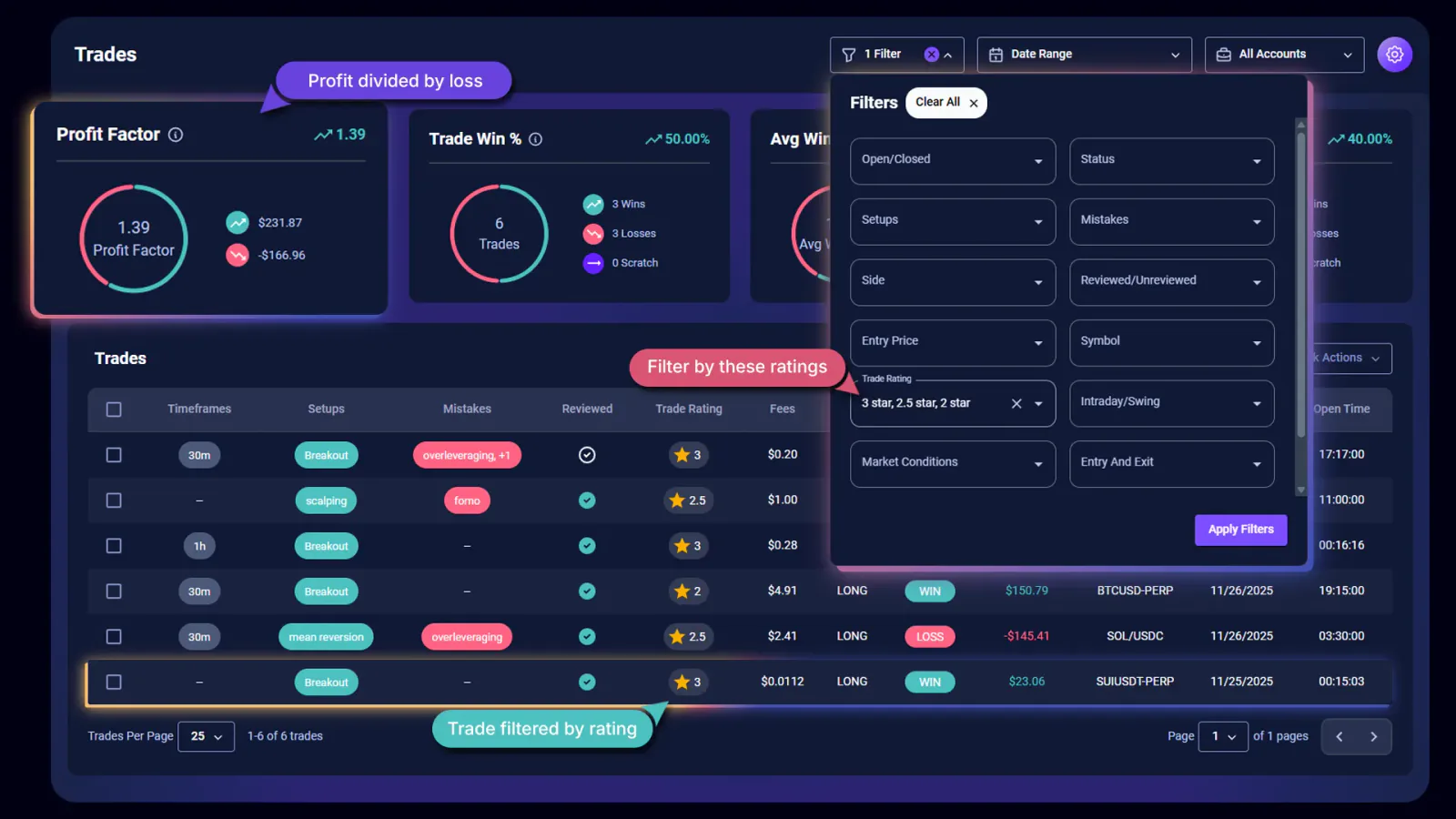
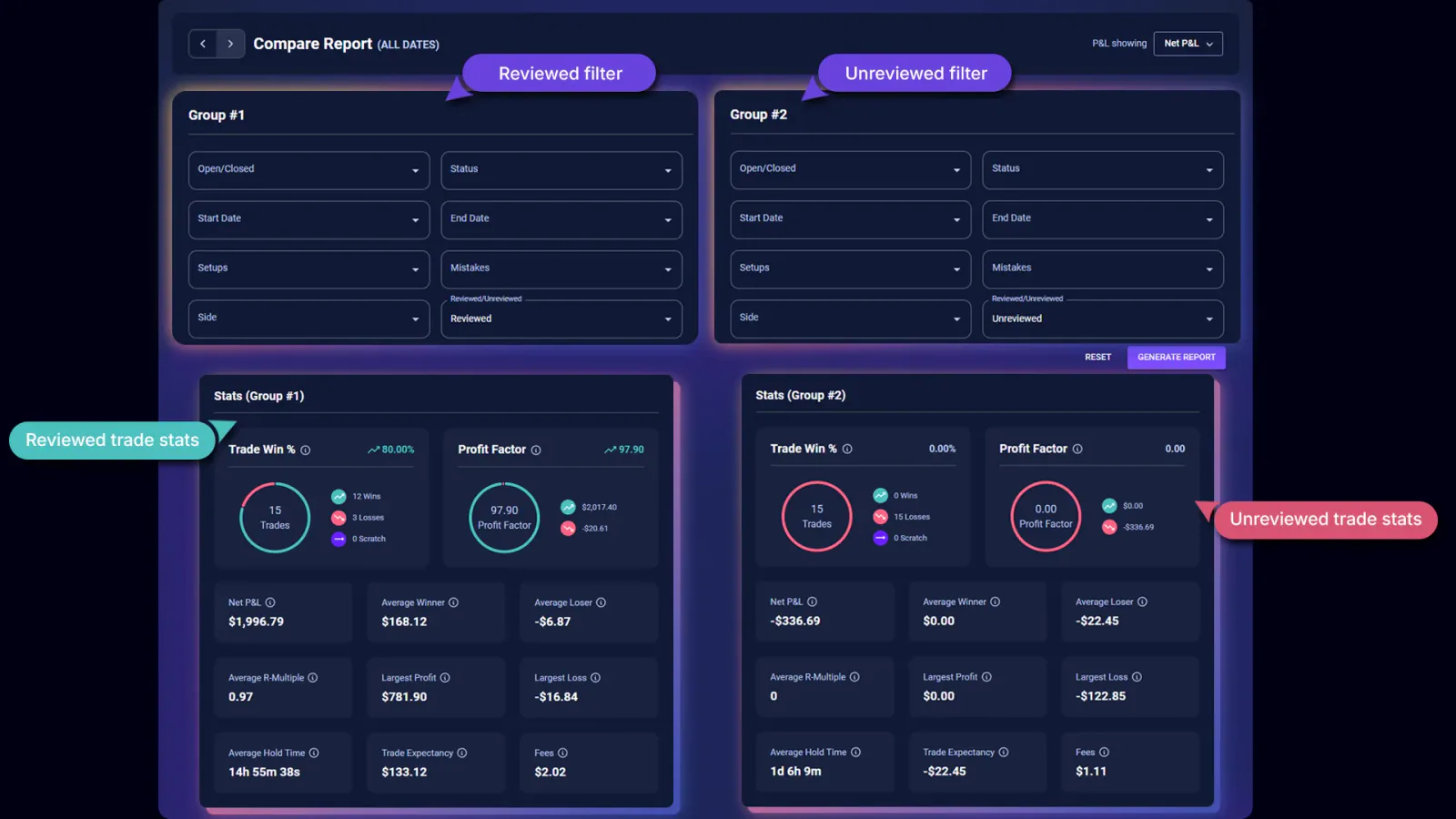
Trade ratings in TradeChainly are also filterable. This means you can analyze only your reviewed trades or compare reviewed trades against unreviewed trades. Many traders realize that unreviewed trades often show worse results, which reinforces the importance of structured review.
The system is simple on purpose. You do not need to build a complicated scoring spreadsheet. You simply open your trade, review what happened, choose a rating, and move on. The platform handles the organization, aggregation, and analytics in the background.
In short, the trade rating feature inside TradeChainly transforms your trading journal into a learning system. Instead of looking at your trades as isolated events, you build a continuous feedback loop. Each rating contributes to your long term growth as a trader, which is exactly what a journal should do.
A Simple Framework for Grading Trades (0–5 System)
A trade rating system only works if it is simple enough to use consistently. If the process becomes complicated, you will eventually stop doing it. That is why a 0–5 scale works so well. It is intuitive, fast to apply, and still gives you enough range to express quality differences between trades.
Inside TradeChainly, you can assign any trade a rating from 0 to 5. Here is a practical way to think about each score.
5: Perfect execution
A 5 means you followed your plan exactly. You waited for your entry trigger. You sized the position correctly. Your stop loss and target were clearly defined. You stayed disciplined during the trade and followed your rules from start to finish. The outcome does not matter. A losing trade can still earn a 5 if you executed flawlessly.
4: Strong execution with small room for improvement
A 4 means you followed your plan well, but there were small details you could improve. Maybe your entry was slightly late. Maybe you exited a little too early. Maybe your emotional state was not ideal but you still respected your rules. Overall, the trade was well managed and aligned with your system.
3: Mixed execution
A 3 sits in the middle. Some parts of the trade were well executed, while others were not. You may have followed your setup but sized slightly too large. You may have managed risk well but entered impulsively. A 3 indicates inconsistency. There was some discipline, but not full alignment with your plan.
2: Poor execution
A 2 means you broke important parts of your process. You might have chased after a fast move. You might have moved your stop irrationally. You might have held onto a losing position for emotional reasons. The trade shows clear process breakdowns, even if parts of the trade were still somewhat structured.
1: Major rule violation
A 1 means the trade was almost entirely emotional. You ignored your trading plan, threw risk management aside, or acted out of frustration or fear. It was not a strategic trade. It was a reaction. These are the trades that usually cost the most in the long run.
0: Unacceptable or reckless trade
A 0 is reserved for trades that should never have happened. This includes extreme revenge trading, gambling entries, overleveraged positions with no stop loss, or clicking into a trade with no plan at all. A 0 forces you to confront behavior that has no place in professional trading.
This framework helps you grade trades fairly. You are not judging yourself as a person. You are assessing your execution quality. Over time, ratings help you see whether you are becoming more disciplined, more consistent, and more aligned with your system.
Because crypto markets move fast, it is easy to drift into emotional trading without noticing. A simple rating after each trade keeps you honest. Inside TradeChainly, you can apply this score while reviewing your Trade Details page, which means you never break your workflow.
If you stay consistent with this system, you will start to see patterns emerge. High rated trades tend to align with your edge. Low rated trades usually come from impatience or emotional reactions. That awareness is what leads to real improvement.
Examples Using Real-World Crypto Scenarios
It is one thing to talk about a trade rating system in theory. It becomes much more useful when you see how it applies in real trading situations. Here are a few common crypto day trading scenarios and how they might be rated inside TradeChainly.
Example 1: A clean BTCUSDT breakout trade
You planned a breakout trade on BTCUSDT. You waited for confirmation, placed your stop loss below structure, and risked an amount that fit your rules. The trade moved in your favor, hit your target, and you exited as planned.
Even if the trade had stopped out, the process was flawless. This is a 5.
Example 2: A good ETH scalp with slightly early entry
You spotted momentum on ETH and entered a scalp trade. Your idea was valid and your plan was clear. However, you entered a bit early instead of waiting for your confirmation candle. The trade still worked, and you managed it well afterward.
This is still a strong trade, but not perfect. This is probably a 4.
Example 3: A SOL futures trade where risk management slipped
You identified a valid setup on SOL. The entry followed your plan, but you sized slightly larger than your normal risk, telling yourself it was “only this time.” The trade worked, and you made a profit.
The profit does not change the fact that you broke your risk rule. This is closer to a 3.
Example 4: Emotional trade during market volatility
Bitcoin dumps quickly after a news event. You enter short without a plan because you feel like you are missing the move. You set no clear stop loss and rely on luck more than structure. The trade somehow still ends in profit.
Even though you made money, this is a poor quality trade. This should be rated a 1 or 2 depending on severity.
Example 5: Revenge trading after a loss
You take a losing trade. Instead of stepping back, you immediately reopen another position with larger size on Bybit, trying to win the money back. There is no strategy, only emotion. The trade ends in a large loss.
This is a classic 0 or 1. It is a breakdown of discipline.
Example 6: A losing trade that was managed perfectly
You enter a well planned trade on ETH. The setup fits your journal stats. You size correctly. You accept the risk. The trade moves slightly against you, hits your stop loss, and you exit as planned. No panic. No hesitation.
Even though you lost money, this is still a 5.
These examples highlight an important truth. The best traders do not judge themselves based only on profit and loss. They judge themselves by the quality of their decisions. A structured trade rating system helps you think like a professional.
Inside TradeChainly, these ratings do not just sit unused. They become part of your trading analytics. Over time, you might notice that your highest rated trades also produce the best long term P&L. You might also see that most large drawdowns come from your lowest rated trades.
That kind of insight cannot be gained by memory alone. You need data. TradeChainly gives you a simple way to connect behavior with performance so you can see the truth about your trading.
How Trade Ratings Improve Your Analytics in TradeChainly
A trade rating system becomes far more powerful when it lives inside your trading journal rather than in your head. TradeChainly integrates ratings directly into your Trade Details page and analytics so you can actually measure how execution quality impacts results over time.
When you rate a trade in TradeChainly, that rating becomes part of your historical dataset. You can later filter trades by rating, reviewed status, tags, date range, account, and more. This gives you the ability to answer questions that most traders simply cannot measure.
For example, you can look at:
How profitable are my 4 and 5 rated trades compared to my 2 and 3 rated trades?
Do I lose the most money on trades I rated 0–2?
Are my best trades also the ones where I felt the calmest and most disciplined?
Does my P&L improve during periods when I am more consistent with rating and reviewing?
This turns your journal into a performance lab. Instead of guessing, you see direct relationships between execution quality and financial outcomes.
Trade ratings also work beautifully with tag analytics inside TradeChainly. You might find that your highest rated trades come from one specific setup. Or that your lowest rated trades are consistently tied to the same mistake tag, such as revenge trading or overleveraging. This clarity helps you refine your strategy instead of endlessly tweaking indicators.
Another powerful benefit is the Reviewed vs Not Reviewed distinction. TradeChainly lets you mark trades as reviewed once you complete your analysis. Many traders discover that the act of regularly reviewing trades leads to better discipline, which eventually reflects in their P&L. When trades stay unreviewed, emotional habits often creep back in.
Over time, trade ratings help you track personal growth. Early in your journey, you might have a lot of 1s and 2s. As your process matures, those ratings should improve. Your average execution score becomes a meaningful metric, even independent of short term gains or losses.
And when you hit a rough patch, the data helps you understand whether the problem comes from market conditions or from your own behavior. If execution scores stay high but results dip, the system is probably still solid. If execution quality declines, you know the fix starts with discipline and process, not strategy overhaul.
All of this happens automatically inside TradeChainly. You do not need to build spreadsheets. You do not need to manually calculate averages. You just review your trades, apply ratings, and let the platform handle the analytics.
How to Build a Repeatable Review Routine
A trade rating system only delivers value when it becomes part of your daily workflow. The goal is not to rate trades occasionally. The goal is to build a consistent review process that fits naturally into how you already trade. TradeChainly is designed to make that easy.
Here is a simple routine you can follow.
Step 1: Sync or import your trades
TradeChainly automatically imports trades from major crypto exchanges like Binance, Bybit, Coinbase, Kraken, KuCoin, Crypto.com, and OKX. You do not need to manually enter every transaction. Once the sync is active, your trades show up inside your journal without extra effort.
Step 2: Open the Trade Details page
From the Trades page, click into any trade you want to review. The Trade Details page shows your TradingView chart, executions, P&L breakdown, tags, risk metrics, and notes. This is your review hub.
Step 3: Tag the trade
Assign relevant tags such as setups, mistakes, or emotions. This step adds structure to your analysis and helps you later identify trends.
Step 4: Add notes if needed
If something important happened during the trade, write it down. This might include hesitation, uncertainty, confidence, fear, rushed thinking, or anything else that influenced your execution.
Step 5: Assign a trade rating
Now apply the 0–5 rating based on execution quality. Stay honest. You are grading discipline, not outcomes.
Step 6: Mark the trade as reviewed
This signals that you have completed your analysis. Over time, you will notice that traders who consistently review their trades tend to maintain much better discipline.
Step 7: Repeat weekly
At the end of the week, open your Trade Reports and Tags Reports inside TradeChainly. Look for patterns. High rated trades will usually cluster around your best behaviors. Low rated trades will expose weaknesses you can improve.
This process does not require hours of reflection. Most reviews take less than a minute once you get used to it. The key is consistency. Crypto trading moves fast, especially for day traders and scalpers. Without a structured review routine, lessons get lost and mistakes repeat.
TradeChainly gives you the tools to stay accountable to your process. Over time, your trade ratings will show you whether you are becoming more disciplined, more selective, and more intentional with your decisions. That is how consistency is built.
Turning Trade Ratings Into Real Trading Consistency
Most traders focus only on results. Green days feel good. Red days feel bad. But real progress in trading does not come from chasing outcomes. It comes from improving decision quality over time. A trade rating system helps you shift your attention toward execution, discipline, and structure. That shift is what separates random trading from professional trading.
By grading your trades on a simple 0–5 scale, you create an honest feedback loop. You start to see when you followed your plan and when emotions took over. You notice which setups bring out your best habits and which environments tend to trigger impulsive behavior. Instead of judging yourself on short term P&L swings, you measure whether you are actually growing as a trader.
TradeChainly makes this process simple. You can assign trade ratings directly inside the Trade Details page, right next to your TradingView chart, tags, and trade stats. The ratings then feed into your analytics so you can see how execution quality impacts long term performance. No spreadsheets. No complicated workflows. Just structured review that fits naturally into your daily trading routine.
If you build the habit of reviewing and rating your trades, you will develop more clarity, more control, and more consistency in the way you trade crypto. And over time, that discipline becomes one of the strongest edges you can have in a volatile 24/7 market.