Your Edge Changes Throughout the Day
Most crypto traders believe that the setup matters more than the clock. If the strategy is good, the time of day should not matter. But once you start trading actively, reality looks very different. Some hours feel smooth and predictable. Other times the market feels choppy, random, and unforgiving. You might win consistently at 14:00 UTC, then give everything back when you trade late at night.
That is not a coincidence. Crypto may trade 24/7, but liquidity, volatility, spreads, and trader behavior all change hour by hour. When those conditions shift, your results shift with them. If you are scalping on Binance or Bybit, even small differences in conditions can completely change your edge. The problem is that most traders never measure it. They rely on gut feel instead of data. That usually leads to overtrading during the worst hours and under-trading when performance is strongest.
TradeChainly solves that problem by giving you a clear, data-driven view of your performance by time of day. Instead of guessing, you can open the Hourly Report inside TradeChainly and see exactly which hours produce profit, which hours drain your account, and where you may want to adjust risk. This is not generic “best time to trade crypto” advice. It is your personal trading data, analyzed automatically.
In this guide, I will show you how to use TradeChainly Reports to identify your best trading hours, cut out the low-quality sessions, and build a trading schedule that works with your strengths instead of against them.
Why Trading Hours Matter More in Crypto Than Stocks
In traditional stock markets, trading happens in a fixed session. Volume concentrates into clear opening and closing periods, then the market shuts down. Crypto is different. Bitcoin, ETH, and perpetual futures on exchanges like Binance, Bybit, and OKX trade nonstop. That creates a false belief that every hour is equal. If the market never closes, why should timing matter?
But once you zoom into the data inside TradeChainly, you see that crypto still has natural “sessions.” Liquidity and participation rotate globally as traders in Asia, Europe, and the United States come online. Funding payments influence behavior. News cycles cluster. Market makers adjust spreads. All of that affects how price moves, how clean the trend is, and how often fake breakouts occur.
For example, the Asian session often brings steady trend development in BTC and ETH. The EU session can add momentum as volume increases. Then the US session sometimes introduces sharp volatility spikes, especially around economic data releases or Bitcoin ETF flows. Each session rewards a different style of trading. A scalper might thrive during high-volatility US hours. A patient trend trader might prefer quieter periods. A newer trader may find late-night trading leads to mistakes simply due to fatigue.
The key insight is simple. There is no universal “best trading hour for crypto.” There is only the best hour for you. Your strategy, risk tolerance, focus level, and exchange conditions all play a role. TradeChainly helps you measure this automatically so you stop relying on internet opinions and start basing your decisions on real results from your own trading history.
Once you understand that crypto has rhythm, the goal becomes clear. You want to align your trading activity with the hours where you consistently perform best, and scale back during the periods where your performance drops.
Where to Find Hourly Performance Data Inside TradeChainly
Once you are aware that different trading hours produce different results, the next step is to actually measure your own data. TradeChainly makes this simple. All of your imported trades flow automatically into the Reports section, where you can break down performance from multiple angles, including by hour.
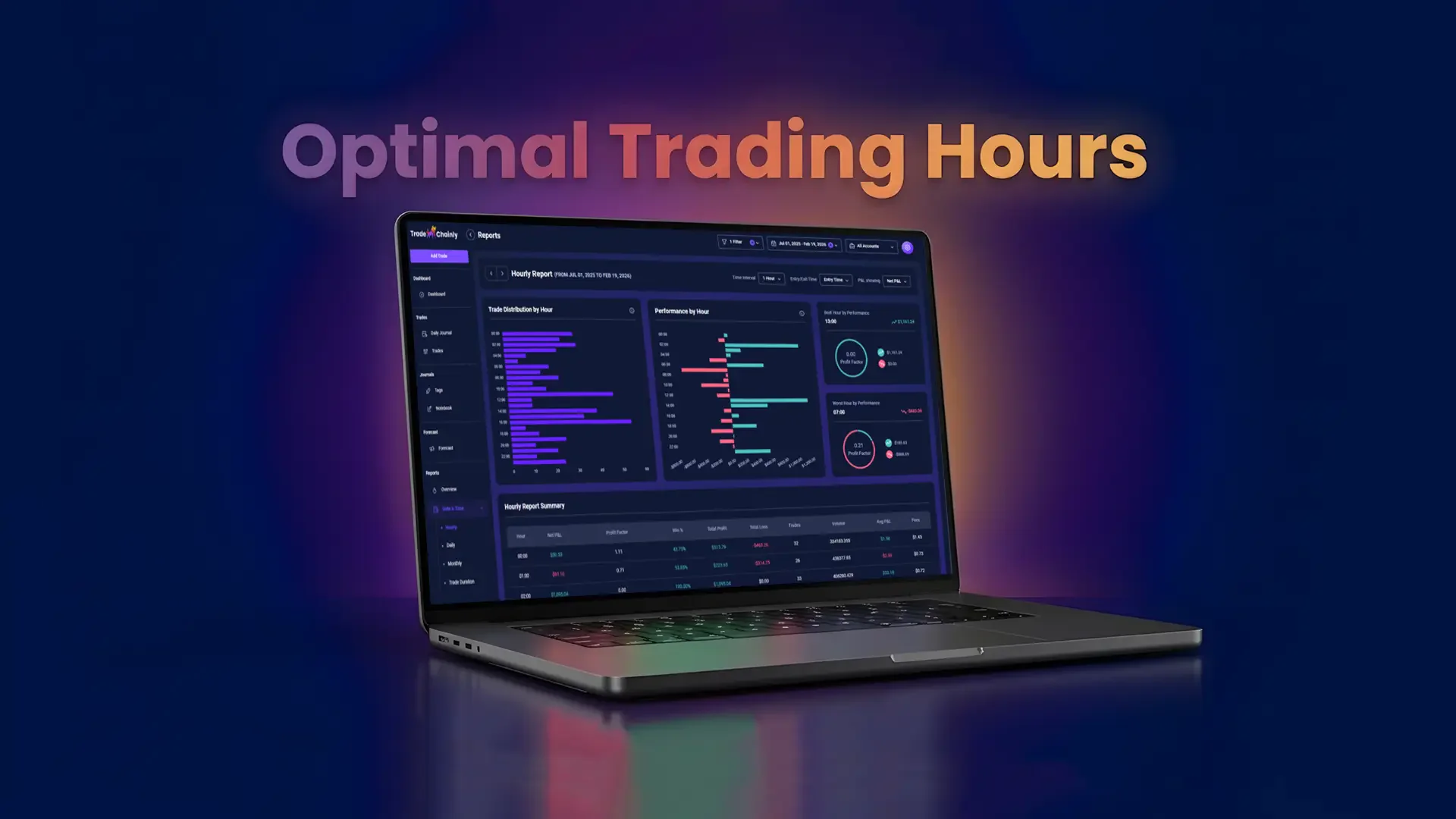
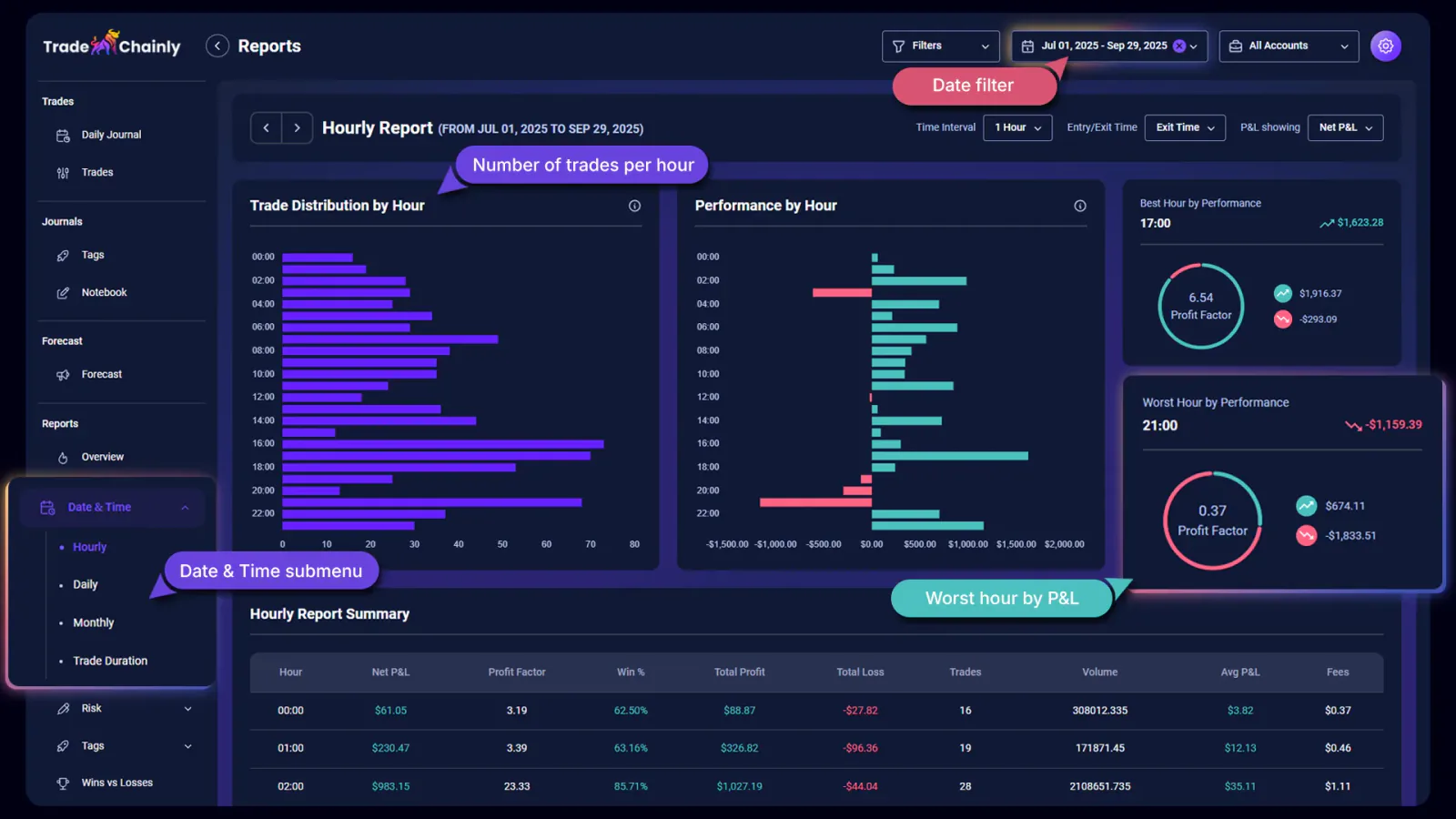
To get started, open TradeChainly and go to Reports. From there, select the Hourly Report. This report is designed specifically for day traders and scalpers who want to understand how performance changes throughout the day. You will see your trading activity grouped into time buckets so you can quickly identify when you trade well and when results tend to fall off.
You can also customize the view based on how you trade. If you want to analyze the time you entered your trades, you can choose entry-based reporting. If you care more about when trades closed and P&L was realized, you can switch to exit-based reporting. Both options can provide useful context depending on your style.
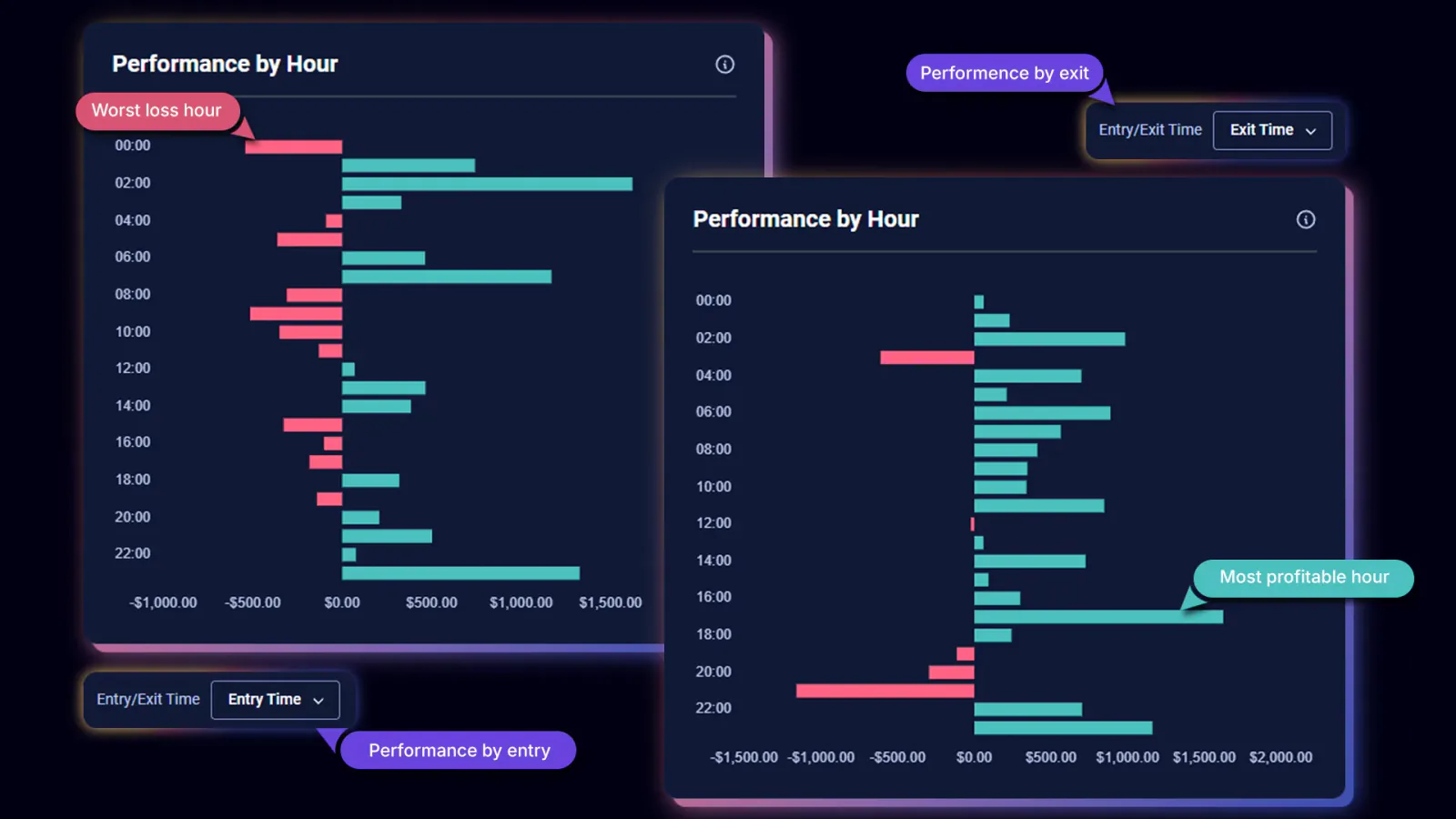
Before reviewing the results, it is usually helpful to apply filters. You can set a specific date range so the analysis reflects your current strategy, not trades from months ago that no longer match how you trade. If you use multiple exchanges or accounts, you can isolate performance per account to keep the data clean. TradeChainly gives you full control so you always know exactly what data you are looking at.
Once the filters are set, you are ready to review the charts and tables. This is where you will start to see clear patterns forming in your trading behavior.
Understanding the Hourly Report in TradeChainly
Once you open the Hourly Report inside TradeChainly, you will see several key sections that break down your performance by time of day. Each one gives you a different layer of insight. When you look at them together, the full picture becomes very clear.
Trade Distribution by Hour
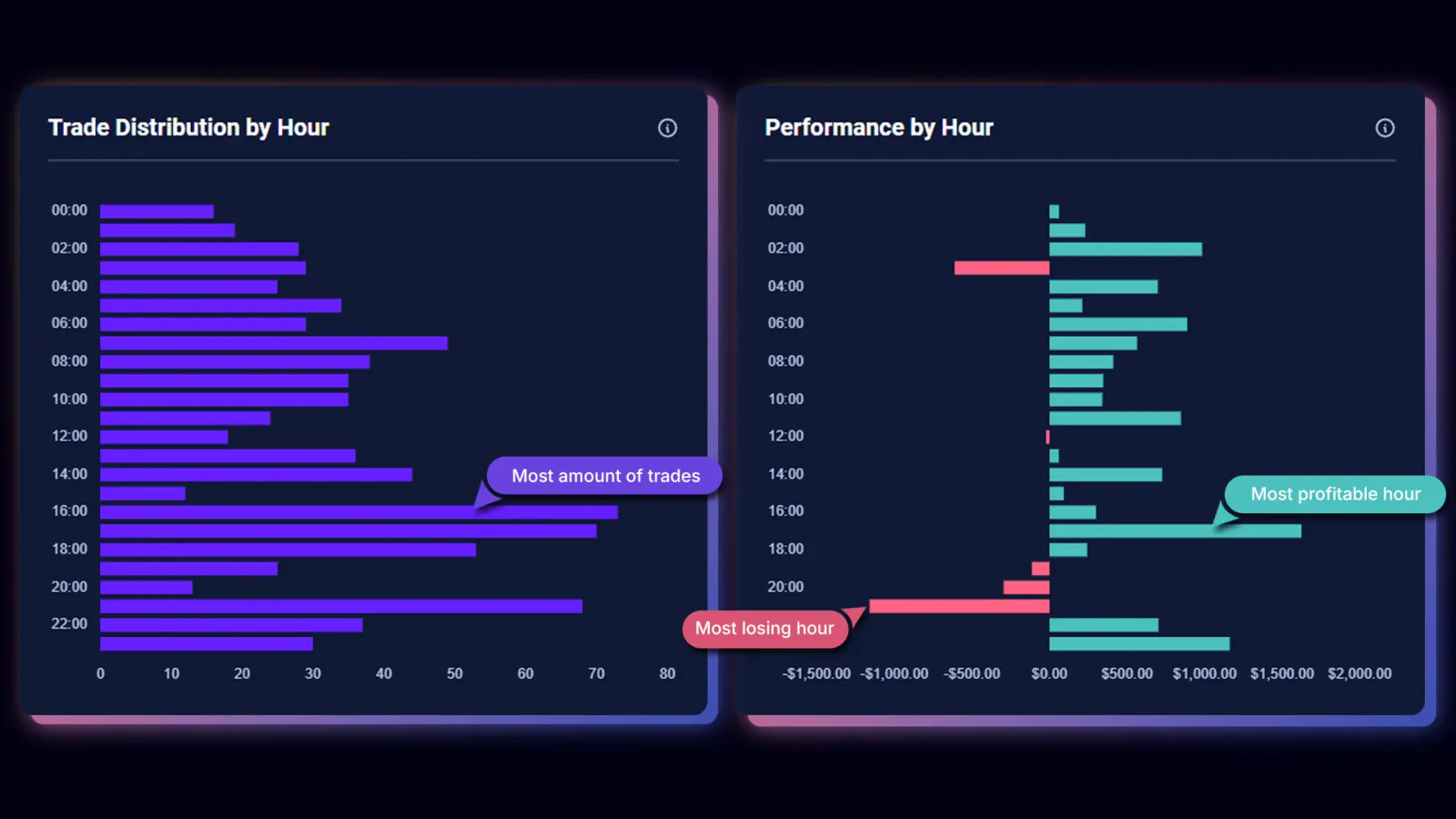
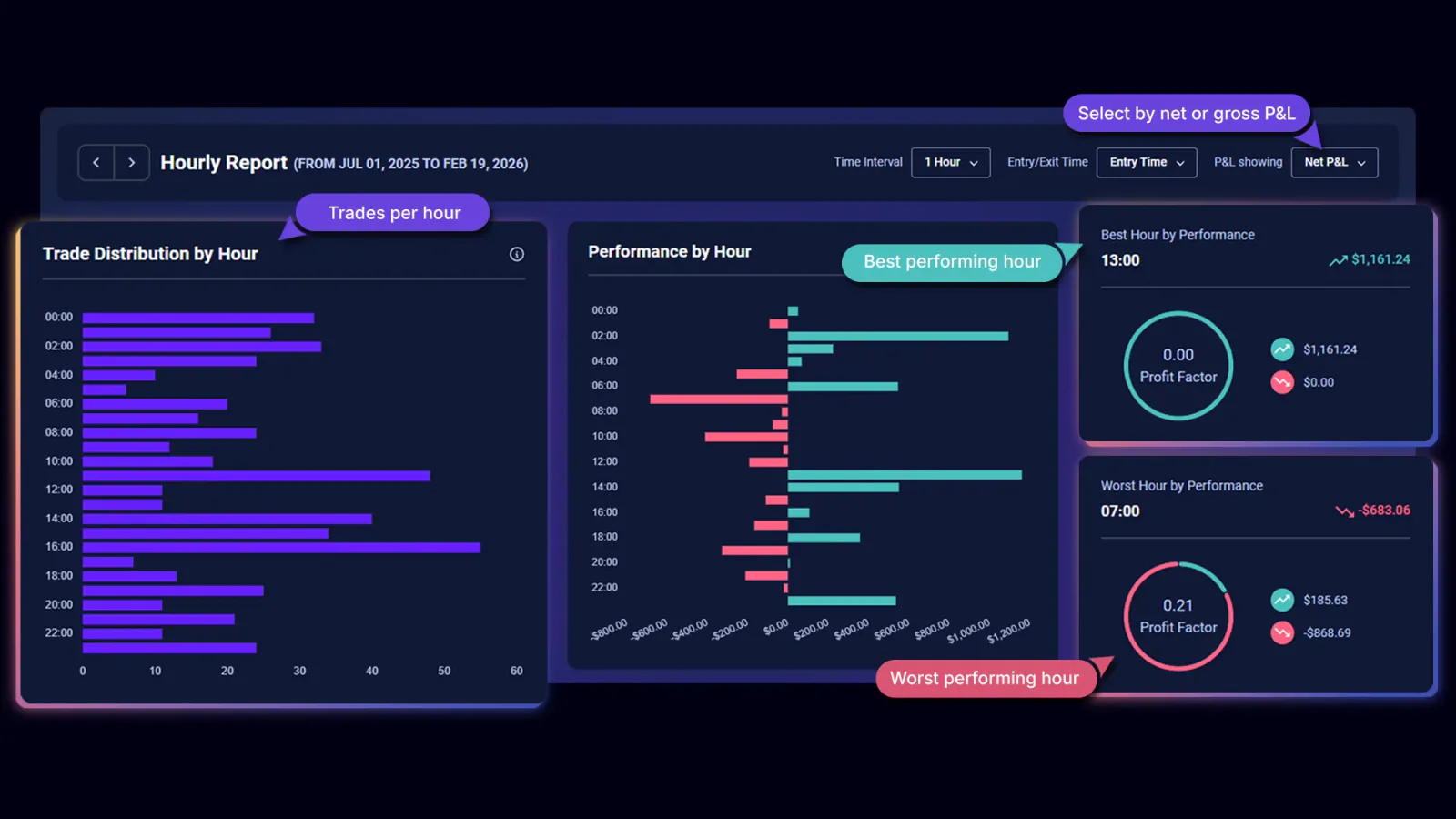
The first thing you will usually notice is the Trade Distribution by Hour chart. This shows how many trades you are placing in each time bucket. For most traders, this chart reveals habits they were not even aware of. Maybe you do most of your trading during the US session without realizing it. Or maybe you are heavily active during late-night hours when you are more tired.
This matters because more trades do not always mean more profit. Sometimes the hours where you are most active are actually the least profitable. TradeChainly helps you see that instantly, instead of discovering it only after a string of losses.
Performance by Hour
Next, you will see how profitable you are in each time interval. This is where the insights really begin to stand out. TradeChainly shows your Net P&L grouped by hour so you can see which parts of the day typically produce gains and which tend to produce losses.
You might notice that a few specific hours are carrying most of your account growth. Or you might see that a handful of bad trading windows are dragging down your overall performance. Without this breakdown, all of those results are blended together, which makes it nearly impossible to understand what is actually happening.
Best and Worst Hour Summary
TradeChainly also highlights your best hour and worst hour automatically. This gives you a fast snapshot of where you excel and where you struggle. For many traders, the worst hour becomes an obvious place to reduce risk size or even step away from the screen completely.
This is especially useful for scalpers and futures traders who rely on tight execution. If your worst performance always happens during quieter or more chaotic periods, it becomes easier to adjust your trading plan around that.
Hourly Report Summary Table
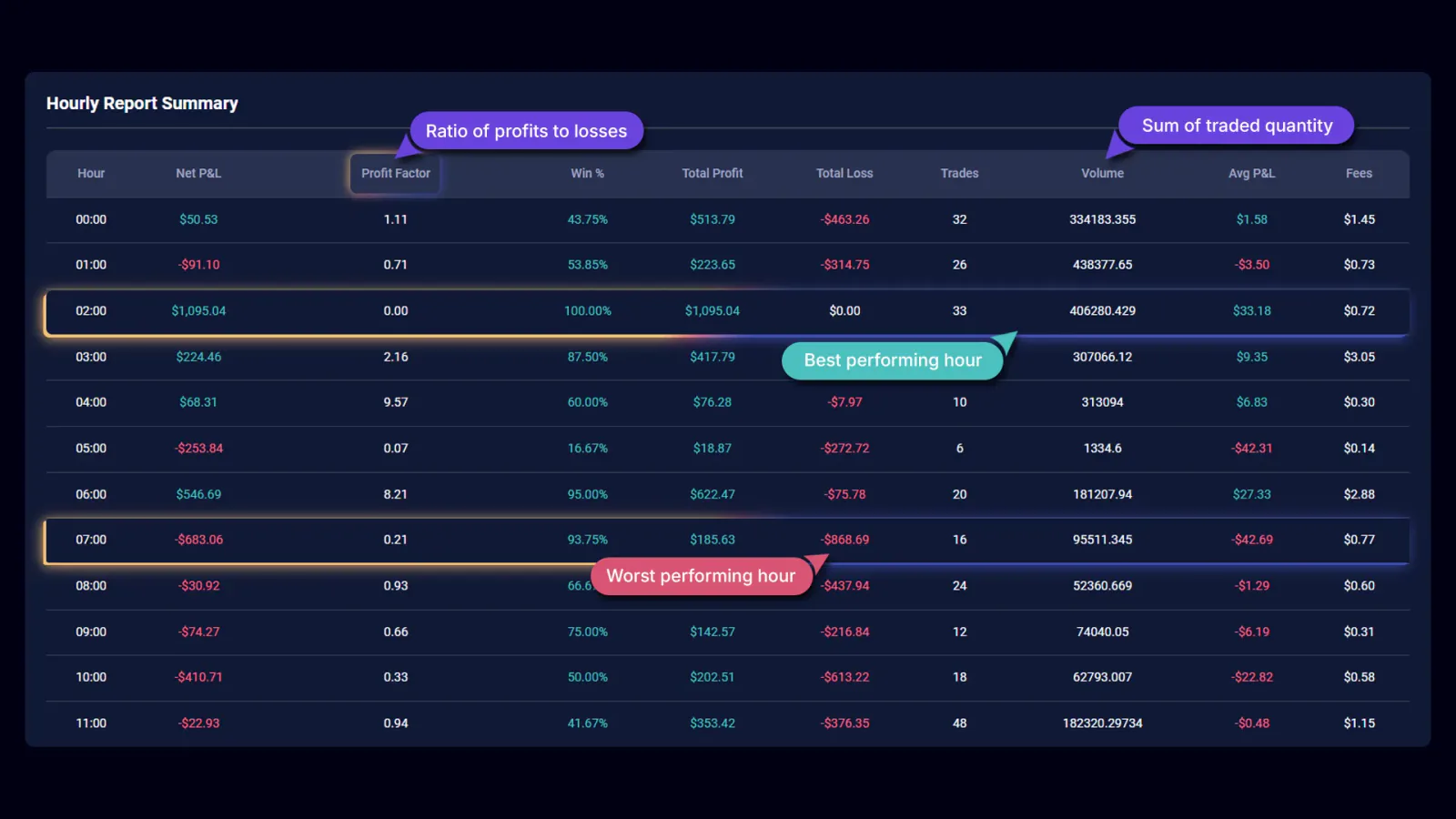
Finally, you will see the Hourly Report Summary. This table goes deeper than raw P&L. It includes metrics like Profit Factor, Win Percentage, Total Trades, Fees, and Average P&L across each time interval. These metrics help you understand not just whether you are winning, but how strong your edge really is during that period.
For example, a high win rate paired with a negative average P&L may indicate that your losses during that hour are much larger than your winners. A strong Profit Factor suggests consistent performance. High fees in a certain window could reveal over-scaling or poor trade selection. When you connect these insights together, you begin to see the true character of each session.
The more often you check this report, the more familiar you become with your own trading tendencies. Instead of thinking about time in a vague way, you will have real numbers showing when you operate at your best.
How to Identify Your Best Trading Hours
Now that you understand what the Hourly Report shows, the next step is learning how to interpret it in a way that actually improves your results. The goal is simple. You want to identify the hours where you consistently trade well, and the hours where you consistently struggle. TradeChainly gives you everything you need to do that.
Start by looking for clusters of profitable hours. If you see that the same two or three time windows repeatedly generate positive Net P&L, there is usually a reason. Maybe that period lines up with the US open on Coinbase or Bybit, where volatility increases and your strategy performs better. Or it may be a quieter session where your decision-making feels clearer. Consistency matters more than isolated spikes.
Next, compare Profit Factor and Win Percentage. These two metrics together reveal the quality of your trading during each period. A high win rate with a weak Profit Factor can signal small winners and large losers. A lower win rate with a strong Profit Factor may indicate fewer trades but better risk management. TradeChainly allows you to see both side by side so you are not fooled by a single metric.
Then review how many trades you are taking in each period. If your worst-performing hours also show high trade volume, that is often a sign of overtrading. This is especially common during late-night trading sessions, when fatigue sets in or when traders chase moves out of boredom. Simply reducing your exposure during those times can protect your account without changing your strategy at all.
It is also important to treat each exchange or account separately when possible. The conditions on Binance may feel very different from Kraken or OKX, and TradeChainly lets you filter your data so you can spot these differences clearly. This is useful if you scalp on one exchange but swing trade on another.
Finally, zoom out and look at the bigger pattern. Most traders discover that a small portion of the day accounts for a large percentage of total profits. Once you identify that window, you can start planning your trading schedule around it. That is where the real edge begins.
Common Patterns Crypto Day Traders Discover
Once traders start reviewing the Hourly Report inside TradeChainly, certain patterns show up again and again. These insights often feel obvious in hindsight, but most people do not recognize them until the data makes them impossible to ignore.
One common pattern is that performance improves during the US trading session. This is usually when volume is highest on exchanges like Binance, Bybit, and Coinbase. More liquidity often means cleaner price action and stronger continuation moves, which benefits day traders and scalpers. If you trade breakout or momentum setups, this may be the window where your account grows the fastest.
Another pattern is performance decay during late-night trading. Many traders notice losses clustering during the hours when they are tired, distracted, or trading simply because they are “available,” not because the market conditions truly support their edge. TradeChainly makes this visible by showing clear red zones on the report. Once you see it, it becomes easier to step away during those weaker hours.
Traders also discover fee drag during periods of high-frequency scalping. Even if win rate remains strong, fees on perpetuals and tight scalps can offset much of the profit. When you view the Hourly Report Summary in TradeChainly, you can see exactly which periods carry the highest fee load relative to profit. That allows you to judge whether the trading activity is actually worth it.
There is also the psychological side. Some traders react poorly to volatility spikes and trade emotionally after large swings. Others freeze up during slow markets and take forced trades. By linking your emotional tags and mistakes to the hourly breakdown, TradeChainly helps you see patterns in behavior as well as performance.
The key takeaway is that everyone has strengths and weaknesses, but few traders take the time to measure them. Once you can see the pattern clearly, you are no longer operating on guesswork. You are operating on facts.
Turning Insights Into Action
Seeing the data is one thing. Changing how you trade based on that data is where the real improvement happens. TradeChainly is designed to help you move from awareness to action so that your trading schedule supports your strengths instead of working against them.
The first step is to define your high-performance trading window. Look at the hours where your Net P&L, Profit Factor, and Win Percentage are consistently strongest. This is the period where your edge is most reliable. Many traders choose to concentrate their focus here. That might mean avoiding distractions, planning trade reviews before and after the session, and treating those hours like protected work time.
Next, look at your worst-performing hours and decide how you want to respond. In some cases, it makes sense to stop trading completely during those periods. In other situations, you may simply reduce position size or trade only your highest-conviction setups. TradeChainly gives you the clarity to make that decision with confidence instead of emotion.
You can also use the Hourly Report alongside TradeChainly’s tag system. For example, you might discover that your “FOMO” or “overleveraging” tags cluster around certain times of day. Or maybe your best setups, such as breakout or momentum trades, perform best during specific sessions. When you combine tags with hourly analysis, you begin to understand not only when you perform best, but why.
Another powerful way to apply these insights is to link them to your risk plan. If your strongest trading window is between 13:00 and 16:00 UTC, you may choose to size slightly larger during that period and trade smaller outside it. Futures traders on Binance or Bybit often find that this simple shift improves their equity curve without increasing overall risk.
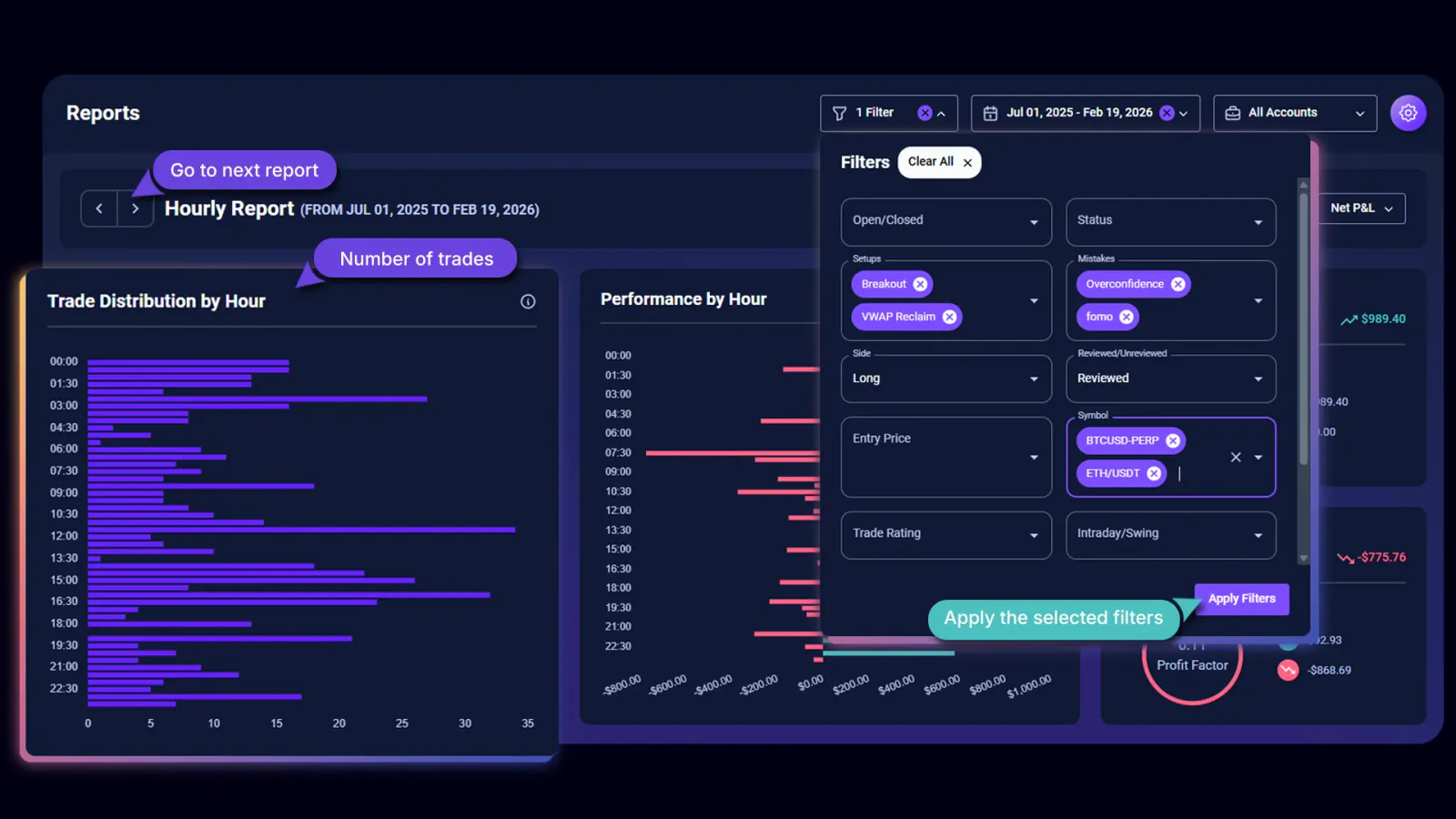
Finally, remember that your best trading hours can evolve as your strategy changes. Checking the Hourly Report regularly inside TradeChainly helps you stay aligned with your current edge rather than outdated assumptions. The goal is to build a trading routine that fits you, not somebody else.
What About Weekends, News Events, and Funding Cycles?
Crypto never closes, which means your performance is also influenced by weekends, macro news events, and funding rate cycles. These factors can change how price behaves during certain hours, and TradeChainly helps you see how they impact your results over time.
Weekends are a good example. Liquidity usually drops on Saturday and Sunday across major exchanges like Binance, Bybit, and OKX. Lower liquidity often means faster spikes, thinner order books, and more stop hunts. Some traders thrive in that environment. Others consistently lose. By reviewing weekend performance in TradeChainly, you can decide whether weekend trading truly benefits you or whether it is better to rest and reset.
News events are another major factor. Economic releases, ETF flows, exchange outages, or regulatory headlines can create extreme volatility. If you trade during US hours, you may notice that certain announcements line up with your worst losing stretches. Or you may find that your system actually performs best when the market is moving fast. The key is to measure it, not assume.
Funding cycles also influence results for perpetual futures traders. When funding flips positive or negative, positioning behavior can shift. If you trade aggressively around funding windows, you may see clear patterns in your Hourly Report. TradeChainly makes it easy to zoom in on those periods so you can evaluate whether they help or hurt your performance.
The most important thing to remember is that the market is always evolving. A schedule that worked for you six months ago may not be ideal today. Reviewing your hourly performance regularly allows you to adapt instead of getting stuck in outdated habits.
Your Best Trading Hours Are Already in Your Data
Most traders try to improve by changing strategies, indicators, or exchanges. But often the biggest improvement comes from something much simpler. You just need to trade more during the hours where you already perform best, and less during the hours where you repeatedly lose. TradeChainly makes that process clear and measurable so you no longer rely on guesswork or memory.
When you use the Hourly Report consistently, you start to see your trading in a new way. Patterns emerge. Strong sessions become obvious. Weak periods stand out. From there, you can shape your trading schedule around your strengths. That might mean focusing on specific sessions, adjusting risk at certain times of day, or taking scheduled breaks during low-quality hours.
The goal is not to trade more. The goal is to trade smarter. TradeChainly helps you build a trading routine that matches your real-world performance, not theory or internet advice. If you want to understand when you trade at your absolute best, the data is already inside your account. You just need the right tool to reveal it.