
Why So Many Active Traders Stay Stuck
Why do some crypto traders put in thousands of trades and still feel like they are in the same place?
Most crypto traders spend hours analyzing charts, entering trades, and managing positions. Very few spend consistent time reviewing what actually happened. That gap is the reason many traders stay stuck at the same level for years. Trading activity alone does not create progress. Reflection is what turns experience into improvement.
A weekly trade review is where your trading stops being random and starts becoming structured. It is where you stop guessing what is working and start seeing it in your data. Without it, you rely on memory, emotions, and recent wins or losses to judge your performance. Those are unreliable. They hide patterns, exaggerate short-term results, and make it easy to repeat the same mistakes.
Crypto markets move fast. Trades stack up quickly, especially for day traders and scalpers. If you wait too long to review, the details fade. If you review too often without structure, it becomes noise. A weekly rhythm sits in the middle. It is frequent enough to stay connected to your execution, but long enough to reveal meaningful trends.
This process is not about judging yourself or replaying every mistake emotionally. A proper weekly review is mechanical. You look at numbers, behaviors, and outcomes. You identify what deserves more focus and what needs to be reduced or removed.
When done correctly, weekly review becomes the most important habit in your trading routine. It is the difference between trading a lot and actually getting better.

Build a Review That Actually Helps
A weekly trade review is not a motivational exercise. It is not about hyping yourself up after a good week or tearing yourself down after a bad one. It is a diagnostic process. You are looking for signals in your behavior and in your data that tell you what deserves attention.
Most traders confuse review with memory. They think about the two trades that hurt the most or the one big winner that felt great. That is not review. That is storytelling. Real review is grounded in numbers and repetition. It asks different questions. What setups made money over multiple trades? Which mistakes keep appearing? Where are you following your plan, and where are you drifting?
It is also not about rewriting your strategy every week. Many traders use review as an excuse to strategy hop. One bad week and they abandon their approach. One good week and they assume they have solved trading. A proper review does neither. It looks for consistency before drawing conclusions. It respects sample size.
Weekly review sits between execution and improvement. Daily journaling captures what happened. Weekly review decides what to do about it. Without that step, your journal becomes a storage system instead of a learning system.

Another misconception is that review must be complex. It does not. Complexity usually hides clarity. You only need a few core metrics and a structured way to look at behavior. The goal is not to analyze everything. The goal is to identify the one or two patterns that matter most right now.
Finally, review is not about being perfect. It is about being honest. The trader who improves is not the one who avoids mistakes. It is the one who sees them clearly and adjusts before they become permanent habits.
The Messy-Data Problem and How To Fix It
A weekly review only works if the data behind it is clean and complete. If your trade history is missing fields, inconsistent, or scattered across platforms, your conclusions will be unreliable. You will end up reviewing feelings instead of facts.
Before you even think about performance, you need a single source of truth for your trades. Every position should have the same basic structure. Entry price, exit price, position size, fees, and result must always be present. For futures traders, funding and leverage effects also matter because they change the real profitability of your system. For spot traders, fees and partial fills often matter more than people expect.
Many traders unknowingly review distorted data. They forget to include fees. They ignore funding. They mix demo trades with live trades. They manually input numbers and introduce errors. Over time, this makes their weekly review less trustworthy, so they stop taking it seriously.
The goal is simple. When you open your weekly review, you should feel confident that what you are looking at reflects reality.
| Data Field | Why It Matters in Review |
|---|---|
| Entry price | Defines trade location and risk quality |
| Exit price | Determines outcome accuracy |
| Position size | Needed for true PnL and risk assessment |
| Fees | Often turn marginal winners into losers |
| Funding (futures) | Impacts profitability on longer holds |
| Trade direction | Long vs short performance comparison |
| Date and time | Identifies session and timing patterns |
| Symbol/pair | Shows asset-specific strengths or issues |
| Tags | Enables behavioral and setup analysis |
Once this data is consistent, review becomes mechanical. You stop guessing and start measuring. Patterns appear faster. Weaknesses become obvious. Strengths become repeatable.

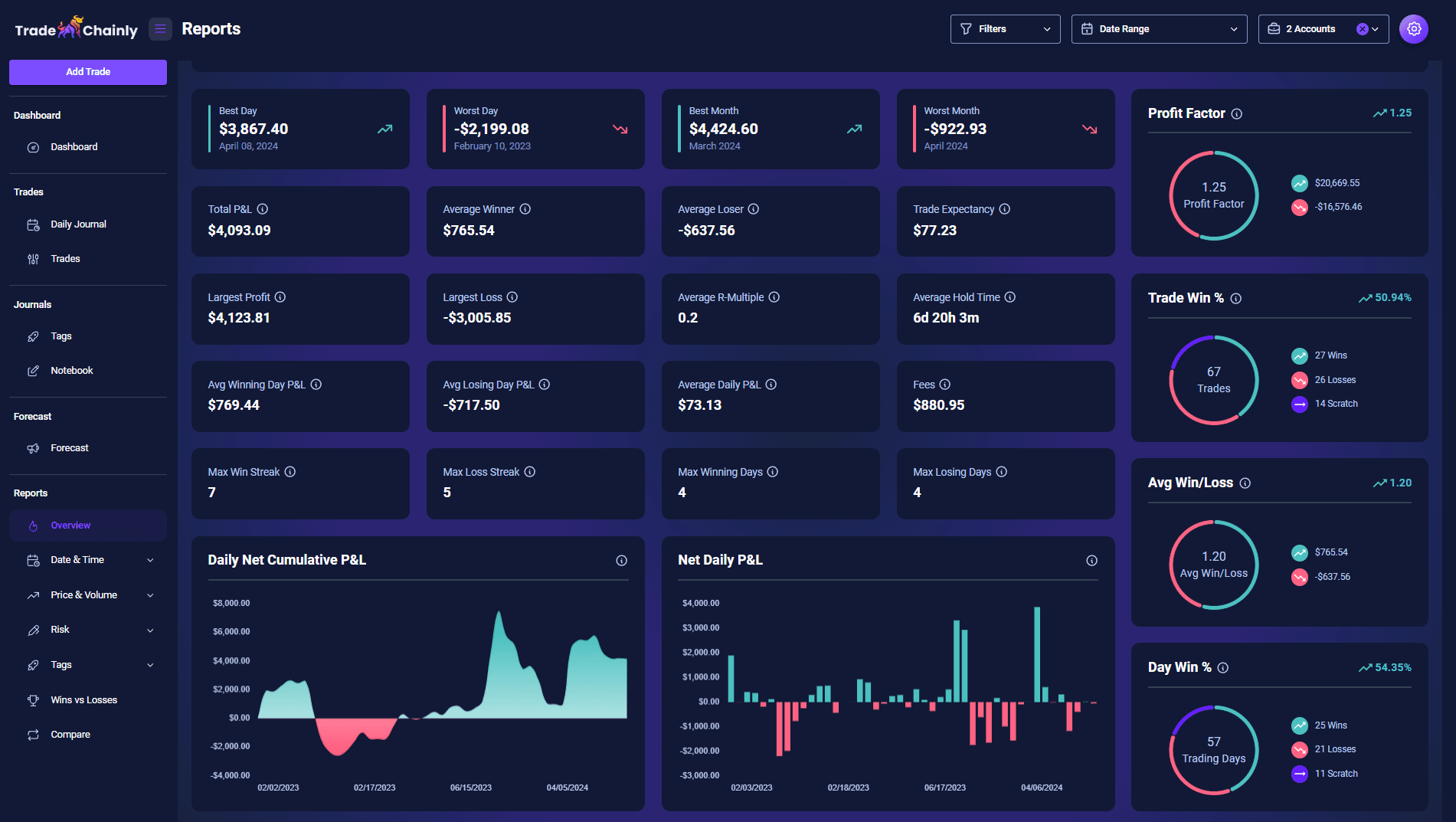
This image should show a clean, structured trade list or dashboard view where each trade has consistent fields. The purpose is to visually reinforce how organized data simplifies analysis.
Without reliable data, no review process can work. With it, even a short weekly session can produce meaningful insight.
Start With the Numbers That Set the Frame
Your weekly review should always begin at the top level. Before you look at individual trades, setups, or emotions, you need to understand what your overall performance is doing. This sets the context for everything that follows. If your high-level numbers are improving, your process is likely working. If they are degrading, something in your execution or discipline is slipping.
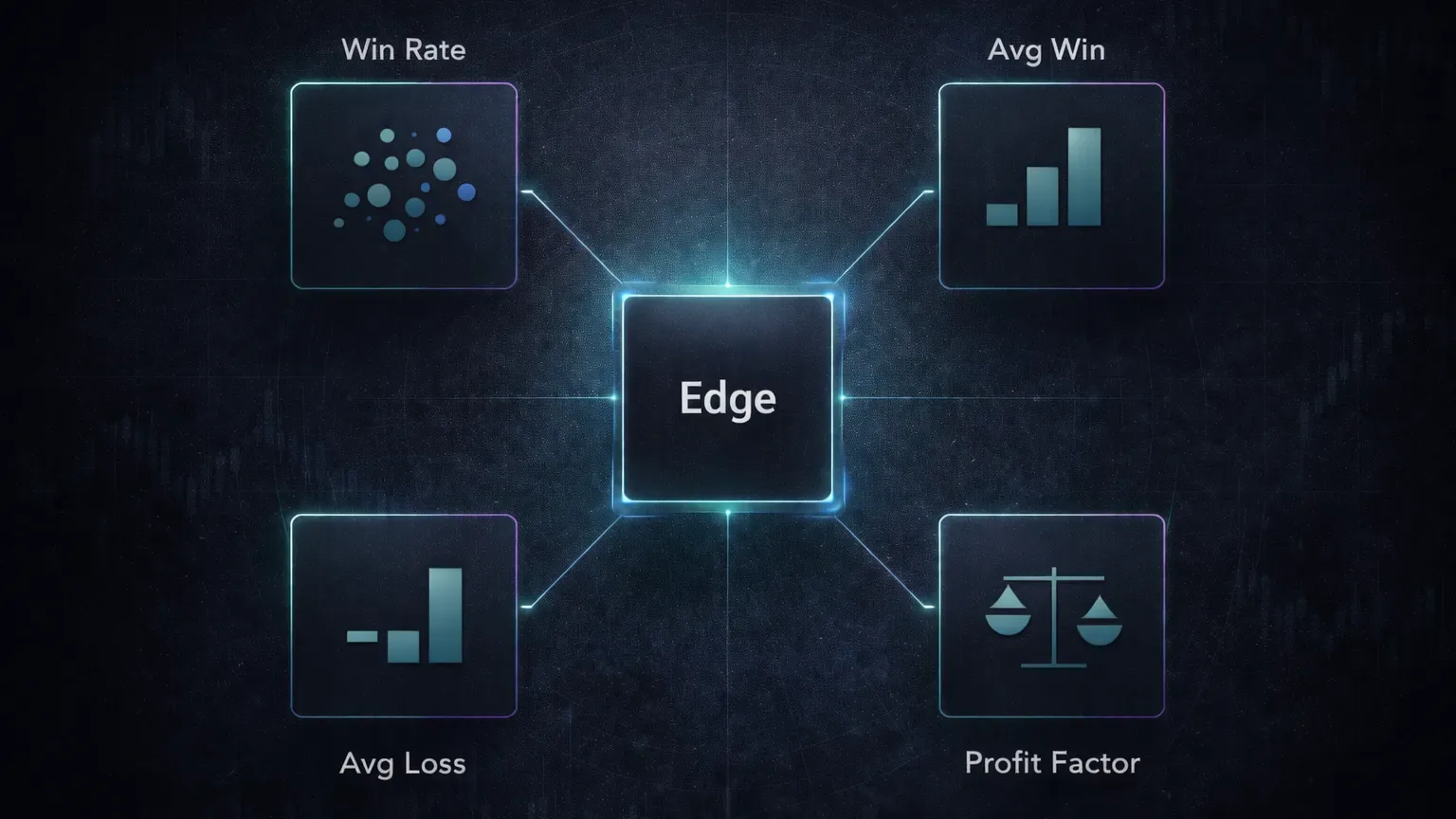
There are four metrics that matter most here: win rate, average win, average loss, and profit factor. Together, they describe how your edge actually behaves.
Win rate tells you how often you are right. Average win and average loss tell you how much you make when you are right and how much you lose when you are wrong. Profit factor shows how efficiently your winners are covering your losers. A profit factor above 1 means you are profitable. A rising profit factor usually matters more than a rising win rate, because it shows your risk and reward balance is improving.
In crypto trading, these numbers can swing quickly because volatility is high and trade frequency is often large. That makes trends more important than single-week results. One good week does not prove progress. One bad week does not prove failure. You are looking for direction over multiple weeks.
If your profit factor is slowly increasing, even while your win rate stays the same, that is a strong signal that your exits, risk management, or trade selection are improving. If your win rate is high but your profit factor is weak, you are likely cutting winners too early or letting losers run too far. If both are deteriorating, your execution quality is probably degrading.
This step is not about diagnosing everything. It is about setting the frame. High-level metrics tell you whether your trading is trending toward efficiency or toward randomness. Once you see that direction, the rest of your review becomes targeted instead of exploratory.
Turn Tags Into Answers, Not Noise
High-level metrics tell you if you are moving in the right direction. Tags tell you why. This is where your weekly review becomes powerful. Without tags, all trades blur together. With them, patterns start separating themselves naturally.
Every trade should carry context. Not just what you traded, but why you traded it and how you behaved while doing so. Setup tags describe the idea behind the trade. Mistake tags describe what went wrong. Emotion tags describe your state of mind. Market condition tags describe the environment you were trading in. Together, they turn raw results into structured information.
When you break your performance down by setup, you stop asking “Did I make money this week?” and start asking “Where am I actually good?” One setup might show a high profit factor and stable execution. Another might look exciting but slowly drain your account. Without tags, both feel the same emotionally. With tags, the difference becomes obvious.
This is especially important in crypto because traders often trade multiple styles at once. You might scalp BTC during high volatility, take range trades on altcoins, and hold breakout plays overnight. If you group all of that together, your review becomes meaningless. Tagging separates your behavior into smaller systems that can be evaluated independently.
Mistake tags are just as valuable. Overtrading, chasing entries, revenge trading, skipping stops, and moving take profit targets are all behaviors that leave fingerprints in your data. When you filter by mistake tags, you can see how expensive each behavior really is. Some mistakes feel dramatic but cost little. Others quietly destroy your expectancy.
Emotion tags reveal something different. They show what internal states are linked to poor decisions. You might notice that trades tagged “rushed” or “bored” consistently underperform. That is not a market problem. It is a process problem.
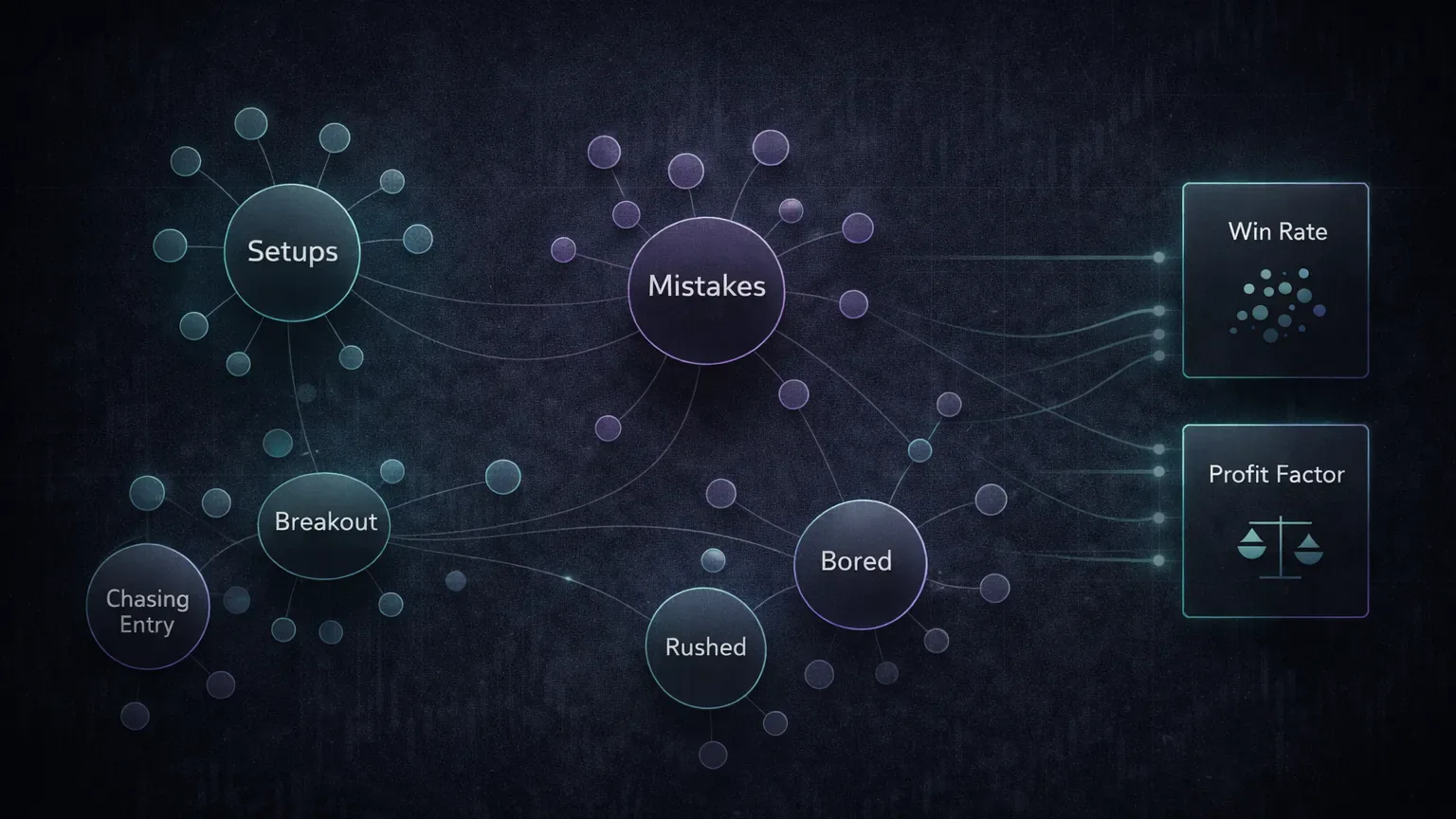
This image should show a tag-based performance breakdown where setups, mistakes, or emotions are grouped with metrics like win rate and profit factor. The purpose is to visually demonstrate how tags transform review from vague reflection into measurable analysis.
The goal is not to tag everything perfectly. The goal is to tag consistently. Over time, your data becomes a behavioral map of your trading. That is what allows weekly review to guide real improvement instead of surface-level adjustments.
One scenario makes this obvious. Imagine a trader who ends a week slightly green and feels fine about it. In the tag breakdown, their “breakout” trades are profitable, but the trades tagged “chasing entry” are consistently negative. The week looks acceptable as a whole, but the behavior is quietly dragging performance down. Without tags, they leave the review thinking the strategy is fine and keep repeating the same leak.
Separate Execution From Outcome Before It Trains Bad Habits
It is easy to judge a week based on profit or loss. That is also the fastest way to fool yourself. Good results can come from bad decisions, and bad results can come from solid execution. If you only review outcomes, you train your brain to chase luck instead of consistency.

Execution quality is about how closely your actions match your plan. Did you enter where you intended? Did you respect your stop? Did you take profits according to your rules, or did you improvise based on fear or greed? These details matter more than whether a trade happened to work.
In crypto, execution errors are amplified. Fast price movement, thin order books on some pairs, and emotional reactions to volatility create small deviations that compound. Chasing an entry by a few ticks, moving a stop slightly wider, or closing a winner early because price spikes can slowly erode your edge even if your setups are sound.
Your weekly review should include a simple but honest scan of your trades. Look for patterns like entering late, exiting early, widening stops, or increasing size after a loss. These behaviors show up long before your PnL collapses. They are early warning signals.
This is also where futures traders need to be especially careful. Leverage hides execution mistakes. A poorly timed entry can still produce profit in a volatile move, giving false confidence. Spot traders feel execution mistakes more immediately because the margin for error is smaller. Both need review, but for different reasons.
When you separate execution quality from results, you protect yourself from emotional learning. You stop rewarding bad habits and stop punishing good ones. Over time, this is what stabilizes performance even when market conditions change.
Pick One Fix or Nothing Changes
The biggest mistake traders make after a review is trying to fix everything at once. They leave their session with five new rules, three adjustments, and a rewritten strategy. By Tuesday, none of it is being followed. Review only creates progress when it leads to focus.
Your weekly review should end with one clear behavioral objective. Not a vague intention like “be more disciplined,” but a specific action you can recognize in real time. Something small enough to apply immediately and important enough to move your performance forward.
This works because trading is driven by habits, not ideas. You already know most of what you should do. What you struggle with is doing it consistently. A single behavioral focus gives your brain a simple filter during live trading. When that moment appears, you recognize it and act differently.
Examples of strong weekly focus points look like this: “Do not enter breakouts unless volume is expanding.” “Stop trading after three losing trades in a session.” “No market orders on low-liquidity pairs.” “Wait for full confirmation instead of anticipating the entry.”
Each of these is observable. You either followed it or you did not. That makes the next weekly review cleaner and more honest.
This step is also where review turns into routine. You are no longer just analyzing the past. You are programming the next week. Over time, these small adjustments stack. One behavior fixed becomes permanent. Then you move to the next.
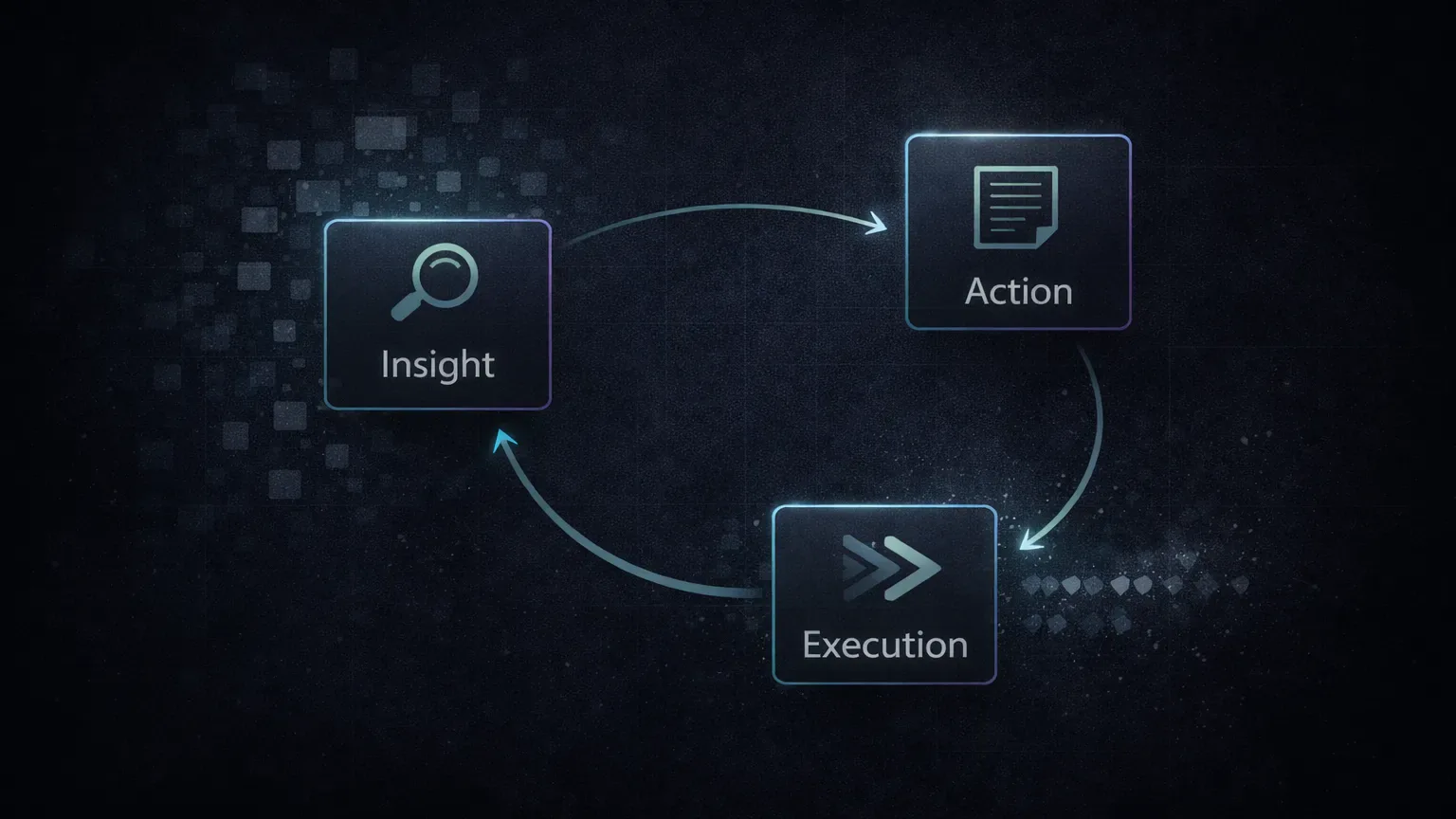
This image should show a simple workflow of insight → action → next week execution. Its purpose is to visualize how review becomes forward-looking instead of purely reflective.
A weekly review without a clear action is incomplete. Insight without application is entertainment. Progress comes from narrowing your attention to the one thing that will matter most in the next set of trades.
Make the Routine So Easy You Cannot Skip It
A weekly review only works if it actually happens. The easiest way to make that happen is to keep it short, predictable, and frictionless. You do not need a two-hour deep dive. You need a repeatable routine that fits naturally into your schedule.
Set a fixed time each week. Most traders choose Friday after the session or Sunday before the new week starts. Consistency matters more than the exact day. When the review lives in your calendar, it becomes part of your trading identity instead of an optional task.
A simple 30-minute structure looks like this.
First 10 minutes: Scan high-level metrics. Look at your profit factor, win rate, and average win versus loss. You are not trying to solve anything yet. You are just getting a directional sense of your week.
Next 10 minutes: Break performance down by tags. Identify which setups performed best, which mistakes were expensive, and which emotions were present in losing trades. This is where patterns usually appear.
Final 10 minutes: Choose your one behavioral focus for the coming week. Write it down. Make it specific. This is the output of the entire review.
If your trades are already imported automatically and your metrics update in real time, this process becomes much easier to maintain. Tools like TradeChainly exist to remove manual work so your attention stays on interpretation instead of data preparation. The less effort it takes to access your review, the more likely you are to do it every week.
The routine should feel lightweight. If it feels heavy, it will be skipped. The power of weekly review comes from repetition, not from intensity.
Let the Review Prove What Works
Most traders spend their energy searching for better indicators, better entries, or better strategies. Very few build a system for learning from their own behavior. That is why weekly review becomes such a powerful edge. It turns your trading history into a feedback loop instead of a forgotten archive.
A good weekly review does not make you perfect. It makes you aware. It shows you what deserves more attention and what deserves less. Over time, that awareness compounds. Your strongest setups become clearer. Your most expensive mistakes become harder to ignore. Your execution becomes calmer because you are no longer guessing what matters.
This is also why consistency beats intensity. One detailed review that happens once every few months does little. A simple review that happens every week quietly reshapes how you trade. It keeps you aligned with your plan and connected to your data, even during volatile or emotionally difficult periods.
When your trades, tags, and metrics live in one place, the process becomes even more natural. Instead of building reports manually, you spend your energy interpreting patterns and deciding what to improve next. That is the role a trading journal like TradeChainly is meant to play: not to impress you with features, but to make disciplined review easy enough to sustain.
Weekly review is not an extra task added to trading. It is the part that makes trading purposeful. If you commit to this process, improvement stops being something you hope for and becomes something you can track.